Get Full Government Meeting Transcripts, Videos, & Alerts Forever!
Get email alerts on the Alcohol Regulation topic
No spam. Unsubscribe anytime.
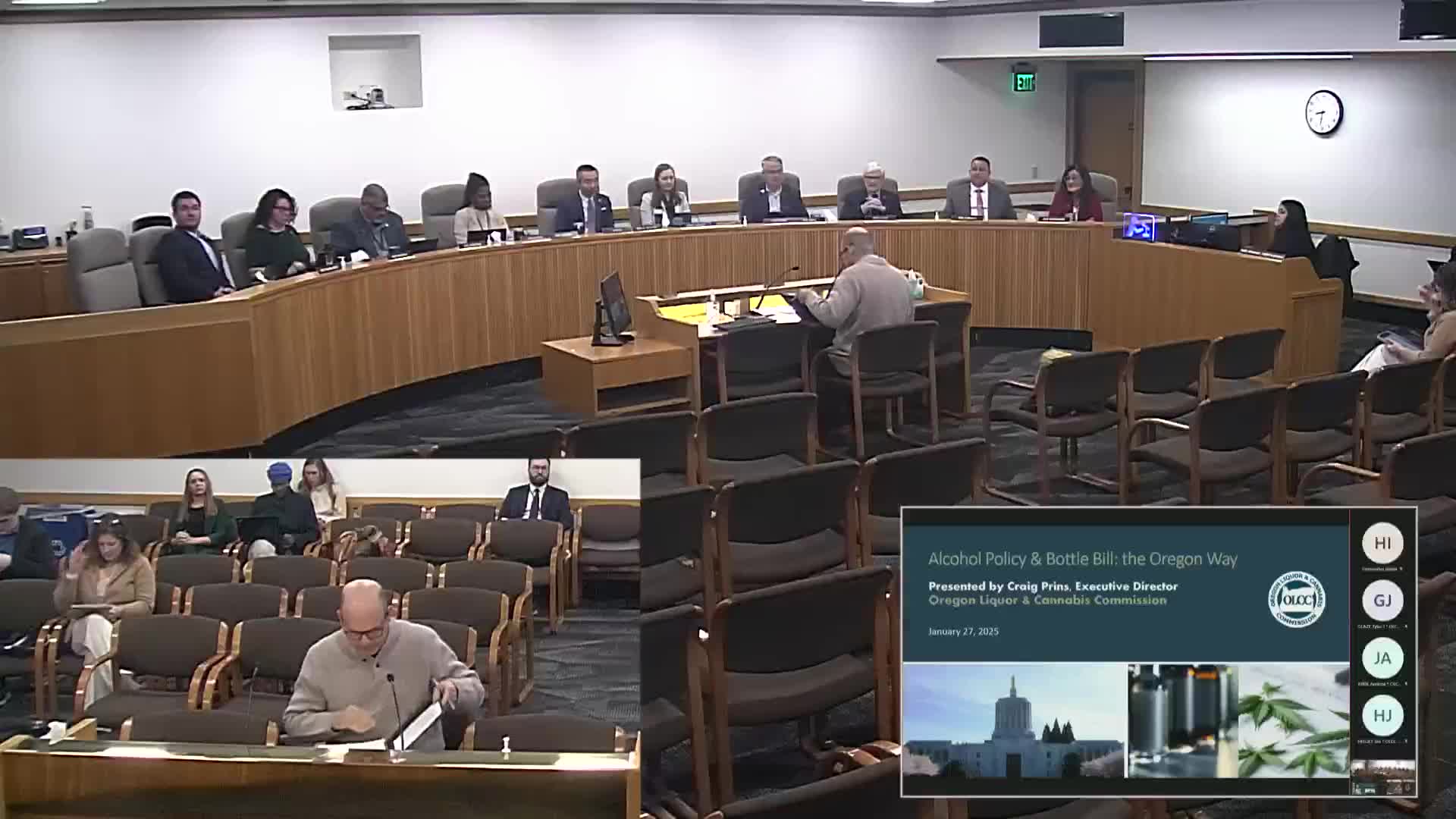
OLCC director briefs House committee on Oregon—s liquor control model, revenue flow and public-health priorities
Summary
Craig Prince, executive director of the Oregon Liquor and Cannabis Commission, told the House Economic Health Committee on Jan. 27 that Oregon—s liquor control system aims to "protect public health and safety while supporting responsible businesses and providing funding for local and state agencies."
Craig Prince, executive director of the Oregon Liquor and Cannabis Commission, told the House Economic Health Committee on Jan. 27 that Oregon—s liquor control system aims to "protect public health and safety while supporting responsible businesses and providing funding for local and state agencies." The informational session ran from 8:30 to about 9:30 a.m. and focused on how the OLCC regulates distilled spirits, collects revenue and enforces underage- and overconsumption-related rules.
Prince said Oregon operates a control model for distilled spirits within a larger three-tier regulatory framework that separates manufacturers, distributors and retailers. "In control states, the state owns a part of the supply chain," he said, describing the OLCC as the state wholesaler for liquor and noting that control systems account for roughly 25% of U.S. liquor sales. He contrasted that with the private licensing model used for beer, wine and cider distribution in many states.
Why it matters: OLCC-collected proceeds flow to the state general fund, to cities and counties, and to public-health programs. Prince walked committee members through the statutory distribution formula: 56% of the alcohol proceed pool (excluding a per-bottle surcharge) flows to the state general fund; roughly 34% flows to cities under two statutory formulas; and about 10% goes to counties. Prince also noted a 50-cent per-bottle surcharge that he said contributes approximately $39 million to the general fund and said about half of privilege-tax proceeds for beer and wine—roughly $18 million biannually—are directed to the Oregon Health Authority for mental-health and substance-use services.
Compliance and public health: Prince said the OLCC focuses enforcement on preventing sales to minors and on excessive consumption. He described the agency—s minor-decoy operations and regional investigators who inspect retail outlets and take action ranging from civil fines to license suspension. "One of our main focuses is not selling to minors," he said. He defined "excessive alcohol use" by widely used public-health benchmarks: any alcohol use during pregnancy or by people under 21; binge drinking (five or more drinks on one occasion for men, four or more for women); and heavy drinking (14 drinks per week for men, seven for women).
Prince and Analise Dolph, executive director of the state Drug and Alcohol Policy Commission, who joined the meeting, framed OLCC work as upstream prevention (regulating access and point-of-sale) that complements downstream treatment and recovery programs overseen by health agencies. Prince also emphasized that pricing, limits on hours and sale locations, and dram-shop liability are among evidence-backed policy tools to reduce overconsumption.
Cannabis and hemp: Committee members raised cannabis as a related policy concern. Prince said the OLCC treats cannabis holistically and that several compliance tools for alcohol have analogues in the regulated adult-use cannabis market. He noted a key difference: "Cannabis is still federally illegal," which constrains federal-state partnerships available for alcohol regulation (he cited the Alcohol and Tobacco Tax and Trade Bureau as an example of a federal partner for alcohol). He also flagged hemp-derived products as a regulatory challenge because hemp products can be processed to yield high THC concentrations while currently lacking the age restrictions of the regulated cannabis market; the transcript notes recent 2024 legislation that will allow the OLCC to begin regulating parts of the hemp market in 2026.
Market trends and warehouse needs: Prince presented sales and volume data showing liquor-case movement peaked in 2023 at roughly 4,000,000 cases in and 3,800,000 cases out, with a small reduction into 2024 and a 2.5% drop in sales year-over-year. He said liquor sales rose for decades before stabilizing after COVID and that alcohol-related deaths rose through 2022. Prince told the committee the OLCC is operating beyond the capacity of a mid-20th-century warehouse in Milwaukee, Oregon, and plans a new Canby warehouse; he said a groundbreaking is scheduled for April 16 and invited members to attend.
Taxes, pricing and product categories: Prince summarized tax rates and legal categories the OLCC uses to distinguish beverages: malt beverages (beer) are taxed at 8 cents per gallon, wine at 67 cents per gallon (77 cents for higher-ABV dessert/fortified wines), and cider is treated according to its ABV. He noted that some ready-to-drink and hybrid products blur historical category lines (for example, some premixed cocktails that contain distilled spirits) and said Oregon has kept liquor-based ready-to-drink products in the control system to preserve public-health safeguards. He also said the OLCC implemented a minimum unit price in 2021 to limit very low-cost alcohol.
Equity and harms: Prince flagged disparities in alcohol-related outcomes. Using Oregon Health Authority data, he told the committee that Native American communities experience worse alcohol-related outcomes despite not necessarily consuming more alcohol, and he connected those disparities to broader socioeconomic inequities.
Next steps: Prince said OLCC staff will follow up with committee members and that he and staff will return for a deeper cannabis briefing if the committee wants one. He also mentioned planned meetings with individual members and staff to discuss bottle-bill questions and local concerns.
Quotes from the meeting: "Our aim is to protect public health and safety while supporting responsible businesses and providing funding for local and state agencies," Craig Prince, executive director, Oregon Liquor and Cannabis Commission. "We are absolutely looking at it holistically," Craig Prince, executive director, responding to questions about cannabis and alcohol substitution.
Ending: The informational meeting closed with committee members signaling interest in a separate cannabis-focused briefing and with an invitation to the Canby warehouse groundbreaking in April. The OLCC will continue to brief legislators on implementation details, funding requests and regulatory changes as the agency advances its biennial priorities.