Get Full Government Meeting Transcripts, Videos, & Alerts Forever!
Get email alerts on the Education topic
No spam. Unsubscribe anytime.
Oregon subcommittee hears that ending federal relief, falling enrollment and rising special-education costs are straining K-12 dollars
Summary
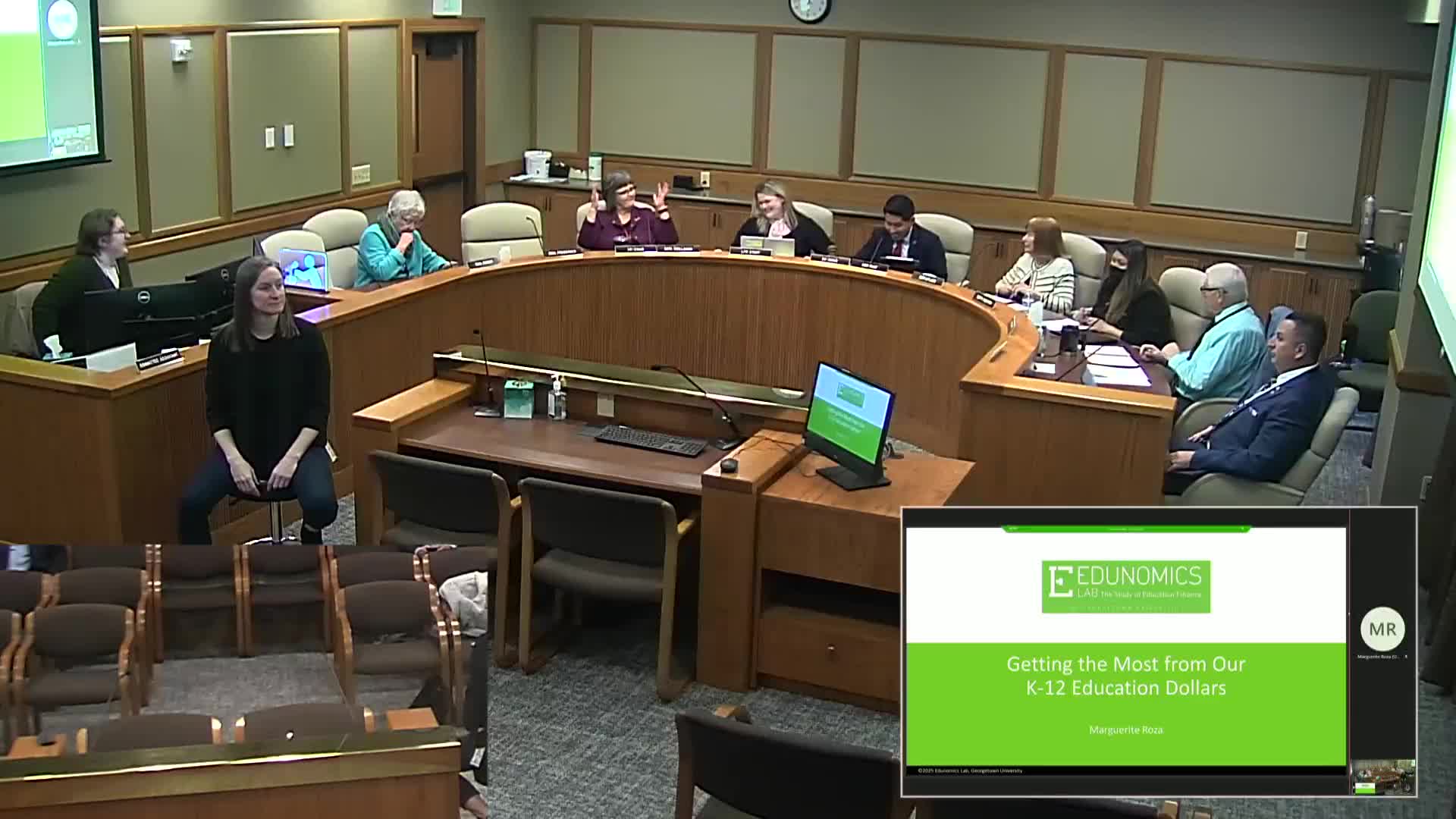
At a Jan. 28 Education Subcommittee informational meeting, Dr. Rosa of the Edgenomics Lab told legislators that one-time ESSER funds have ended, enrollment is declining and test scores have not recovered, and urged sharper targeting of dollars to improve reading and math outcomes.
Dr. Rosa, director of the Edgenomics Lab and a research professor at Georgetown University, told the Oregon Education Subcommittee on Jan. 28 that one-time federal relief funds have ended, enrollment is falling and some districts face budget gaps even as per-pupil spending rose.
"The number 1 stressor for superintendents is the budget," Dr. Rosa said, summarizing what she described as a new and extremely challenging school finance landscape in Oregon and nationally.
Her presentation, condensed to fit a 30-minute informational meeting, said the federal Elementary and Secondary School Emergency Relief (ESSER) funds that boosted spending have largely expired and that many districts used that temporary money for recurring commitments. She told the committee that per-pupil expenditures in Oregon rose over the past decade but that statewide reading and math test scores did not recover after the pandemic despite the extra spending.
Why it matters: Dr. Rosa framed the gap between dollars spent and student outcomes as the central fiscal problem for K-12 finance going forward. She said enrollment declines—driven by lower birthrates and out-migration—will reduce long-term revenue because most school funding follows students. She added that special-education costs have grown to take a larger share of district budgets and that math in particular is a predictor of later life earnings and the state’s economic prospects.
Details from the presentation and discussion
- ESSER and temporary funding: Dr. Rosa noted ESSER funds ‘‘ended in November or September’’ and warned districts that had used one-time funds for recurring expenses could face fiscal instability. She estimated unprecedented federal relief on the order of "over, I think, 3,000 or more dollars per student in federal dollars alone." (Amount described by Dr. Rosa as an estimate.)
- Enrollment decline: Dr. Rosa cited projections showing sizable enrollment drops over the next decade in several states, including Oregon, and said the early grades will be affected first because of falling birthrates. She said some projections imply roughly an 11% shrinkage in some systems over a decade.
- Staffing and hiring: Dr. Rosa said schools now employ more staff than at any prior point in Oregon’s records, a pattern she attributed to pandemic-era hiring driven by temporary funds. "The teacher shortage is actually over," she said, adding that the labor market has shifted and districts are in some cases trying to shrink staff by attrition rather than aggressively hire.
- Outcomes vs. spending: Using state test data and comparisons Dr. Rosa’s lab posted online, she said the relationship between dollars and outcomes in Oregon is weak: higher spending has not produced the expected recovery in reading and math. She singled out math: "8th grade math scores ... are the biggest ... predictor of student lifetime early earnings," and warned that sustained low scores pose risks to students and the state economy.
- Special education: Dr. Rosa said identification rates declined during the pandemic then have risen, and that some districts now spend 16–18% of their budgets on special education. She argued stronger universal (Tier 1) reading instruction could reduce later special-education placements and costs.
- Policy implications and strategies: Dr. Rosa and committee members discussed approaches districts and states are using, including (a) focusing explicitly on outcomes and using frequent progress checks; (b) targeted pay increases for high-value teachers or hard-to-staff roles instead of across-the-board raises; (c) returning some specialists to classrooms when that yields better student-facing instruction; and (d) concentrated investments in reading instruction and, where needed, additional time or tutoring in math. She cited Mississippi and Tennessee as examples of states that set outcome-focused priorities and used data-driven course corrections.
Questions from members and follow-ups
Subcommittee members asked about the contract that brought Dr. Rosa's research to Oregon, comparisons across states and tests, how special-education costs are counted in small districts, and whether IDEA (the Individuals with Disabilities Education Act) funding is at risk. Dr. Rosa said her center provided training and statewide data to superintendents and school board members under a previous contract and that cross-state comparisons use state tests that can be normalized to the National Assessment of Educational Progress (NAEP). She told the committee she does not expect IDEA to disappear and described it as longstanding federal law.
No formal action was taken; the meeting was informational. Staff said slides and data are available through the Legislative Fiscal Office and the Edgenomics Lab website.
Taper: Committee members emphasized the need to pair fiscal discussion with classroom practices, noting that test scores are one indicator among many. The subcommittee adjourned after agreeing to share remaining questions with staff and to host further presentations on higher education and juvenile programs at upcoming meetings.