Get Full Government Meeting Transcripts, Videos, & Alerts Forever!
Get email alerts on the Education topic
No spam. Unsubscribe anytime.
Education subcommittee receives LFO briefing on state budget process and education spending
Summary
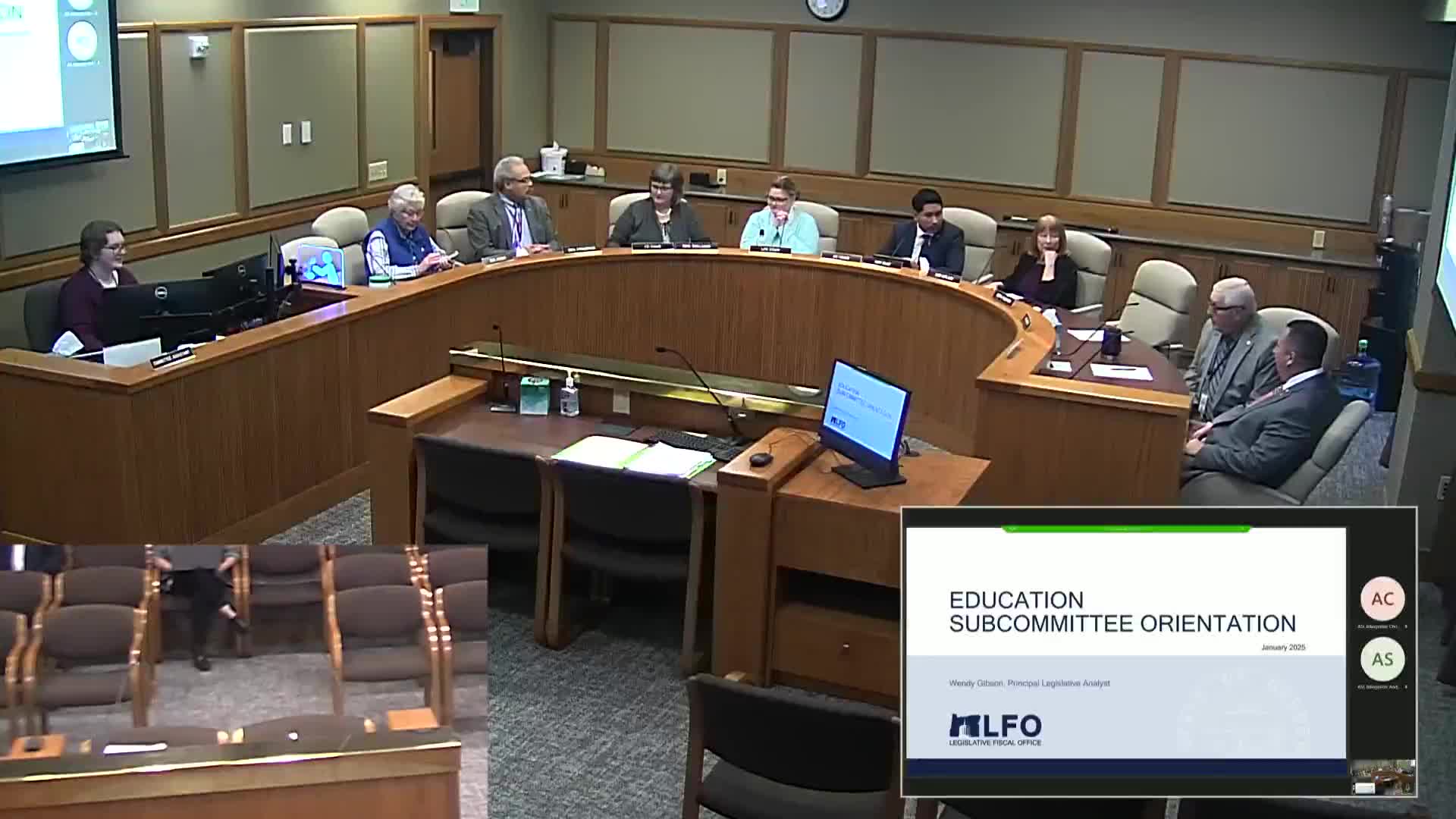
The Education Subcommittee opened an informational meeting Jan. 27 with an overview from the Legislative Fiscal Office of how the state develops and reviews the biennial budget and the major budget drivers affecting K–12, early learning and higher education.
The Education Subcommittee opened an informational meeting Jan. 27 with an overview from the Legislative Fiscal Office of how the state develops and reviews the biennial budget and the major budget drivers affecting K–12, early learning and higher education.
Wendy Gibson, the Legislative Fiscal Office analyst assigned to K–12 and early learning, told the subcommittee that LFO is “a nonpartisan, independent, permanent, professional support office to the legislature” and that its responsibilities include preparing fiscal impact statements, agency budget reviews and detailed analyses that subcommittees use in decision-making. Gibson described three types of fiscal impact statements LFO issues: no fiscal impact, minimal fiscal impact and fiscal impact determinations; she said LFO sometimes issues an “indeterminate” finding when agencies cannot provide sufficient data.
The briefing summarized the budget cycle and the major funding sources the subcommittee will consider, including the general fund, lottery fund, other funds and federal funds. Gibson said the tentative budget prepared by legislative and executive staff based on the December revenue forecast currently projects revenues to exceed the tentative budget by “approximately $767,000,000” for the 2025–27 biennium, but she cautioned that figure does not account for a number of large one-time investments that phased out after the last biennium.
Nut graf: The presentation framed the subcommittee’s role in reviewing agency appropriation bills and fee measures, evaluating policy option packages, and deciding what programmatic investments — such as summer learning, early learning supports and higher-education financial aid — will be sustained or reduced as one-time pandemic and other funds expire.
LFO staff walked members through the education program-area budget composition. Gibson said the state school fund is the largest single line in the education budget, with a current-service-level figure cited at about $11.4 billion for the 2025–27 biennium, and that the Department of Education’s current-service-level total was presented as roughly $5.7 billion. The Higher Education Coordinating Commission’s total funds budget was shown as about $3.8 billion; the Department of Early Learning and Care’s current-service-level budget was presented near $1.5 billion, with most of that as grant funding for child care and related programs. LFO also noted that the budget’s payout structure is heavily weighted toward special payments — money sent directly to districts, colleges and providers — which LFO characterized as the majority of education spending.
Members pressed staff on specific concerns and requested clarifications. Representative Susan McClain and others asked how ‘‘other education’’ is defined; Gibson explained it excludes the State School Fund and includes items such as higher education, Teacher Standards and Practices Commission activities, the Department of Early Learning and Care grants, and funding from the Fund for Student Success. Members also discussed enrollment declines, which LFO said are a key driver because the State School Fund is distributed on a per-pupil basis; members noted that falling enrollment can leave districts with fixed costs despite fewer students.
Committee members asked for and were told they will receive agency budget materials and LFO reviews on OLIS before hearings; Gibson said agencies have been instructed to identify budget items that phased out and to include reduction options and vacancy information in their supplemental materials. The subcommittee co-chairs and members discussed coordination with policy committees for items that are primarily policy (such as calendar changes or summer learning redesign) but may carry fiscal impacts that Ways and Means must consider.
The meeting closed after staff identified upcoming presenters for later hearings, including Edgenomics (an academic presenter scheduled the next day) and the Higher Education and Youth Development presentations later in the week. No formal votes or motions were taken during the informational meeting.
Ending: The subcommittee will move from orientation into a series of informational and public hearings in the coming weeks; LFO materials for each agency will be posted on OLIS and will form the basis for work sessions and any recommendation amendments the subcommittee forwards to the full Joint Committee on Ways and Means.