Get Full Government Meeting Transcripts, Videos, & Alerts Forever!
Get email alerts on the Harbor Plan Goals topic
No spam. Unsubscribe anytime.
Nantucket committee refines harbor-plan goals, agrees edits on objectives and enforcement language
Summary
The Nantucket Harbor Plan Update Committee on Monday, Jan. 27, reviewed revised draft goals and objectives for the harbor plan and agreed on a set of wording changes and structural edits intended to make the document clearer for the public and for future implementation.
The Nantucket Harbor Plan Update Committee on Monday, Jan. 27, reviewed revised draft goals and objectives for the harbor plan and agreed on a set of wording changes and structural edits intended to make the document clearer for the public and for future implementation.
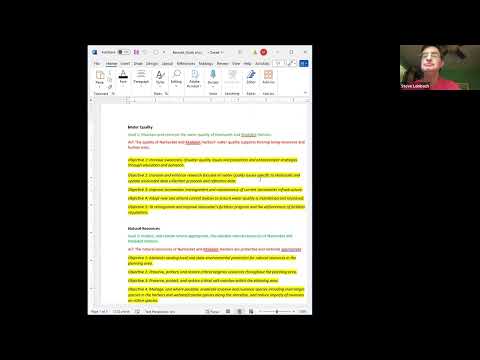
Committee members spent the opening hour comparing previously adopted "green" goals with newly proposed "red" end-state statements. Several committee members and town staff said the red language better conveyed the long-term purpose of the plan, while other members preferred the action-oriented wording in green. After discussion the committee asked staff to combine the action verb from the green goals with the explanatory language from the red alternatives — for example, keeping a clear verb such as "maintain, improve, or ensure" and appending the public‑purpose clause that explains why the goal exists.
The meeting also produced a number of targeted edits to objectives and recommendations: committee members asked staff to
- add ‘‘regulations’’ and ‘‘policies’’ alongside ‘‘bylaws’’ where applicable so the document reflects the full range of implementation tools; - create a standalone objective on septic systems to reflect persistent concerns about legacy systems and direct flows to harbors; - add fertilizer licensing and enforcement language to the fertilizer objective and clarify what aspects the Town can enforce under current state rules; and - remove redundant or overly technical phrasing (for example, replacing the word "intermodal" with clearer language such as "ground transportation" or describing ferry-terminal access in plain terms).
On enforcement and feasibility, staff and committee members repeatedly noted that some enforcement options are constrained by state law. Jeff, a town staff member, and other staff explained that while private‑property inspections are limited, the Town can pursue enforcement through licensing, documentation and other compliance measures. Committee members specifically asked staff to call out licensing as part of the fertilizer objective and to consider enforcement actions that do not require on‑site property access.
The shellfish and fisheries sections drew detailed comment. The Harbor Shellfish Advisory Board's green‑crab concerns were noted in the recommendations: the draft continues a recommendation to "continue efforts to eradicate green and Asian shore crabs" in Nantucket and Madaket harbors. Committee members also asked that the plan emphasize better documentation of commercial and recreational shellfishing activity so future regulatory changes or enforcement actions rest on consistent data.
In the commercial‑waterfront section the committee agreed the plan should reaffirm limits on non‑water‑dependent development. Members recommended stronger wording — replacing language that "limits" non‑water‑dependent uses with language that continues to "prohibit" conversions that would remove water‑dependent uses from the waterfront, and to keep that prohibition prominent in the recommendations.
Other changes requested by the committee included adding a septic objective, clarifying responsibility and sequencing in recommendations (who will lead follow‑up actions), reducing jargon for public audiences, and explicitly including Madaket Harbor in sections that now reference only Nantucket Harbor. Committee members also discussed marine fuel logistics and navigation resiliency (including how to keep fuel access and navigation open during seasonal or weather disruptions) and asked staff to ensure those topics are included in the recommendations.
Staff said they will rework the draft goals and objective wording, fold in the edits discussed at the meeting and circulate the revised sections prior to the committee’s next meeting, which the group scheduled for Monday, Feb. 10. The committee closed the meeting after confirming staff will send the coastal‑resilience section to outside reviewers (including the conservation commission and shellfish advisory board) before the next session.
Votes at a glance The committee recorded two procedural roll‑call votes at the start of the meeting: approval of the meeting agenda and approval of two sets of minutes (listed in the meeting as "12924" and "1625"). Both motions passed on roll call with all members present recorded as voting in favor. The roll call names heard during votes included Peter, Phil, Steve, Dave and Emily; the motions were recorded as approved by the committee.