Get Full Government Meeting Transcripts, Videos, & Alerts Forever!
Get email alerts on the Land Use Braidwood Hills topic
No spam. Unsubscribe anytime.
Eugene Planning Commission admits rebuttal evidence, debates Goal 5 mapping and Randy Lane connection during Braidwood Hills appeal
Summary
At its Jan. 28 meeting the Eugene Planning Commission voted to reject and not consider certain late testimony, signaled support to admit second-period rebuttal evidence, and took straw-poll positions on whether the Braidwood Hills site is on the city's Goal 5 scenic sites inventory and on street-connection requirements for Randy Lane.
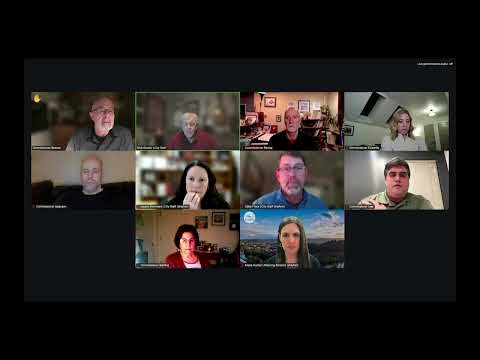
The Eugene Planning Commission on Jan. 28, 2025, considered deliberations in the appeal of a hearings official's denial of the Braidwood Hills tentative plan unit development and subdivision application and acted to reject certain late testimony while admitting rebuttal materials submitted in a second open-record period.
The commission unanimously approved a motion to "reject and not consider the testimony identified in items 1 through 9 on pages 8 through 11 of the packet," a staff-recommended list of late materials that staff labeled as new evidence outside the scope of the appeal. Commissioner Edwards moved to adopt the staff recommendation; the motion passed unanimously among commissioners present.
The commission then began line-by-line deliberations on the appeal issues raised by the applicant. Staff and the city attorney repeatedly reminded commissioners that, because this is a quasi-judicial appeal, the commission must limit itself to (a) the issues raised by the appellant and (b) evidence that was properly before the hearings official or shown to be responsive rebuttal evidence. "New evidence before the planning commission is not okay," said Lauren Summers, assistant city attorney, describing statutory limits on evidence and argument in appeals.
Staff and the applicant disputed whether multiple documents and analyses submitted in the second open-record period should have been rejected by the hearings official. Nick Gioiello, a city planner leading the presentation, summarized staff's view that some materials submitted in August 2024 were responsive rebuttal evidence to referral comments and therefore should be considered. A straw poll of commissioners indicated support for reversing the hearings official's rejection of that evidence.
The commission then addressed whether the entire Braidwood Hills site is included on the city's acknowledged Goal 5 scenic-sites inventory (the Scenic Sites Working Paper and its Figure H-2). Staff contended the Figure H-2 map is part of the acknowledged inventory and that the property is shown on the map; if the commission so finds, certain clear-and-objective tree-preservation and some geotechnical demonstration requirements in Chapter 9 of the Eugene code would not apply at the PUD review stage. Gabe Flock, the city's principal planner, told commissioners the map and adoption history support treating Figure H-2 as part of the city's Goal 5 inventory.
Commissioners debated the policy implications. Commissioner Ramey said the result felt "exactly the opposite of what Goal 5 was set to be," expressing concern that labeling the site a Goal 5 resource could remove some protections for wooded areas. Staff and several commissioners emphasized a legal and procedural distinction: the finding before the commission was narrow (whether the map is part of the acknowledged inventory and whether the property appears on it), not a general re-legislation of Goal 5 policy. A straw poll on that question showed mixed votes among commissioners (multiple commissioners raised hands in support while others abstained or opposed during the informal poll).
The commission also considered emergency-access and street-connection standards. On appeal issue 3 staff recommended removing a condition the hearings official had imposed that would have barred on-street parking on newly constructed streets. Staff argued the fire-code signage and parking restrictions are enforced through the fire code at the time of permitting and that the PUD standard for secondary emergency access is met by the site's layout. The commission's straw poll on that appeal issue was unanimous in favor of staff's recommendation.
A related debate focused on whether the proposed extension of Randy Lane must be a public street. The applicant sought an exception under the code to avoid building a public extension, citing existing steep grades. Staff recommended finding that the applicant had submitted responsive technical evidence (submitted in the second open-record period) demonstrating slopes exceeding 20 percent at locations that would preclude building the public-standard street as proposed and therefore meets the criteria for an exception to the street-connection requirement. A straw poll indicated commissioners were prepared to accept the applicant's slope-based exception for the street-connection standard, while separate analysis and a later straw poll supported the hearings official's conclusion that the portion of Randy Lane pointing toward the site should be dedicated as a public right-of-way (staff recommended and the commission's informal vote supported public dedication and conditions to require a 40-foot right-of-way meeting public-street standards).
Staff and commissioners clarified how the exemptions operate in practice: a PUD review finding of Goal 5 coverage can remove the requirement to demonstrate compliance with specific Chapter 9 tree-preservation or geotechnical criteria at the PUD stage, but building permits and later site-development permits remain subject to building-code, geotechnical and tree-permit requirements that apply at the construction or permitting stage. "Even an applicant for a clear-and-objective PUD with a site that is entirely covered by Goal 5 does still need to get a tree removal permit when they decide to build on the property," Summers said, stressing that later permit-level reviews can trigger other requirements.
What commissioners recorded tonight were primarily staff motions and straw-poll signals rather than final, adopted, written findings. Staff told the commission it will prepare a revised draft final order reflecting the commission's direction (for adoption at a future deliberation). The commission set its next deliberation dates (staff noted Feb. 11 and Feb. 25 on the calendar and identified a specific February 18 deliberation date if needed) and asked staff to circulate the presentation slides and a table summarizing staff recommendations on each appeal issue to aid the next meeting.
Votes at a glance
- Motion to "reject and not consider the testimony identified in items 1 through 9 on pages 8 through 11 of the packet" (staff list of late evidence identified as new evidence): moved by Commissioner Edwards; second not specified in the transcript; outcome: approved (commissioners present voted unanimously to adopt the staff recommendation). Note: the motion instructed staff and the record that those listed materials would not be considered as part of the commission's evidentiary record.
- Straw polls (informal, nonbinding): commissioners indicated support for admitting the applicant's second-period rebuttal materials (appeal issue 1), mixed/contingent support on the Goal 5 Figure H-2 mapping issue (appeal issue 2), unanimous support for the staff position on secondary emergency access and removal of the hearings official's no-parking condition (appeal issue 3), and support both for allowing the applicant's slope-based exception on street connection and for requiring public dedication of Randy Lane where staff recommended (appeal issues 4 and 5). These were recorded as straw polls to guide preparation of a draft final order rather than as final adoption votes.
Why it matters
If the commission adopts findings at a later session consistent with the staff-recommended draft order, the decision would (a) admit rebuttal evidence that the hearings official excluded, (b) treat the Figure H-2 Scenic Sites map as part of Eugene's acknowledged Goal 5 inventory for the Braidwood Hills property (with implications for how certain tree-preservation and geotechnical criteria apply at the PUD stage), and (c) resolve several connectivity and street-standard questions for Randy Lane that affect whether the extension would be built to public-street standards or allowed as a private roadway under code exceptions. Any final planning commission decision on the appeal can be appealed to the Land Use Board of Appeals (LUBA).
Meeting context and next steps
The commission planned to reconvene to finish deliberations and to receive an updated draft final order reflecting tonight's direction. Staff told commissioners it will provide the slides and a one-page table summarizing recommendations on each appeal issue before the next deliberation session.