Get Full Government Meeting Transcripts, Videos, & Alerts Forever!
Get email alerts on the Career Technical Education topic
No spam. Unsubscribe anytime.
ODE outlines career-connected learning; Sabin Schellenberg Center highlights credentials and college credits
Summary
State CTE officials briefed the Senate Education Committee on career-connected learning, federal Perkins funding, and statewide programs; Sabin Schellenberg Professional-Technical Center described student outcomes, credentials and outreach.
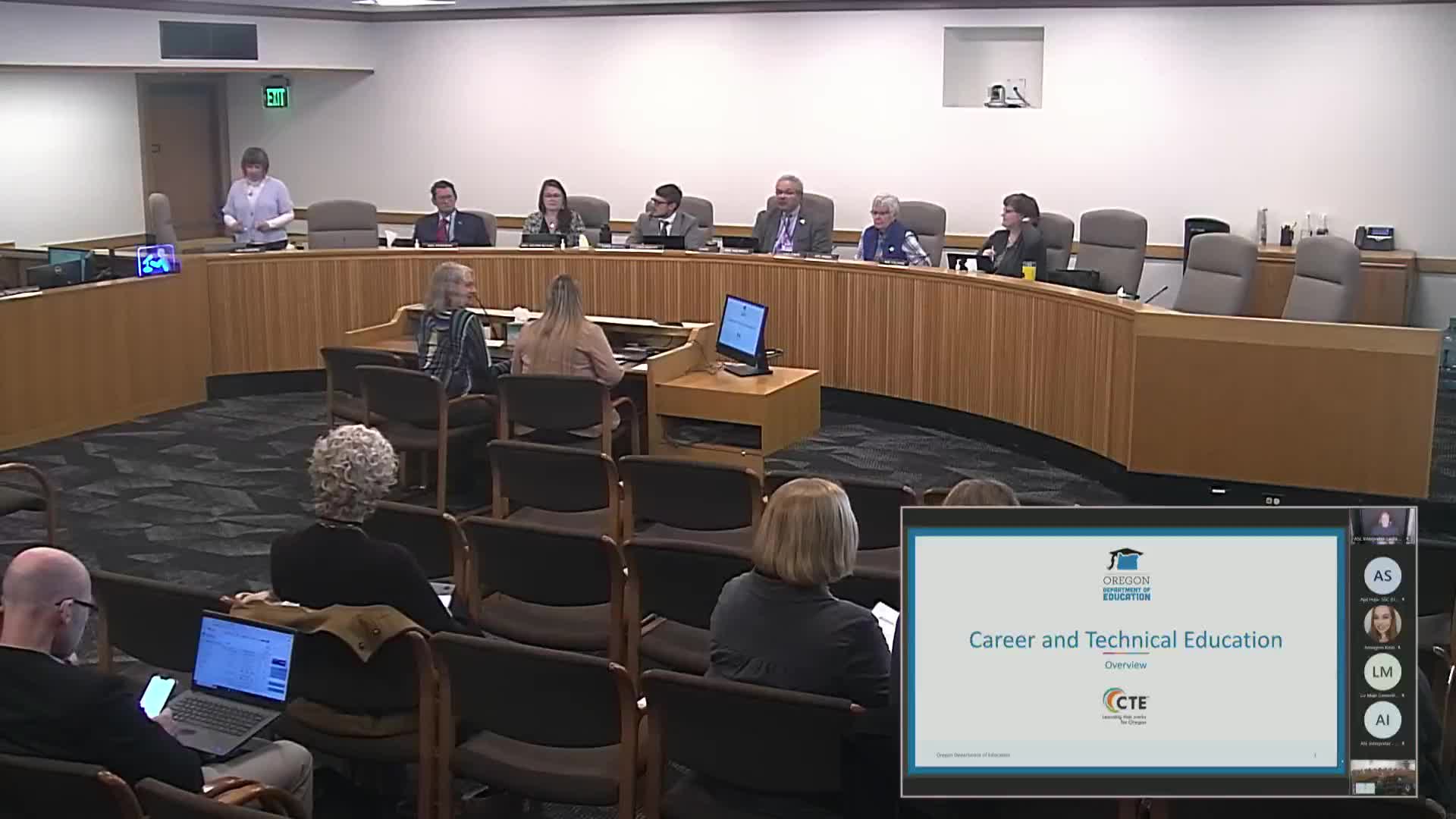
Oregon Department of Education staff provided a high-level overview of career and technical education (CTE) and career-connected learning during an informational session of the Senate Education Committee, then the Sabin Schellenberg Professional-Technical Center described local program offerings and student outcomes.
Janelle Ives, Oregon CTE state director, summarized a career-connected learning framework that ranges from awareness and exploration to preparation and on-the-job training, and described required elements for approved CTE programs, including standards alignment between secondary and postsecondary providers, industry partnerships, and student support services. Ives noted Oregon’s use of federal Carl D. Perkins funding and said the state has been developing statewide programs of study to replace locally developed programs over the past four years.
Cassie Medina, assistant superintendent for education innovation and improvement, and Ives told the committee that students who concentrate in CTE (typically two or more years of work in a program) show higher attendance and higher graduation rates nationally and, in Oregon, arrive into the workforce with higher wages six years after graduation.
The Sabin Schellenberg Professional-Technical Center in North Clackamas School District presented program-level details. Principal Ajay Huja and Assistant Principal Liz Mackey said the center offers 16 programs across three campuses with industry-standard facilities and shared services (transportation, facilities, scheduling). Mackey said students last year earned 455 industry-recognized credentials and roughly 2,000 college credits through dual-enrollment arrangements; many credentials, such as automotive ASE-series certifications and CNA certificates, lead directly to living-wage jobs or to articulated postsecondary credit.
Savvy outreach and student support work at Sabin Schellenberg has focused on reducing course-drop rates among students receiving special education and English-language supports; administrators said they introduced welcoming events, added a counselor on site, and tracked drop reasons, leading to fewer course withdrawals.
Committee members praised CTE and asked about expanding regional partnerships and how to reach families earlier (elementary and middle grades) so students and parents know about career pathways. Sabin Schellenberg staff invited committee members to an open house on Feb. 26.
The presentation was informational; no committee action was taken.