Get Full Government Meeting Transcripts, Videos, & Alerts Forever!
Get email alerts on the Regional Inclusive Services Funding topic
No spam. Unsubscribe anytime.
ODE outlines formula and biennial reporting plan in SB 868 to address $52 million funding gap for regional inclusive services
Summary
ODE told the Senate Education Committee that SB 868 would require the agency to develop a funding formula and post a biennial report explaining differences between formula-calculated needs and approved funding for regional inclusive services, which serve students with low‑incidence, high‑cost disabilities.
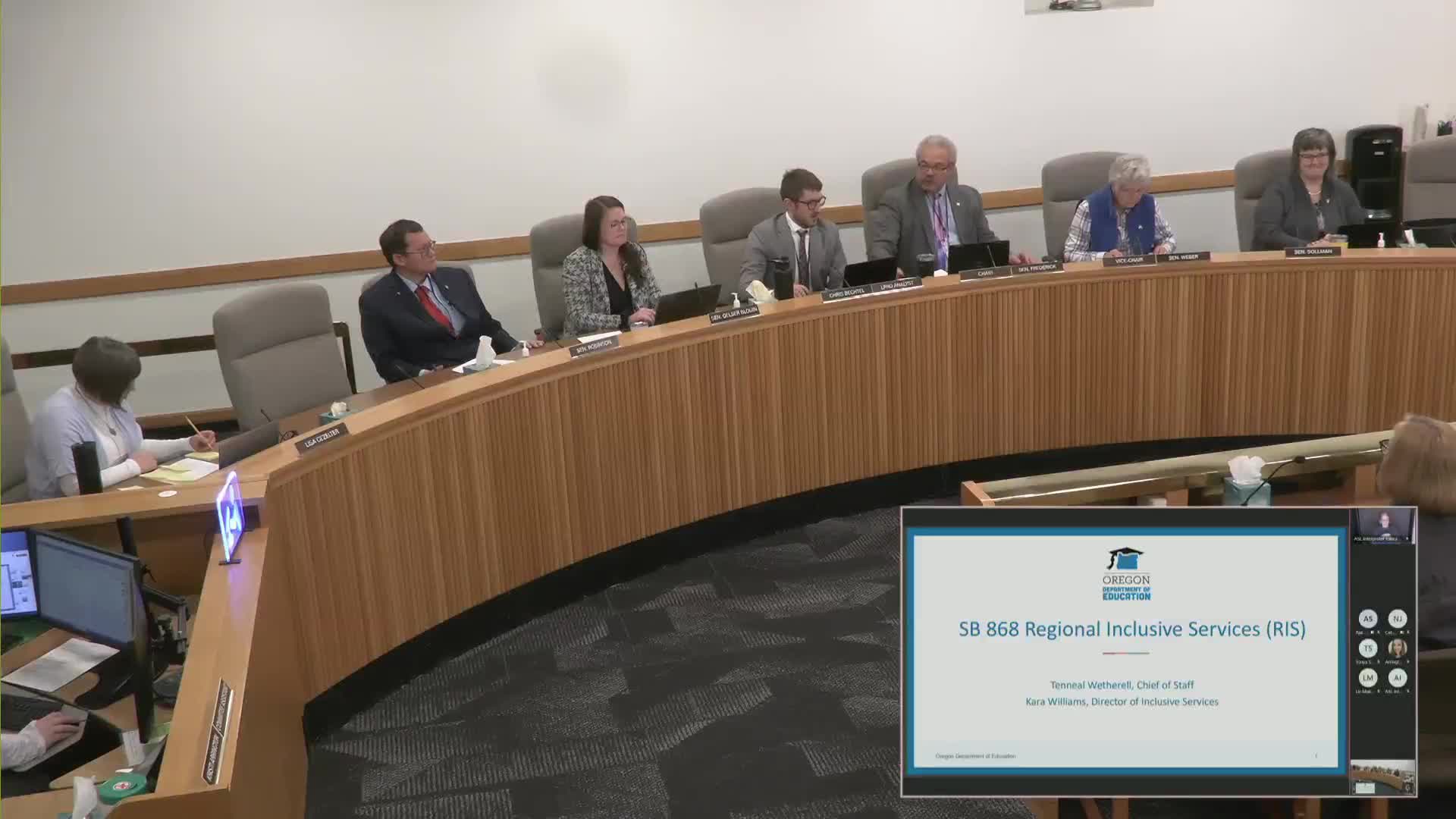
At a public hearing on Senate Bill 868, Oregon Department of Education officials described a proposed formula and reporting requirement intended to stabilize funding for the state’s Regional Inclusive Services program, which serves students with low‑incidence, high‑cost disabilities.
Cara Williams, director of Inclusive Services at ODE, and Teneal Weatherall, ODE chief of staff, said the regional model—established in the 1980s—delivers specialized staff and services across eight service areas for conditions such as autism spectrum disorder, traumatic brain injury, and deaf‑blindness. Williams said the number of students needing regional services has increased about 40% since 2009 while per‑student funding has declined in real terms.
ODE staff presented a funding-model example that sets a target service-cost figure of $3,481 per student and applies a biennial inflation rate of 4.2 percent. Using their student-population estimates, ODE calculated a target service-level of roughly $122 million for the upcoming biennium and said that represents a roughly $52 million gap from the current service level. ODE staff said the agency now budgets about $69 million for the program and supplements it with roughly 40 percent of federal IDEA discretionary funds to raise available funding closer to $75 million.
Under the bill language described in testimony, ODE would develop the formula to calculate the cost of operating regional special-education programs and, no later than Sept. 1 of each even-numbered year, submit and post an explanation of differences between formula-calculated funding and the legislature’s approved funding, including reasons for those differences.
Regional program leaders from across Oregon testified in support and described local impacts. Kathy Jensen, executive director for K–12 special education at Northwest Regional ESD (region 8), detailed service examples in coastal and small districts and said funding volatility forces districts and contractors to make difficult tradeoffs and has driven some specialized staff to leave the state. Tanya Smith, filling in for Intermountain ESD (region 1) superintendent Mark Mulvihill, said caseloads have risen dramatically—her region’s autism consultant caseloads have grown from about 40 students historically to more than 130—and she said eastern Oregon’s seven-county region has only 10.5 regional staff to serve 642 students, stressing the model’s strain in rural areas.
Committee members asked for district-level or historical data comparing allocated funding to actual local costs; ODE staff said they could compile illustrative comparisons but that differences in local contracts and service delivery complicate direct statewide comparisons.
The hearing provided testimony and no committee action; ODE said the bill would give the legislature regular, formula‑based information to inform funding decisions for regional inclusive services.