Get Full Government Meeting Transcripts, Videos, & Alerts Forever!
Get email alerts on the Legislative Priorities topic
No spam. Unsubscribe anytime.
Lake County supervisors refine 2025 state and federal priorities; add public safety, flood resiliency and call out roads
Summary
At a Jan. special governance workshop, Lake County supervisors heard presentations from state and federal advocacy firms and directed staff to revise draft 2025 legislative priorities to explicitly include public safety, flood resiliency and to call out roads under infrastructure while noting federal funding uncertainty after an OMB directive.
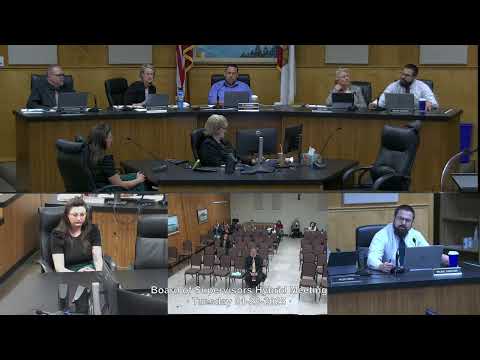
Lake County supervisors on Jan. 15 heard state and federal advocacy briefings and asked staff and the county’s contract lobbyists to revise the county’s draft 2025 legislative priorities to include public safety and flood resiliency as distinct priorities and to explicitly call out roads under infrastructure.
The board opened the agenda item with a presentation from Matthew Rothstein, Chief Deputy County Administrative Officer, who summarized the county’s draft priorities and introduced the contract advocates. Jeff Neal of Nielsen Merksimer reviewed the state landscape and urged the board to adopt a short, flexible set of priorities that lets county advocates respond quickly to introduced bills. Joe Cron of Paragon Government Relations and members of his team reviewed federal issues and warned the board that a recent Office of Management and Budget memorandum could create short-term uncertainty for some federal funding streams.
The presentations framed an extended discussion among supervisors about priorities the county should emphasize in Sacramento and Washington. Multiple supervisors argued that wildfire resilience and defensible-space programs remain crucial and should stay on the list. Supervisor Owen and others emphasized roads as a pressing local need and asked that “roads” be specifically referenced inside the infrastructure priority so rural corridors get targeted consideration. Supervisor Pysko and others asked that flood risk reduction be elevated—either as its own priority or as a clearly identified subcategory within disaster resiliency—because sedimentation and post‑fire runoff threaten communities across the county.
Supervisors also pressed for public safety to be added to the state and federal lists. They cited recent changes in crime‑related funding streams and the uncertain status of Victims of Crime Act (VOCA) dollars; Supervisor Sabatier said the state provided a one‑year backfill for VOCA but long‑term federal funding remained unclear. Cron and Neal told the board both firms could pursue public safety and VOCA-related advocacy under the existing contracts and encouraged the board to put those priorities on its short list.
Advocates and supervisors noted a second area of short‑term uncertainty. Joe Cron and Paragon staff flagged an OMB directive issued the night before the meeting that asked federal agencies to review assistance programs and, in some cases, temporarily pause awards pending alignment with the new administration’s priorities. Cron said Paragon was preparing a memo and monitoring litigation and agency guidance; he cautioned the board that the directive’s practical effect for county programs was still unfolding.
Public commenters and board members urged alignment of the county’s priorities with partner groups such as CSAC, NACO and RCRC where possible. Betsy Khan of the Essential Public Information Center, speaking during public input, urged more explicit linkages between Vision 2028 goals and actionable targets in the general plan update and related county strategic planning work. Several supervisors said staff would pursue a longer “legislative platform” later in 2025 so the county can provide more detailed guidance to advocates while keeping the public facing priorities concise and flexible.
After discussion, the board gave staff direction to: 1) revise the draft state and federal priority statements to explicitly add public safety and flood resiliency (or to place flood resiliency as a clear subcategory of disaster resiliency), 2) list “roads” within the infrastructure/funding category, and 3) return the revised drafts for formal acceptance. Nielsen Merksimer and Paragon were asked to incorporate the edits into their advocacy plans and to watch for rapidly changing federal and state bill activity so they can react on the county’s behalf.
Board members stressed that adopting broad but clearly signaled priorities helps the county’s advocates move quickly as new bills are introduced; Jeff Neal told the board the state bill introduction deadline was Feb. 21 and that hundreds of bills typically appear in the final weeks before the deadline. Paragon staff reiterated that federal funding and rulemaking could shift quickly and promised a follow‑up memo about the OMB directive and its implications.
The board did not take a formal, recorded vote on the item during the workshop; the direction to staff was given as board consensus and the revised priority language will be returned for formal adoption.
Why it matters: County priorities guide lobbyists’ day‑to‑day work in Sacramento and Washington and shape which bills and grant programs county staff prioritize. Supervisors emphasized protecting existing funding streams for fire mitigation, public safety, roads, broadband, and flood risk reduction—areas that affect large portions of Lake County’s largely rural population.
Next steps: Staff will prepare revised state and federal priority statements reflecting the board’s guidance and return them for formal consideration. County advocates from Nielsen Merksimer (state) and Paragon Government Relations (federal) will monitor bills and federal guidance and brief the CAO’s office on rapidly emerging issues.