Get Full Government Meeting Transcripts, Videos, & Alerts Forever!
Get email alerts on the Government Ethics topic
No spam. Unsubscribe anytime.
Oregon Government Ethics Commission reports sharp growth in trainings, advice and complaints
Summary
The Oregon Government Ethics Commission told the House Committee on Rules it has expanded staff and training amid a rising caseload since assuming enforcement of public meetings law, citing increased requests for advice and a surge in complaints.
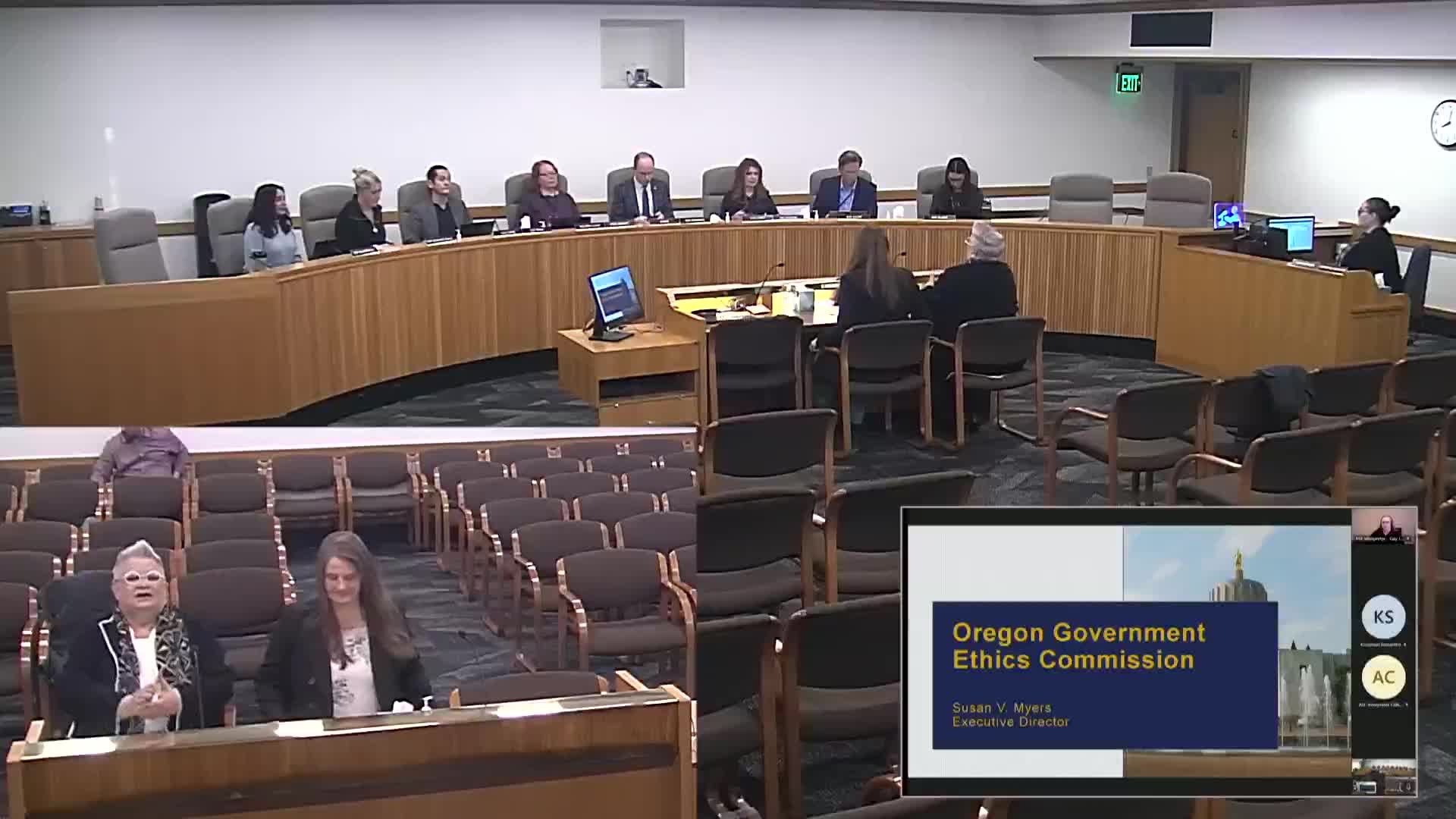
The Oregon Government Ethics Commission told the House Committee on Rules on Jan. 27 that its workload and public outreach have grown markedly since it assumed responsibility for enforcing the public meetings law.
The agency’s executive director, Susan Myers, told committee members that the commission now has jurisdiction beyond chapter 244 ethics rules to include the public meetings law and lobby provisions, and that the agency has expanded personnel and training to respond.
Myers said the commission has 15 staff, up from nine before the last budget cycle, and that the agency’s funding is split roughly 50% on state FTE assessments and 50% from a municipal audit fee assessment. Becky Mason, the commission’s operations and policy analyst, said the commission delivered nearly 14,000 trainings in 2024 across in-person sessions and webinars and that the volume of outreach has driven increased requests for written advice and complaint filings.
Commission staff reported specific operational figures to the committee: about 721 pieces of written advice issued in 2024 (nearly double the prior year), roughly 566 complaints filed in 2024 (a 31% increase from the year before), and several hundred active cases (the transcript referenced about 272 open cases). The agency said public meetings law now accounts for a large share of new matters handled since the commission began enforcing that law in September 2023.
Myers and Mason described the commission’s investigative process: complaints must be signed (not anonymous), preliminary review is confidential and Commission-run, and a typical investigation period is approximately 180 days, after which the matter may be dismissed, settled by a stipulated final order, or result in other outcomes. The commission also noted rulemaking and an approved training approval process for external training providers; the Oregon School Boards Association training is among those approved.
Committee members pressed on several operational points. Representative Boshart Davis flagged the commission’s requested budget increases and characterized a roughly 25% increase as substantial; agency staff said rising demand, inflation and proposed policy packages explain the increase. Members asked whether more training should reduce complaints; staff replied that successful outreach often increases reporting because people become more aware of possible violations and the resources to report them.
Lawmakers asked about the commission’s ability to act on media reporting and audit findings. Myers said the commission may open inquiries based on credible reporting or audit referrals, but the decision to open a motion rests with the nine-member, Senate‑confirmed commission. She clarified the commission’s jurisdiction is over individuals (public officials) rather than ordering how an agency spends money.
Committee members also asked about the number of filers and system users. The commission said roughly 7,000 people are required to file statements of economic interest; the same systems are used by about 900 registered lobbyists and roughly 2,100 client employers. Agency staff said they are requesting funds to modernize aging filing and case-management systems and to cover increasing DOJ counsel costs.
The commission framed its sanctions approach for public meetings law as primarily educational. Myers said the statute allows civil penalties up to $1,000 per violation, but the commission’s established penalty matrix generally begins with a letter of education, then mandatory training, and civil penalties rising from an initial $50 where aggravating factors apply.
Why it matters: the commission’s expanded jurisdiction over public meetings law plus a large increase in outreach and complaints means more local governing bodies and officials will be subject to education, advisory contacts, and potential investigations. Several committee members signaled interest in whether statutory or process changes are needed to reduce technical enforcement burden.
The committee closed the informational portion of the meeting and proceeded to public hearings on five bills the commission proposed.