Get Full Government Meeting Transcripts, Videos, & Alerts Forever!
Legislative analysts brief Public Safety Subcommittee on corrections, youth corrections and public defense forecasts
Summary
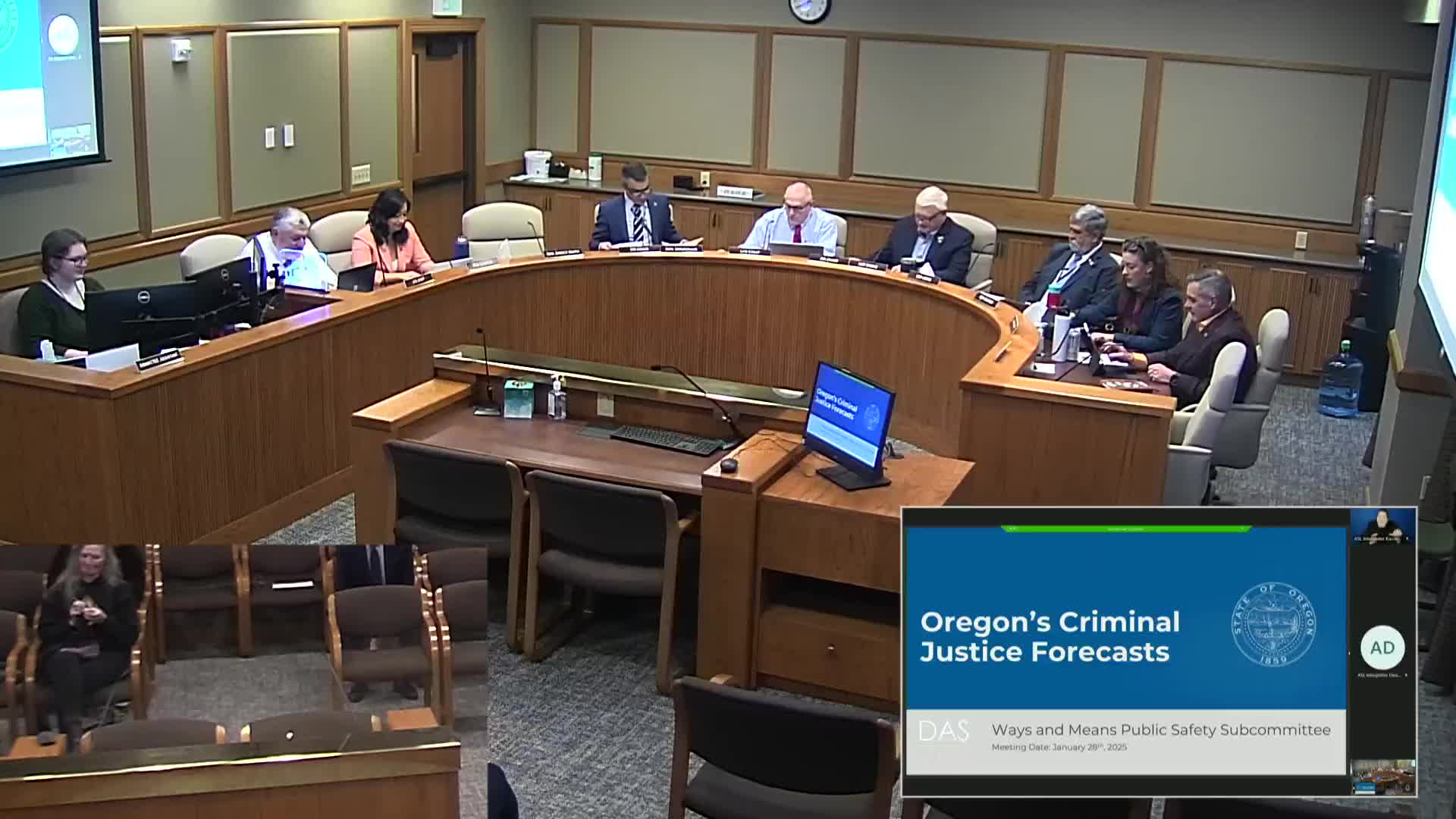
The Public Safety Subcommittee heard an informational briefing Jan. 28 from the Office of Economic Analysis on its latest forecasts for adult corrections, youth corrections and public defense, with analysts saying the forecasts are intended to inform budgeting and capacity planning and that updated figures will be provided in April.
The Public Safety Subcommittee heard an informational briefing Jan. 28 from the Office of Economic Analysis on its latest forecasts for adult corrections, youth corrections and public defense, with analysts saying the forecasts are intended to inform budgeting and capacity planning and that updated figures will be provided in April.
The report matters because the forecasts feed directly into agency budgets and discussions about prison and youth-custody capacity and the availability and contracting for public defense attorneys, a subject the Legislature changed in 2023 under Senate Bill 337.
Michael Kennedy, an economist with the Office of Economic Analysis, opened the presentation by describing the agency’s statutory role and recent changes that shifted forecasting responsibilities from individual agencies to OEA. “I think it’s important to start with what we are directed to forecast in Senate Bill 337 and ultimately ORS 151235,” Kennedy said, summarizing the legal direction that underpins the public defense forecast.
Kennedy and Mitchell Desai, OEA’s economist for corrections and youth corrections, outlined methodology and risks. The adult corrections and youth corrections forecasts use a demographic flow model: population in a month equals the previous month’s population plus admissions minus releases, with adjustments for law changes. OEA releases forecasts biannually in April and October and also maintains monthly counts for corrections and youth corrections. For adult and youth corrections, OEA projects 10 years out; for public defense it has chosen,…
Already have an account? Log in
Subscribe to keep reading
Unlock the rest of this article — and every article on Citizen Portal.
- Unlimited articles
- AI-powered breakdowns of topics, speakers, decisions, and budgets
- Instant alerts when your location has a new meeting
- Follow topics and more locations
- 1,000 AI Insights / month, plus AI Chat