Get Full Government Meeting Transcripts, Videos, & Alerts Forever!
Get email alerts on the State Budget topic
No spam. Unsubscribe anytime.
LFO briefs General Government subcommittee on budget rules, funds and DAS assessments
Summary
Legislative Fiscal Office staff gave an orientation to the Joint Ways and Means General Government Subcommittee on Jan. 27, covering committee procedures, quorum rules, budget terminology, fund types, and upcoming DAS assessments and agency hearings.
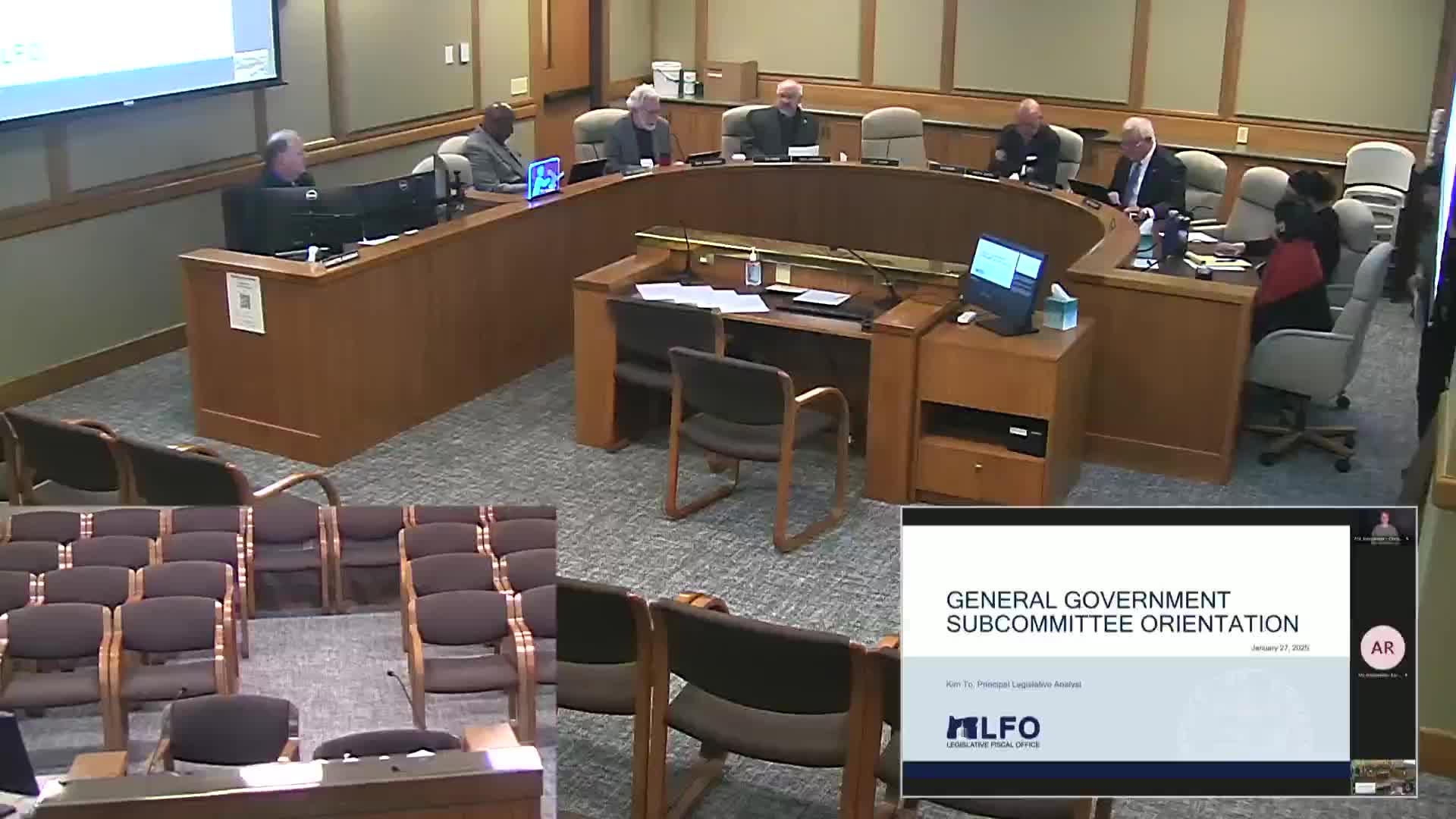
The Joint Ways and Means Committee’s General Government Subcommittee held an orientation Jan. 27 in Hearing Room H 170, where staff from the Legislative Fiscal Office (LFO) reviewed committee procedures, the state budget process and what members should expect in upcoming agency budget presentations.
Kim, an analyst with the Legislative Fiscal Office and the subcommittee’s coordinator, told members that the panel will hear agency budgets, fee bills and related policy measures and that the subcommittee “does not have the power to table or hold legislation.” She outlined how LFO staffs this panel, how to find meeting materials on OLISS, and how members should raise technical questions and amendment requests.
The briefing aimed to give new and returning members the tools to follow budgets and to identify issues to pursue in phase 2 work sessions. LFO staff emphasized that the subcommittee will consider administrative budgets and assessments that affect many state agencies — notably Department of Administrative Services (DAS) assessments — and that those assessment decisions can change costs across state government.
LFO role and products
LFO staff described their nonpartisan role in producing fiscal impact statements, budget reports and package-level analyses that trace changes from a prior biennium to a proposed budget. Kim said LFO analysts review agency requests, travel to agencies for oversight, and publish reports and highlights on legislatively adopted budgets. She listed LFO staffing levels and noted rotating analyst coverage: “Depending on the state agency that we’re discussing on the day, you will have a different rotation of LFO staff in the middle,” she said.
Budget basics and terminology
The LFO presentation covered the basic building blocks members will see in agency presentations: current service level (CSL), policy option packages, technical and essential packages, and how the governor’s recommended budget is developed from agency requests. Kim explained that CSL starts from the prior legislatively approved budget, phases in roll-up costs and removes one-time items; policy option packages add proposed changes above CSL.
Staff also reviewed fund types members will encounter — general fund, lottery fund, federal funds and “other funds” — and the distinction between limited and nonlimited items. Kim warned that “other funds” can include a variety of revenue sources and that members should always ask for the source of any “other fund” in an agency’s budget.
Quorum and public‑meeting guidance
Members asked about quorum and meeting-law boundaries. LFO staff explained how the subcommittee’s quorum is composed of both House and Senate members and clarified when meetings among subsets of members could or could not violate public‑meeting requirements. The office advised members to notify co‑chairs and staff ahead of absences so the committee can make alternate arrangements when votes are required.
Budget math and statewide context
LFO walked members through biannual budget timing (the biennium runs July 1 of an odd-numbered year through June 30 of the next odd-numbered year), how the governor’s budget is submitted and how the May revenue forecast factors into final balancing. Staff noted the state uses an ending balance and two reserve funds (the Education Stability Fund and a Rainy Day Fund) that require three‑fourths legislative approval to tap.
On the revenue outlook, LFO cautioned that the tentative December forecast’s small surplus does not reflect many one-time items that must be continued or replaced; staff said those one-time commitments exceed $1 billion and significantly reduce the apparent surplus when building the 2025–27 budget.
Delinquent debt and oversight
Representative Gomberg raised uncollected state debt as a budget concern. LFO replied that it publishes an annual “delinquent debt” report with agency-by-agency balances, collections and write-offs and recommended members consult that report for oversight questions.
Subcommittee scope, schedule and what to expect next
Kim outlined the subcommittee’s hearing phases: an initial informational and public‑hearing period, agency phase‑1 presentations, follow‑up (phase‑2) hearings for deeper questions, and work sessions to adopt an LFO‑recommended package that moves to full Ways and Means. She listed expected early hearings: DAS — including rates and assessments and a discussion of Workday and Oregon Buys — Employment Relations Board, Public Records Advocacy Office and the Construction Contractor Board. LFO also scheduled a tour of the DAS Executive Building to inform space and facilities discussions.
What members were asked to do
Staff asked members to read posted materials on OLISS in advance, attend hearings (the subcommittee meets Monday–Thursday at 8 a.m.), raise questions during presentations, and relay any topics they want the co‑chairs to highlight for phase‑2 follow-up. Kim said amendments to bills should be emailed to the Legislative Fiscal Officer (Amanda Bridal) per posted instructions.
The orientation closed with staff contact information and a reminder that, unlike some program subcommittees, the General Government Subcommittee covers a wide mix of administrative agencies and several license or fee‑driven boards, a scope that drives many small but technical budget decisions. The panel adjourned after members asked a few scheduling and procedural clarifications.