Get Full Government Meeting Transcripts, Videos, & Alerts Forever!
Get email alerts on the Tax Compliance Certificates topic
No spam. Unsubscribe anytime.
DOR seeks expanded tax-compliance checks for licenses and state contracts; witnesses warn of costs and unintended harms
Summary
Senate Bill 800 would expand the Department of Revenue's ability to require proof of tax compliance for some occupational licenses, contractors and state contracts; the committee took public testimony Jan. 27 and asked DOR and stakeholders to refine the proposal.
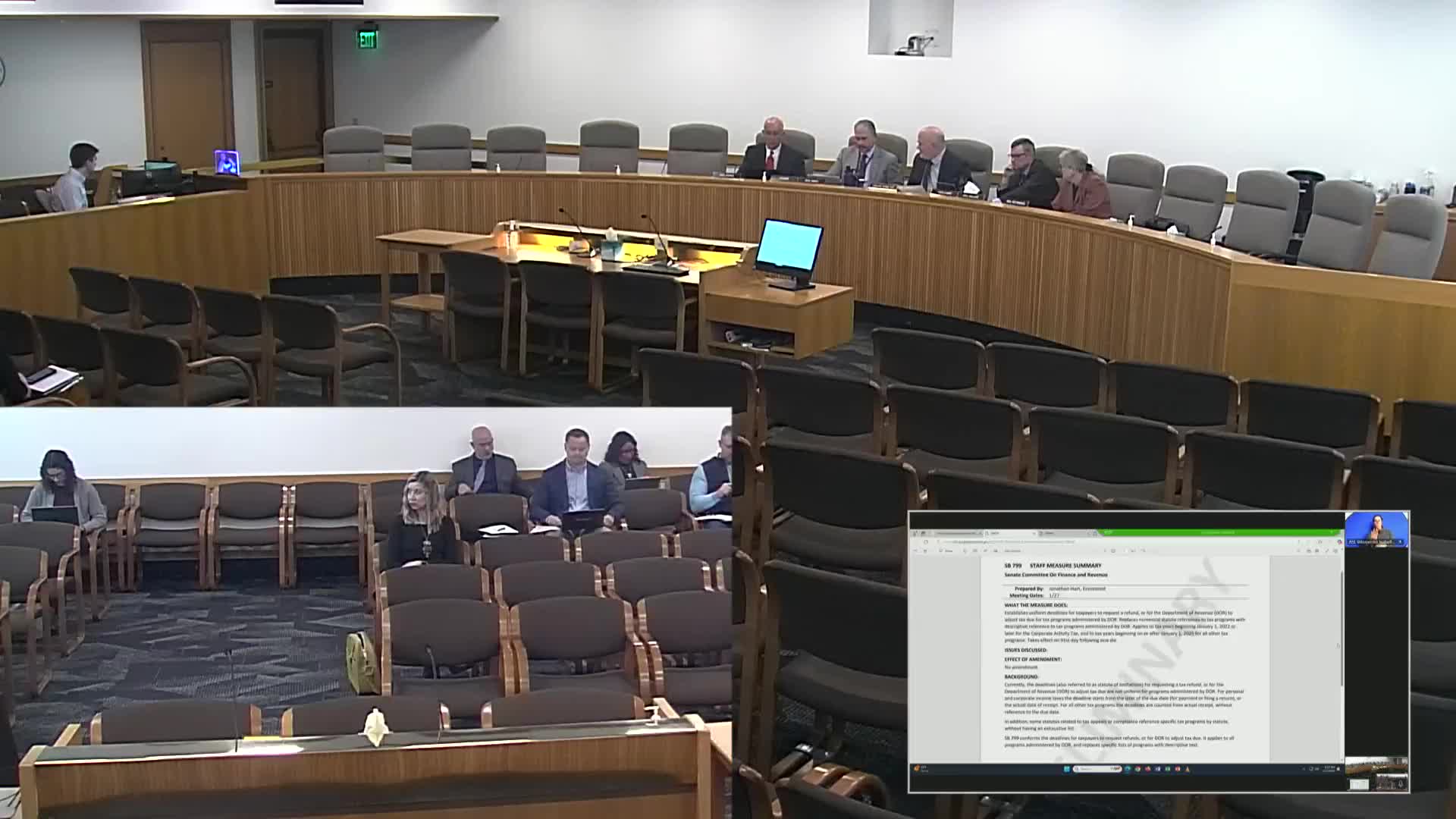
Senate Committee on Finance and Revenue held a public hearing on Jan. 27, 2025, for Senate Bill 800, which would expand tax-compliance requirements tied to state licenses and certain state contracts and permit the Department of Revenue to require and verify tax compliance certificates from license applicants and contractors.
Deanna Mack, administrator of the DOR collections division, told the committee the proposal is grounded in prior pilot projects and more recent examples of noncompliance among some licensees. Mack described a trigger-based approach: if a licensing group's overall compliance rate falls below the statewide average (the bill contains a 95% threshold), the group would be required to demonstrate tax compliance for at least five consecutive years by obtaining a tax compliance certificate from DOR and attaching it to licensing or contracting applications. "So the requirement is there for all licensees unless they're an employee of someone else, but if a group of licensees overall compliance rate drops below the average for everyone else then that group will be required to demonstrate tax compliance for at least 5 consecutive years by obtaining a tax compliance certificate from our agency," Mack said.
Mack said DOR would require licensing agencies to send lists of licensees to the department so DOR can perform data matches and measure compliance; the bill would require the Oregon State Bar to provide a list of active and inactive members annually. Mack outlined the timeline the department envisions if the bill becomes law: the bill would likely take effect in September 2025, section 2 (data and certificate process) would be effective Jan. 1, 2026, the first lists would be due March 1, 2026, and DOR would study compliance and notify affected agencies after two years of data (spring 2028). Mack said DOR planned to automate issuance of compliance certificates through its Revenue Online portal and that agencies already use DOR certificate checks for some licensing programs.
The bill also would allow DOR to share information with the Oregon State Bar about failures to comply with any trust fund program and to pass legal costs related to license suspension actions. Mack said the bill is not identical to other pending procurement bills and does not replace the existing self-certification regime for contracts in this text; DOR suggested raising the dollar threshold for contract-based checks from $1,000 to $10,000 to align with procurement direct-award thresholds.
Witnesses raised concerns about the bill's potential administrative burden and unintended consequences. Nolan Pleshet, a lobbyist for the League of Oregon Cities, said the bill could reduce the pool of contractors available to cities, increase costs, and place substantial operational burdens on local governments that must check certificates or refuse to renew licenses or contracts when certificates are missing. "The bill could have major impacts on operations because it would require the city to refuse to reissue, reinstate, renew, or extend any license, contract, or agreement until the agency receives a certificate issued by the Department of Revenue," Pleshet said, and he asked for clarification about whether DOR-issued certificates and the bill's other processes could be standardized to avoid duplication.
Committee members pressed DOR on scope and safeguards. Senator McClain expressed concern about potentially taking livelihoods and public-service consequences if essential license holders lose the ability to work, citing sanitation and water-treatment examples. Mack said ordinary driver's licenses would not be affected (commercial driver's licenses are considered occupational), and that DOR views payment plans and appeals filed with the tax court as forms of compliance under the administrative rule. "If they set up a payment plan with us ... we would consider them in compliance," Mack said.
Senators also discussed outreach and stakeholder engagement; Mack said DOR had spoken with some agencies including the bar and ODOT and would provide further information on outreach. Chair Meek and other members signaled interest in stakeholder work groups to refine language and asked for written testimony from affected parties, including municipalities. The League of Oregon Cities said it would file written testimony.
Why it matters: SB 800 would expand tools the state can use to enforce tax compliance, potentially improving collections and leveling the competitive field for businesses that pay taxes. Opponents warned the mechanism could have unintended economic and social impacts on small businesses, essential public services and workers if not carefully tailored and implemented with remediation pathways (for example, payment plans) and clear exemptions.
What remains unresolved: The committee did not vote; DOR and stakeholders will need to refine definitions (what counts as a license, how remediation/payment plans interact with certificate issuance), harmonize the proposal with separate procurement bills, and clarify administrative and fiscal impacts on cities and small businesses before the committee decides whether to move the bill.