Get Full Government Meeting Transcripts, Videos, & Alerts Forever!
Get email alerts on the Seawall Compliance topic
No spam. Unsubscribe anytime.
St. Pete Beach planning board discusses options to accelerate seawall height compliance
Summary
Planning board members debated possible triggers and enforcement approaches for bringing seawalls up to Nov. 2024 code standards (5-foot NAVD88 on bay side, 6-foot on gulf side) including upland-development triggers, inspection programs, fill/drainage rules, and living-shoreline options; staff will return with draft changes for commission review.
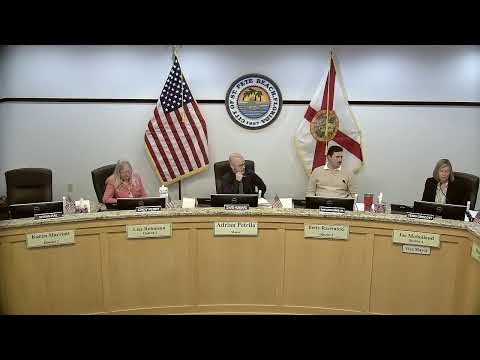
The City of St. Pete Beach Planning Board spent the bulk of its Jan. 27 meeting discussing how and when private seawalls should be required to meet the city's minimum height standards adopted in late 2024.
Planning staff described the current code as requiring seawall compliance when one of three conditions is met: replacement or repair of more than 50% of the seawall's length; repair costs exceeding 50% of the seawall's depreciated value; or an elevation change along more than 50% of the seawall's length. The city's current minimum elevations are 5 feet NAVD 1988 on the bay side and 6 feet NAVD 1988 on the gulf side, staff said.
The commission requested the discussion last month to consider whether the city should accelerate compliance based on upland development activity (such as rebuilding, substantial renovations, or adding a pool) rather than only on seawall work itself. Board members also debated several related issues: whether to treat seawall and cap replacement as a single triggering event; how to define 'substantial improvement' for upland development; whether the city should conduct routine or post-storm waterside inspections; how fill behind a raised seawall should be regulated to avoid creating localized 'bathtub' conditions; and whether living or hybrid shorelines should be promoted as alternatives to gray infrastructure.
Staff said the 5-foot bay-side standard was selected with a roughly 2050 planning horizon in mind, citing NOAA intermediate sea-level-rise projections of nearly 1 foot between 2020 and 2050 and king tides as high as about 3.6 feet. Staff told the board seawalls have a typical useful life of 30 to 50 years, which informed the decision to adopt a horizon-based elevation.
Board members referenced approaches used elsewhere. Broward County's approach was cited for its 2050 horizon and for a policy that would prohibit administrative waivers after a set year; Treasure Island's draft language was discussed for tying compliance exceptions to how close an existing seawall is to the standard (for example, within about 12 inches). Staff said any change that limits administrative relief would require legal review against state statutes and other limitations.
Several members urged the city to create or formalize a post-storm inspection protocol so failing seawalls are identified by staff rather than solely reported by neighbors. Staff said code enforcement timeframes for violations generally range from 30 to 90 days, and that large seawall replacements would likely warrant more lenient timelines to allow for permitting and contractor scheduling.
Members also raised fill and drainage concerns. Several said simply requiring seawall elevation increases without coordinating changes to nonstructural fill or drainage rules could create yards that retain water and cause nuisance or environmental effects. Staff noted that fill for drainage and landscaping is commonly permitted for that limited purpose, but that the city must ensure any raised grade does not direct water onto adjacent properties.
Other discussion points included: treating cap replacement as a potential trigger for elevation work, including certain elective upland changes (such as adding pools) as triggers, and promoting living shorelines or hybrid approaches where appropriate. Several members suggested commercial conditional-use reviews include seawall compliance as a condition.
The board did not adopt ordinance language at the meeting. Members summarized points they wanted staff and the city manager's office to study and asked staff to return within a few months with draft code language that addresses thresholds for upland triggers, inspection protocols, the fill/drainage interface, cap replacement rules, and encouragement of living-shoreline alternatives.