Get Full Government Meeting Transcripts, Videos, & Alerts Forever!
Get email alerts on the Artificial Turf topic
No spam. Unsubscribe anytime.
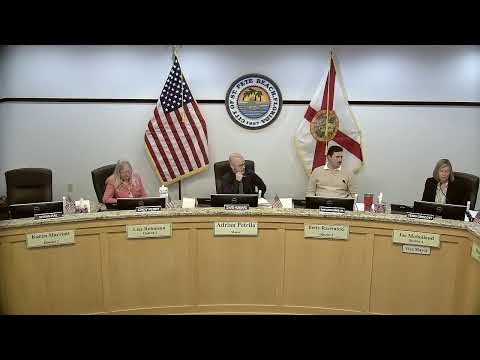
St. Pete Beach planning board recommends ordinance limiting artificial turf on private property
Summary
The City of St. Pete Beach Planning Board voted to recommend Ordinance 2025-3, which places new limits on artificial turf coverage, product standards, and placement on private property and prohibits turf in city right-of-way.
The City of St. Pete Beach Planning Board voted unanimously Jan. 27 to recommend Ordinance 2025-3 to the City Commission, a draft ordinance that would add restrictions and technical standards for artificial turf on private property.
The ordinance limits how much turf can contribute to nonvegetated surface area on a site, sets product and subgrade performance standards adapted from neighboring jurisdictions, and prohibits artificial turf in the city right-of-way and in required buffer areas, planning staff told the board.
Board members said the measure codifies consensus from earlier meetings and asked staff to bring any suggested amendments before sending the ordinance to the commission. Planning staff described the draft as preserving an existing “80/20” approach to site permeability: in broad terms, turf is treated as impermeable unless it meets the draft’s specified product and subgrade performance standards, and a majority of a typical lot must remain vegetated.
Under the draft language presented to the board, a typical residence could have as much as about 76% of the lot in impermeable surfaces (driveways, buildings, pool decks, etc.) and an additional up to roughly 20% of the lot in semi-permeable material such as turf, while the remainder of the lot must be vegetative green space. The draft excludes permeable turf used for sports fields or similar uses but bars turf from required buffer areas. Turf placed in those special-use categories must still meet the product and subgrade standards in the ordinance.
The draft requires manufactured turf to “appear lifelike,” be recyclable, carry a minimum maintenance warranty and meet minimum pile-height and blade characteristics. Staff said many technical requirements—such as underlayment material sizing and testing—were largely adapted from the City of Tampa permitting standards and FDOT guidance, and that the city will implement detailed product and installation checks through a landscaping permit process rather than by frequent future code changes.
Staff also said turf would not be allowed in city right-of-way; existing turf in the right-of-way could remain until substantial re-landscaping, at which point the site would need to be brought into compliance. The city’s right-of-way maintenance permit language currently states the city is not responsible for replacing materials other than standard sod; staff said the city sometimes attempts to preserve materials but cannot guarantee it.
Planning staff framed the ordinance as consistent with several policies in the City of St. Pete Beach Comprehensive Plan and the Boca Ciega Bay Aquatic Preserve Management Plan that encourage reduced runoff, native and drought-tolerant landscaping, and reductions in net impervious surface to limit post-development runoff and urban-heat effects.
Chair Hubbard called for a motion; after discussion a motion to recommend approval of Ordinance 2025-3 passed on a 4–0 roll call vote (Member Perry: yes; Vice Chair Angelides: yes; Member Grocott: yes; Chair Hubbard: yes). The board did not identify a mover and seconder by name on the record before the roll call.
Staff told the board the ordinance has not yet been scheduled for City Commission review and said any final technical standards will be implemented through landscaping permits to allow future adjustments as product standards evolve.