Get Full Government Meeting Transcripts, Videos, & Alerts Forever!
Get email alerts on the Curriculum topic
No spam. Unsubscribe anytime.
Rockwood R‑VI board postpones approval of multiple curriculum updates until Feb. 6
Summary
After presentations from district curriculum staff, the Rockwood R‑VI Board of Education voted to postpone approval of multiple revised course curricula across science, math, social studies and theater until the Feb. 6 board meeting.
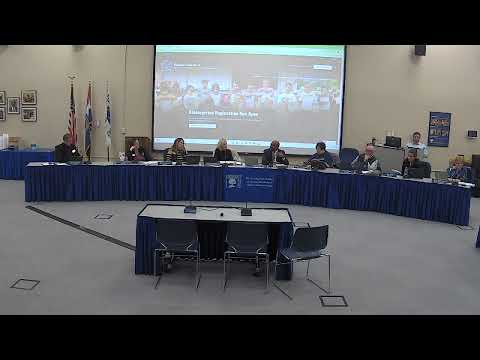
The Rockwood R‑VI Board of Education on Monday voted to postpone approval of several revised course curricula after district staff presented planned changes and asked for more implementation and review time.
District curriculum leaders described updates for secondary science, K–5 and secondary math, elective social studies and theater arts, then the board voted on a sequence of motions to delay formal approval until the Feb. 6, 2025 meeting. The postponements passed by voice vote.
Why it matters: The presentations outline instructional and assessment shifts the district intends to require across grades and subjects — from new proficiency scales in science to “building thinking” classrooms in math and inquiry‑driven elective social studies— and staff said they want more time for teacher training, public review and alignment before final adoption.
During the science presentation, Dr. Megan Bray summarized the program evaluation and community feedback: “We had 4,144 students that gave us feedback on our survey, 566 parents and 73 teachers,” and said the revised chemistry and anatomy courses now include proficiency scales that define “mastery, proficient, developing and emerging.”
Math coordinators Carrie Skeeter and Marietta Kozatek described a districtwide effort to shift classroom practice. Skeeter and Kozatek told the board the district is emphasizing problem solving, student discussion, vertical alignment and “intentional fluency practice” that will be embedded across K–5 rather than confined to a single unit. They said the district will pilot lab classrooms and bring in external speakers for professional development.
Jordan McGahy, who led the social studies presentations, said elective offerings will expand to include History of St. Louis and Women’s History and that teachers designed those courses around inquiry and project‑based learning. McGahy said the changes were informed by a program review that drew thousands of student responses and hundreds of parents and teachers.
Megan Meyer, speaking for theater, said every middle and high school has a theater teacher and that the writing team created a standard equipment list, added technical‑theater instruction and wrote a peer‑mentor course to formalize roles used in some classes now.
Votes at a glance
- Motion to postpone approval of secondary science (Human Anatomy & Physiology, Chemistry, Honors Chemistry) until Feb. 6, 2025 — outcome: postponed (voice vote). - Motion to postpone approval of K–5 math course curriculum until Feb. 6, 2025 — outcome: postponed (voice vote). - Motion to postpone approval of secondary math (Algebra I, Algebra II, AP Calculus AB/BC, Math Reasoning & Applications) until Feb. 6, 2025 — outcome: postponed (voice vote). - Motion to postpone approval of secondary social studies electives (Civil War & Reconstruction, Contemporary Issues, Economics & Personal Finance, History of St. Louis, Law & Justice, Psychology, Sociology, Women’s History) until Feb. 6, 2025 — outcome: postponed (voice vote). - Motion to postpone approval of secondary theater arts (grades 6–12 courses, including peer mentor course) until Feb. 6, 2025 — outcome: postponed (voice vote).
District staff repeatedly told the board they plan implementation training this spring and over the summer, and they emphasized that proficiency scales and clearer parent communication (unit parent letters and videos) will accompany the rollouts. Board members asked for opportunities to visit lab classrooms and for clarity on how project‑based learning will be aligned to standards and assessed.
The board’s postponement gives staff time to refine proficiency scales, strengthen parent communications and complete implementation planning ahead of the February vote.