
Horseheads Central School District reviews redistricting, transportation and new schedule after six weeks
Get AI-powered insights, summaries, and transcripts
Subscribe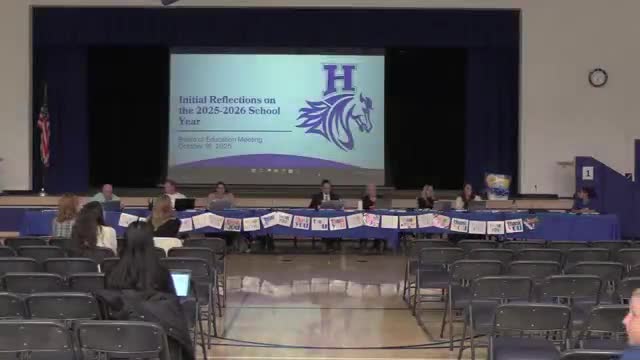
Summary
School leaders presented initial reflections six weeks into the 2025–26 consolidation and new daily schedule, reporting mixed operational progress on transportation and early data on attendance and instructional minutes. The board voted to form an ad hoc committee to study start times and schedule impacts.
Horseheads Central School District leaders presented an initial six‑week review of the district’s redistricting, consolidated elementary schedule and transportation plan at the Oct. 16 board meeting, and the Board of Education voted to form an ad hoc committee to study start times and other schedule issues.
The presentation traced the schedule changes to multi‑year planning and a 2017–18 elementary schedule study and said the district’s primary aim was “protecting core instruction” while responding to falling enrollment and state requirements. Mr. Gill (staff member, presentation lead) told the board the changes were intended to increase student contact time and to align special‑area rotations, multi‑tiered supports (MTSS) and building usage following consolidation.
Why it matters: the schedule and bus changes affect thousands of students each day, shape delivery of core instruction and connect to state aid. District staff said they are tracking ride times, attendance and other early indicators to spot problems and make short‑term fixes while planning longer‑term adjustments.
District presenters explained transportation parameters they were given and the tradeoffs those parameters created. The district used a staggered schedule (middle/intermediate, high, then elementary) to allow the new consolidated routing to operate without adding buses or drivers. Transportation staff—identified in the meeting as Rich (transportation staff member) and Tony (staff member)—explained three planning metrics they tracked: roll time (moving buses between schools with students on board but not yet on the run), load time (time spent loading additional students at a school) and ride time (the run from district property to home).
Those metrics produced mixed results. District slides and presenters reported that, counting ride time only (the time from when the bus leaves the school to delivery at home), elementary runs are now under an hour for all students; 100% of elementary ride times are below one hour. On combined measures (roll time + load time + ride time) staff said 59 students across the district currently have total time on the bus above one hour, with some individual total bus times reaching about 1 hour 23 minutes. Presenters emphasized the distinction between ride time and total bus time on parent tracking apps and said drivers and dispatch staff have been working daily to shave minutes from routes.
Special‑needs routing showed marked improvement in the district’s account: staff said nearly 60% of special‑needs runs are now under an hour and all special‑needs runs are under 1.5 hours; that work involved reorganizing routes and creating a two‑tier pick‑up model. Rich told the board that special‑needs runs are operationally complex because some destinations are off‑site partner programs with long travel distances and because some students require additional time to board.
District staff also presented early attendance and behavior data for the first five weeks, reporting “no discernible differences” in elementary tardy or attendance rates compared with the prior year. Mr. Gill said the district remains about 48 hours above the state minimum instructional‑time requirement for the K–4 population and similarly above the minimum for grades 5–6; he noted the district keeps a cushion so that unexpected weather or utility closures do not force use of remote instruction to make up hours. Staff described the state minimum as 900 hours and said falling below the minimum could reduce state aid; the presentation included district estimates of potential reductions if a building fell a day short (district staff noted those dollar figures are approximate and prorated by affected student population).
Board members, teachers and parents pressed staff on several operational issues during and after the presentation: early‑dropoff participation (Tony reported roughly 23 students are currently using an early‑dropoff program), student supervision at some sites, how specials (music, art, library) are scheduled under the new four‑day cycle, and communication timing. Board members asked staff to post more data and to provide written breakdowns where possible; they asked for continuing tweaks to BOCES, CTE and high school coordination.
Action and next steps: the board voted to direct the president to propose parameters for an ad hoc board committee to study start times, schedule impacts and related operational issues (motion passed). The president will return proposed committee scope, membership and timeline at a future meeting under board policy for ad hoc committees.
"The main thing is instruction," Mr. Gill said during the presentation, summarizing the district’s stated priority. Board President Dan (board president) thanked staff for the review and asked for additional data requests to be brought back to the board. The district said it will continue daily route adjustments and data monitoring while the ad hoc committee is formed and the board considers longer‑term changes.