Get Full Government Meeting Transcripts, Videos, & Alerts Forever!
Get email alerts on the Co2 Injection Regulation topic
No spam. Unsubscribe anytime.
Louisiana CO2 alliance warns Tangipahoa officials of risks, urges local opt-out and stronger liability rules
Summary
A representative of the Louisiana CO2 Alliance told the Tangipahoa Parish Council that planned carbon dioxide injection wells in the region pose risks to water and mineral rights and urged parishes to seek opt-out authority and stronger liability and notification rules.
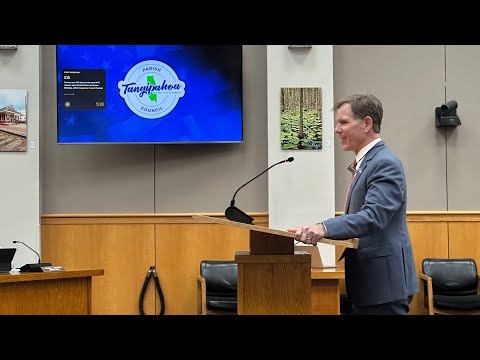
Roland Hollins, an Allen Parish police juror and representative of the Louisiana CO2 Alliance, told the Tangipahoa Parish Council on Jan. 27 that his coalition is pushing several bills this legislative session to protect parishes where CO2 injection projects are planned.
Hollins said four parishes have come together to form the alliance and that his group is asking parishes across the state to join as nonpaying associate members to influence legislation. “We have to protect our water sources. Nothing is more important to a community or to a parish than your water source,” Hollins said.
He described three proposed injection sites affecting his region and said one privately owned site would receive about 150,000,000 metric tons of CO2. “At $85 a ton, that's $12,750,000,000, and our parish is gonna receive nothing,” Hollins said, arguing for local compensation and trust funds for affected parishes.
Hollins said the alliance is supporting an opt-out bill that would let individual parishes vote to accept or reject CO2 projects within their boundaries. He described other proposed measures including an “injection integrity” bill that would criminalize continuing injections after a detected leak without immediate stoppage and notification of local and state officials, stronger liability caps and clearer protections for mineral owners whose rights could be affected by underground CO2 plumes.
Council members asked about outcomes in other states. Hollins cited an Illinois injection site that had experienced two leaks and said industry notification to local authorities came only after a later leak. When a council member asked whether nearby residents were affected, Hollins said available public information indicated the leaks had not reached local water supplies but acknowledged that not all facts were publicly available.
Hollins said the alliance paid more than $60,000 for a local risk assessment and shared the report with industry and legislators to inform proposed rules. He said the alliance’s primary priorities are (1) opt-out authority at the parish level, (2) higher liability and compensation for damage, (3) criminal penalties or immediate enforcement when leaks occur and (4) protections for mineral rights and land values.
President Miller and other council members said they would consult parish legal counsel and noted the Police Jury Association is working on revenue-sharing proposals; Miller invited conversation with state legislators who were present. Sen. Bill Wheaton entered the meeting during the discussion.
The council did not take formal action on the presentation. Hollins asked council members to consider becoming associate members of the alliance and said he would continue meeting with legislators this session.