Get Full Government Meeting Transcripts, Videos, & Alerts Forever!
Get email alerts on the Traffic Calming topic
No spam. Unsubscribe anytime.
NDOT proposes five speed-cushion locations for Lewis Street; project moves to resident ballot
Summary
Nashville Department of Transportation staff presented a design that would add five sets of speed cushions on Lewis Street to reduce speeds and improve safety; the project will go to a six-week mailed/online ballot of adjacent property owners and institutions and requires two-thirds of respondents to approve construction.
Nashville Department of Transportation (NDOT) staff on Jan. 21 presented a traffic-calming plan for Lewis Street that proposes five sets of speed cushions along the corridor and explained how the neighborhood will vote on whether the project proceeds to construction.
NDOT project lead David Greaves said the cushions are intended to reduce average speeds along the length of Lewis Street and described the program’s selection and ballot process. "This is a program that NDOT runs that focuses on residential streets," Greaves said, adding that the agency typically selects whole-street projects rather than single-block fixes.
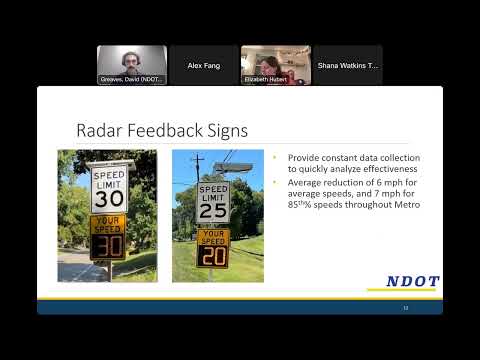
Greaves said NDOT relies on a mix of the "three E's" — education, enforcement and engineering — but that engineered changes such as speed cushions are the most reliable way to reduce speeds when police enforcement is limited. He cited NDOT before-and-after data showing average speeds falling from 31 to 22 miles per hour and 85th-percentile speeds from 37 to 25 after similar installations.
Why it matters: NDOT and Vision Zero officials use measured vehicle speeds, crash history and proximity to destinations such as libraries and schools to prioritize streets for traffic calming. Lewis Street was one of 25 streets selected in March 2024 from about 500 applicants, according to Greaves, indicating the street scored highly under NDOT’s formula.
Design and coordination: The presented plan relies mainly on speed cushions spaced to create a sustained slowing effect; NDOT staff said Lewis Street’s flat, relatively straight profile and few driveways made it suitable for cushions. The project overlaps other nearby work: Greaves noted permanent bulb-outs are being installed around Cannon Street and that NDOT is coordinating the Lewis Street work with the city’s Vision Zero program.
Public suggestions and NDOT responses: Meeting participants asked NDOT to consider additional measures. A resident identified as Elizabeth asked for painted crosswalks; Greaves said NDOT will "evaluate" whether crosswalk markings can be included. Shana Watkins, representing the Tennessee Justice Center, asked how ballots are handled when a property is owned by a public housing agency; Greaves said ballots for properties owned by the Metropolitan Development and Housing Agency (MDHA) are sent to MDHA and that MDHA can relay resident input through NDOT’s public input page.
Ballot and eligibility details: Greaves described the vote process: NDOT mails postcards to owners of parcels that touch Lewis Street, using Metro's register of deeds to generate the list. Residential properties, churches and schools each receive one ballot; operating businesses are ineligible. NDOT excludes clearly vacant lots and limits ballots so that one person who owns multiple parcels does not get multiple votes. The online/mail ballot remains open about six weeks; if two-thirds of respondents vote yes, the project will move to construction. Greaves cautioned that construction timelines are presently long because of the queue of approved projects.
Outreach: Greaves encouraged neighborhood outreach to improve response rates and offered to coordinate with local ambassadors or neighborhood groups. Meeting participants suggested sending information to Pruitt Branch Library and to neighborhood ambassadors who work informally within MDHA developments to help residents access and complete ballots.
What was not decided: The meeting was informational; no formal vote or final construction approval was taken. NDOT indicated it will consider written feedback, may hold a second neighborhood meeting if requested, then proceed to the ballot stage.
Ending: NDOT staff said they will revise plans as needed based on feedback, share timelines for mailers, and accept public input via the project’s public input page and by email to n.traffichoming@nashville.gov. The agency asked that local correspondents be copied to that email address to keep staff aligned.