Get Full Government Meeting Transcripts, Videos, & Alerts Forever!
Get email alerts on the Education Blueprint topic
No spam. Unsubscribe anytime.
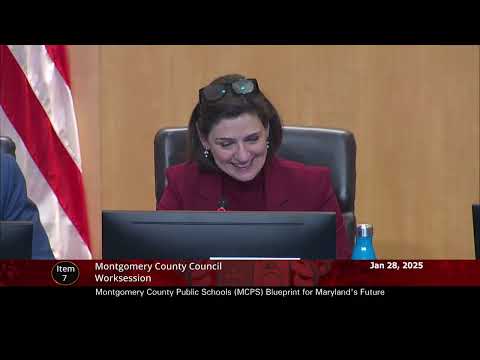
Montgomery County council holds work session on Blueprint for Maryland’s Future, flags funding and implementation questions
Summary
County council held a work session with Montgomery County Public Schools staff and county analysts to review the Blueprint for Maryland’s Future, discuss state proposals that could pause or alter parts of the law, and flag local cost pressures including community schools expansion, AP/dual-enrollment fees and potential federal funding cuts.
Montgomery County Council members and staff met in a work session to review Montgomery County Public Schools’ (MCPS) implementation of the Blueprint for Maryland’s Future and to discuss how proposed state changes and uncertain federal funding could affect the county’s FY26 budget and beyond.
Council staff and MCPS presented an overview of the five pillars of the blueprint and detailed projected local and state funding for FY26. Kristen Cummings, legislative analyst, summarized recently filed state legislation, saying, “It would pause implementation of the teacher collaborative time as part of pillar 2, due to the fact that there isn't enough staff to be able to handle the freed up time that the other teachers would be using for other purposes.” The council heard that the governor’s proposal would also freeze community-school funding at FY26 levels for two years and redirect some funding toward teacher recruitment programs.
The nut graf: The session aimed to give council members a clearer picture of what the blueprint’s requirements could mean for the county budget as the superintendent’s proposed FY26 budget and state legislative activity remain in flux. Presenters urged close monitoring of Annapolis developments and highlighted program areas — community schools, pre-K, dual enrollment/AP/IB exam costs and special education — where local costs or implementation details are still unclear.
Major points and details
• Community schools expansion and local match: Ivana Alfonso Windsor, chief financial officer, said MCPS projects community schools will increase from 53 to 75 for FY26 and that the state projects an additional $10,700,000 for community schools next year “but it does come with our local share of almost $9,000,000 to meet the guidelines as stated by the state.” Windsor said community schools are state-determined and that many Title I schools in the county are already operating as community schools.
• State bill summaries and timing: Council staff noted several proposed changes in the governor’s bill, summarized as (1) pausing or piloting teacher collaborative time while redirecting some funds to teacher preparation and recruitment, (2) creating a state-level instructional coaching/mentorship program and a Maryland School Leader Academy, and (3) freezing community-school funding for two years while increasing flexibility for concentration-of-poverty grants.
• Ancillary and implementation costs: Staff stressed that local costs tied to blueprint goals extend beyond formula line items (for example, facility construction and materials for pre-K and career programs) and that MCPS is compiling an ancillary-cost report expected later this spring or early summer.
• Pre-K sliding scale and administrative burden: Staff and MCPS described a newly proposed five-tier pre-K sliding scale and a state proposal to cap family contributions at 7% of annual income. Janine Bakke, director of the Division of Blueprint for Maryland’s Future, told the council, “We need timely guidance on a lot of these requirements and mandates,” and explained that implementing a sliding-scale system requires substantial administrative work and coordination with county partners.
• Dual enrollment, AP and IB costs and equity questions: Councilmembers pressed MCPS on participation and who bears exam and course costs. Peggy Pugh, chief academic officer for MCPS, said, “The way the legislation is written currently, it it it speaks to all. And so we are required by that to provide access to the assessments for all students.” MCPS staff reported preliminary data indicating about 73% of dual-enrollment participants were not eligible for free-and-reduced-price meals (FARMs) in fall 2024; staff said AP participation generally reflects the district’s overall FARMs distribution. MCPS provided these AP details: AP exams generally cost $90 per exam, AP Capstone exams $146, and the district recorded approximately 55,952 AP exam instances (transcript figure provided by MCPS). Staff also said students eligible for FARMs pay a reduced AP exam fee of $53 and that IB exam costs currently lack a similar state differentiation.
• Federal grant risk: Multiple council members and MCPS officials flagged possible reductions in federal funding. MCPS reported roughly $112,000,000 in federal grants reflected in its budget and said any reductions or changes passed down from state guidance could materially affect services, especially for high-need students.
• Local budget sizing: MCPS staff said the system has identified about $39,000,000 in ongoing base elements that align to blueprint requirements; the superintendent’s proposed budget includes a further $11,000,000 increase to meet FY26 items the district has identified so far, though staff cautioned these numbers could change with state action.
Discussion versus decisions
This was a work session and informational briefing; no formal council votes or board actions on blueprint policy or funding occurred at the meeting. Presenters repeatedly emphasized that items remain in flux pending state legislative outcomes and MSDE guidance.
Next steps and outlook
Council staff and MCPS said they will continue to analyze ancillary costs, refine participation and cost-disaggregation data for dual enrollment / AP / IB programs, and monitor the legislative session closely. Staff noted an ancillary-costs report for blueprint implementation is expected later this spring or early summer and that further budget deliberations will follow during the council’s FY26 budget review cycle.
Ending: The council thanked MCPS staff and board representatives for the briefing and said the topic will continue to be discussed in committee and during the budget process as state legislation and federal funding details evolve.