Get Full Government Meeting Transcripts, Videos, & Alerts Forever!
Get email alerts on the Ethics Commission topic
No spam. Unsubscribe anytime.
Portland leaders debate whether new ethics commission should cover city and school employees
Summary
City and school officials met in a joint workshop to discuss a proposed ethics commission ordinance created by voter-approved charter change; debate focused on whether the commission should handle complaints about city appointees and school employees or whether those matters must stay in personnel processes.
Portland held a joint workshop of the City Council and Board of Education to revisit an ethics commission ordinance required by voters in Charter Question 8 and to clarify who the commission would cover.
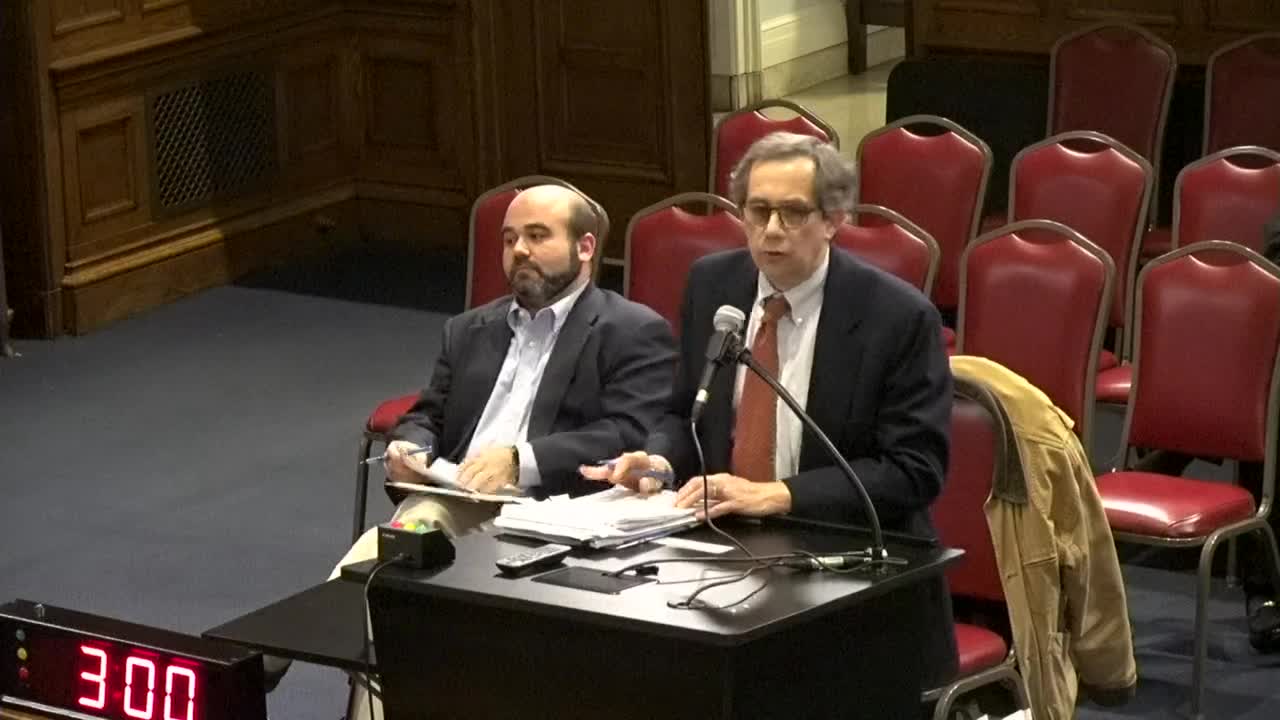
Outside counsel Jim Catsafikas, an attorney at Perkins Thompson representing the city, told both bodies that voters approved a charter amendment requiring the council to establish an ethics commission and later adopt a code of ethics. "In November of 2022, the Charter Commission, proposed to the voters, and the voters accepted ballot measure ballot question 8," Catsafikas said, explaining that the charter change is located in Article 8 and directs the city to create an ethics commission ordinance first, and then a code of ethics the commission would administer.
Why the debate matters: the workshop centered on whether the commission should adjudicate complaints involving employees who are already covered by existing personnel policies, collective bargaining agreements and constitutional employment protections — specifically the city manager, corporation counsel, city clerk and the school superintendent. The draft ordinance circulated November 24, 2024 would form a seven‑member commission; school officials say the school board would nominate at least three names for initial appointments so the school side has representation in shaping the code.
School district counsel Aga Dixon of Drummond and Wissom, retained by Portland Public Schools, said the November draft reflects a shared, practical approach by the lawyers to make the ordinance workable alongside existing personnel systems. "The November 2024 draft that was presented to you all is is that consensus," Dixon said, adding that the district’s aim is implementation that respects personnel procedures, grievance processes and due‑process guarantees.
Several council members and board members raised legal and practical concerns. Catsafikas and other counsel warned that classifying the city manager, corporation counsel and city clerk as outside the employee protections in personnel rules could create legal exposure and complicate recruitment. Catsafikas noted the city’s nonunion personnel policy lists those three positions as city employees and recommended handling employee grievances through established personnel channels rather than the new ethics commission. Councilor Sykes read into the record the charter’s carve‑out language, emphasizing it requires that "complaints regarding city employees ongoing or prior alleged violations or misconduct shall be referred to the city for appropriate action under its personnel policies." Sykes argued the charter language supports keeping employment matters within personnel systems.
Board members asked how the commission’s advisory opinions and public decisions would interact with confidential personnel investigations, and whether a single code could account for differences in the school context where dispute dynamics — for example those involving student‑related matters — sometimes differ from other municipal matters. Several participants suggested the commission could draft a code that both bodies adopt or that the council and school board adopt parallel codes to preserve necessary confidentiality and due process protections.
Two procedural motions were taken at the start of the meeting so the bodies could meet jointly and permit public comment on the council's schedule: a motion to suspend the rules to allow the joint workshop, moved by Councilor Sykes and seconded by Councilor Bullitt, and a motion to suspend the rules regarding public comment, moved by Councilor Sykes and seconded by Councilor Bullock; both motions passed unanimously.
Next steps: corporation counsel advised the ordinance has already had prior readings and public comment at an earlier hearing and that the council may accept amendments and schedule the ordinance for a future vote after additional drafting. Participants agreed the next phase is for the ethics commission, once appointed, to draft a proposed code of ethics for both bodies to consider; participants also discussed the option of incorporating a final code into personnel policies or collective bargaining where appropriate.
The workshop closed with no final vote on the ordinance itself; councilors indicated they will consider amendments (including one submitted by Councilor Sykes and Councilor Phillips that was noted in the meeting backup) and return the ordinance to an upcoming council agenda for public hearing and a decision.