Get Full Government Meeting Transcripts, Videos, & Alerts Forever!
Get email alerts on the Transportation topic
No spam. Unsubscribe anytime.
Residents, bicycle advocates urge Portland to adopt Vision Zero resolution for safer streets
Summary
Multiple public commenters at the Jan. 6 Portland City Council meeting urged the city to adopt a Vision Zero resolution and create institutional capacity for bicycle and pedestrian safety, including a complete streets board and a dedicated sustainable transportation manager.
Several Portland residents and advocates used the Jan. 6 public comment period to press the City Council to adopt a Vision Zero commitment and strengthen city capacity for safe walking and bicycling.
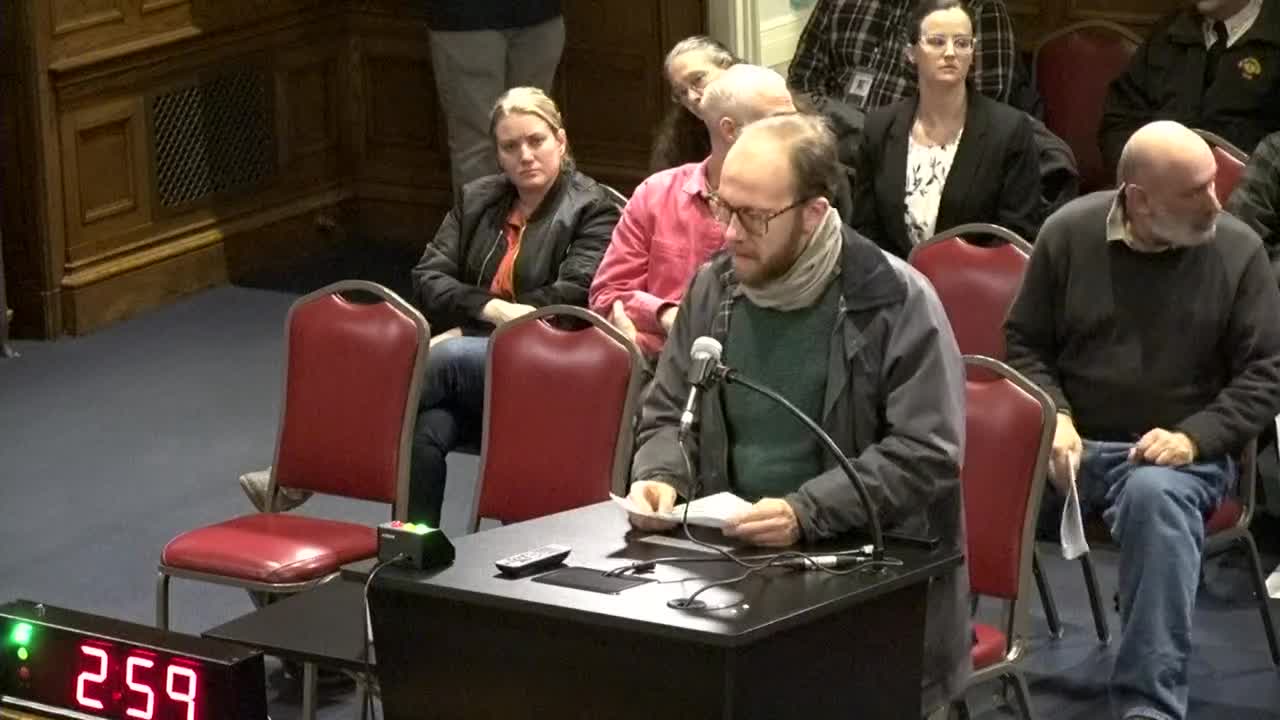
Winston Lumpkins, introduced himself as a resident of District 1 and past chair of the Portland Bicycle and Pedestrian Advisory Committee, said the committee’s five priorities for 2025 emphasize shifting planning toward safety and accessibility rather than prioritizing automobile speed. “We need to shift our thinking and planning to value safety and accessibility over sheer automobile speed,” Lumpkins said, urging adoption of the Greater Portland Council of Governments’ Vision Zero plan or a city companion policy, creation of a complete streets board, an update to the street design manual, and hiring a sustainable transportation manager.
Zach Peretz, of Hunter Street, also urged the council to adopt a Vision Zero resolution, describing Vision Zero as a municipal commitment to reduce traffic fatalities to zero and stressing that “your resolutions matter. They establish the principles and values that guide policy, plans, and projects.” Peretz listed multiple U.S. cities and international jurisdictions that have adopted Vision Zero approaches.
Bill Weber, representing the Portland Climate Action Team (PCAT), said the city’s 2019 resolution declaring a climate emergency and subsequent 1 Climate Future Climate Action Plan set interim goals to reduce greenhouse gas emissions by 35% by 2030 — a target he said the city appears unlikely to meet. He urged councilors to use the upcoming Sustainability and Transportation Committee public comment session to strengthen actions to meet that 2030 interim goal.
Why it matters: Speakers tied street safety to public‑health, climate and economic outcomes — arguing that safer, slower streets reduce fatalities and can enhance local economic activity — and they asked the council to formalize commitments that will shape future transportation planning and projects.
Council response: The council did not deliberate on a Vision Zero resolution at this meeting; speakers asked the Sustainability and Transportation Committee and the full council to consider formal adoption and to expand staff capacity to implement street‑design and bicycle/pedestrian priorities.