Get Full Government Meeting Transcripts, Videos, & Alerts Forever!
Get email alerts on the Solid Waste Master Plan topic
No spam. Unsubscribe anytime.
Solid-waste subcommittee reviews master plan, landfill and recycling contracts, and compost pilot
Summary
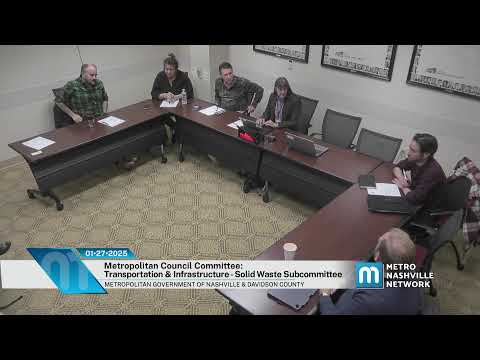
Members of the Transportation & Infrastructure Committee’s Solid Waste Subcommittee discussed the county’s 10-year solid waste master plan, recycling and composting capacity, upcoming hauling and processing contract expirations, and next steps for department structure, transparency and pilot-program funding.
At a meeting of the Transportation & Infrastructure Committee’s Solid Waste Subcommittee (date not specified), the chair opened by noting the group’s purpose and asked staff to summarize the county’s 10-year solid waste master plan and current services.
The subcommittee heard a presentation from Jen Harmon, a Metro Waste Services presenter, who summarized the plan’s history and key targets and described current programs and infrastructure. “The main goal is really diversion. It’s 90% diversion from landfill,” Harmon said, summarizing the plan’s “zero waste” definition and priority areas: increasing recycling, recovering food waste, expanding composting, and diverting construction and demolition material.
Why it matters: subcommittee members said the city is approaching a short window to resolve disposal and processing capacity. Members raised imminent contract expirations and limited local infrastructure as immediate operational and budgetary questions that affect service reliability, costs and where residents’ trash and recycling are ultimately processed.
Most important facts
- Legal and planning context: Harmon said state rules administered by the Tennessee Department of Environment and Conservation (TDEC) require each solid waste region to maintain a 10‑year solid waste management plan; Davidson County acts as its own region and must submit an annual progress report to TDEC. Harmon traced the plan’s development from a 2017 waste-characterization study through board approval in December 2019, TDEC approval in early 2020 and Metro Council adoption in 2021.
- The master-plan goal: The plan defines “zero waste” as 90% diversion from landfill and prioritizes recycling, organics recovery (food and yard waste), construction and demolition (C&D) diversion, and public education.
- Waste composition (2017 characterization, municipal solid waste by tonnage): paper and organics together are the largest portions of the municipal solid waste stream; plastic was cited at about 16.4% and C&D at about 12.2% of municipal solid waste. Harmon noted the study covers municipal solid waste (household and many commercial streams) and that C&D sometimes ends up in MSW landfills despite regulations.
- Current services and contracts: Harmon outlined Metro Waste Services infrastructure: four staffed convenience centers (accepting recyclables, electronics, tires, scrap metal, mattresses and food waste), seven recycling drop-off sites (unstaffed), curbside collection in the Urban Services District (USD) and a pilot curbside food-scraps collection program serving roughly 731 households. Metro’s disposal contract sends collected waste via a local transfer station (contracted to Republic Services) to Murfreesboro; curbside recycling is processed under a contract with Waste Management (WM), which presently accepts a limited range of plastics and does not accept curbside glass.
- Pilot programs and counts: Harmon reported about 144,000 trash customers and about 112,000 recycling customers in the city’s curbside system and said the food-scraps pilot (initially 750 households, now reporting 731 participating households) has collected a substantial amount of material (the transcript lists the collection figure as stated by staff; unit not specified). The pilot was funded initially by a private donation and later by a TDEC organics-management grant to extend the program through the fiscal year.
Questions and operational concerns
Council members and department leaders discussed convenience-center access and distribution (several members said centers are concentrated on the east side and less convenient for west-side residents), the need for audits or updated waste-characterization work, and whether Metro should invest in local processing infrastructure rather than relying entirely on private contractors. Council member Bradford said convenience-center distribution is a frequent constituent complaint and asked whether Metro has studied the cost and feasibility of operating more or improved centers.
Richard Thurman, identified in the meeting as Director Richard Thurman, said standing up a dedicated waste services department and seeking capital for infrastructure would be part of the next budget cycle. “I think...the decision and the commitment by this council and the administration to kinda develop a department and kinda go in that direction,” Thurman said, describing an intention to request positions and capital to support enforcement and operations.
Contract timing and regional options
Members repeatedly raised the timing of major contracts: the chair and staff said both the county’s disposal (hauling/transfer) and recycling-processing contracts run toward expiration in 2027 (two years from the meeting), creating urgency for planning. Members discussed regional solutions and said neighboring jurisdictions, including Murfreesboro, also face capacity constraints; one member asked whether incineration or other technologies used abroad should be considered. Staff cautioned that building local landfill capacity takes many years and noted that transfer stations and recycling processing facilities are often exempt from site‑notification rules that apply to landfill siting in Tennessee (referred to in the meeting as Jackson Law).
Compliance, contamination and customer communications
Subcommittee members and staff discussed enforcement and customer-notification systems for contamination or rejected carts. Council member Parker urged establishing a clear notification and escalation process (for example, reporting and remedial steps when recycling is contaminated or a cart is repeatedly left at the curb). Staff said enforcement and compliance functions are a gap in current structure and recommended adding compliance officers and supervisors to support notifications, fines and container management.
Processing capacity and ownership questions
Members debated whether Metro should build or partially own recycling-processing capacity to reduce dependence on a single private contractor and to incentivize broader material acceptance (more plastics, glass). Staff noted incremental approaches are possible (co‑located transfer and processing facilities, brokered material from convenience centers) and that capital requests will be considered in the department build-out.
Transparency and public education
Members repeatedly requested clearer public reporting on where recyclables and compostables go and how they are processed, saying better transparency would increase public trust and participation. The chair asked staff for a short, digestible summary the council can use to explain destinations for recyclables, who processes them, and basic program metrics.
Next steps and follow-up
The subcommittee tentatively scheduled a reconvening in March (on a standing-committee day) and requested several staff follow-ups: a one-page briefing on where curbside recycling is processed and what happens to common materials; a budget estimate for sustaining and scaling the food-scraps pilot; and coordination to schedule tours of local compost and recycling processing facilities. The group also discussed meeting cadence and agreed to meet roughly every other month unless urgent items arise.
Ending
The meeting closed after roughly an hour of discussion with the chair thanking staff and asking the department to deliver the requested briefings and tour options. No formal motions or votes were recorded during the session.