
Board approves project labor agreement for Bracker Elementary after hour-long debate
Get AI-powered insights, summaries, and transcripts
Sign Up Free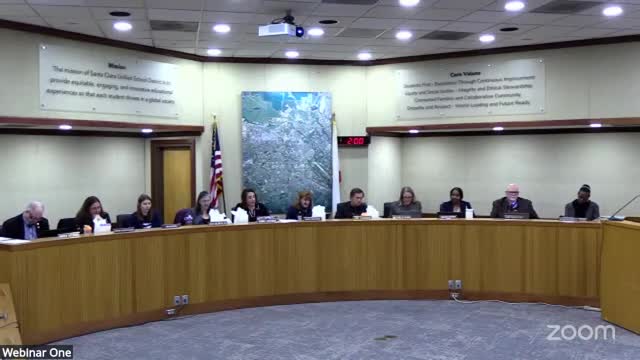
Summary
The Santa Clara Unified School District Board of Trustees approved a pilot project labor agreement for the Bracker Elementary construction project in a 6–1 vote after staff described negotiated provisions and trustees and union representatives discussed local hire, bid protections and oversight mechanisms.
The Santa Clara Unified School district board on Jan. 23 approved a project labor agreement (PLA) for the Bracker Elementary School construction project, voting to adopt the pilot contract 6–1.
The PLA will govern terms for labor on the Bracker construction project identified by district staff as the pilot. Chief Business Officer Mark Scheel told the board the agreement was developed collaboratively with the San Mateo–Santa Clara Building Trade Council and was intended to be a pilot tailored to the district’s needs.
Why it matters: a PLA can change how a public-construction contract is run, affecting who bids, worker pay and benefits, apprenticeship and local-hire commitments, and dispute procedures. Trustees said the district must balance these potential benefits against cost and bidder competition.
Scheel, presenting the agreement, framed it as co‑crafted rather than litigated. He said the PLA includes explicit project definitions, language to allow cooperative buying ("piggyback") contracts where appropriate, contingency steps if no bids are received, and a joint administrative committee to monitor implementation. Scheel said the committee would include representatives from the trade council and the district and that the superintendent is the designated tie-breaker for certain committee decisions.
"We're not here to work against you. We're here to work with you," David Beeney, executive director of the San Mateo–Santa Clara Building Trades Council, told the board during public comment, urging approval and describing apprenticeship and curriculum supports to benefit students.
Union members who addressed the board described family and scheduling benefits from local work. "If you would help us out, you know, it would be a big opportunity," insulator Matthew Flores said. Emmanuel Zendejas of Local 104 said local work and prevailing wages help families remain in the area.
Trustees praised parts of the agreement but disagreed about whether it secured enough enforceable, measurable benefits for residents. Trustee Watanabe and others said they supported the PLA because it can increase local hiring, provide living wages and support apprenticeship pathways; Trustee Muirhead praised the district’s collaborative approach. Trustee Roderman said she was initially skeptical but appreciated provisions that connect students to careers in construction.
Trustee Ryan said the PLA "is not, in my opinion, ready for approval" because it lacks specific, enforceable guarantees he said were promised by labor partners—such as explicit rebid authority or contractual caps tied to engineering estimates, mandated percentages of hires from district families, and required apprenticeship slots for local students. Scheel and other staff acknowledged those limits and described the agreement as a pilot; Scheel said the district retains public-contract-code protections including the ability to reject bids if necessary.
After public comment and extended trustee discussion, Trustee Fairchild moved to approve the PLA and Trustee Muirhead seconded. The board approved the agreement in a roll-call vote the chair announced as 6–1, with Trustee Ryan expressing the principal no vote in debate and staff recommending implementation of the PLA as a pilot.
The PLA includes: - A jointly chaired administrative committee (district and trade council representatives) with the superintendent named as tie‑breaker for specified decisions. - Language allowing cooperative buying/piggyback contracts under conditions negotiated with the trade council. - A procedure for addressing scope items with no bidders and steps for rebidding or alternative approaches. - Provisions mentioning local employment preference, apprenticeship pathways and veterans employment as program goals, and commitments to avoid work stoppages. - A retention clause revised during drafting (language changed from "shall" to "may" in at least one provision to address district concerns).
Next steps: staff will incorporate the PLA into contracting for the identified Bracker Elementary project and report back on implementation as this pilot proceeds. Trustees asked staff to track costs, negotiation hours and legal expenses associated with the PLA and to return with empirical results if future PLAs are proposed.
"I'm happy with the agreement that is in front of you this evening," Scheel said during discussion, adding that the district team entered the talks as a learning pilot.
The board vote to approve the PLA was recorded as: mover Trustee Fairchild; second Trustee Muirhead; outcome: approved (tally: yes 6, no 1).