Get Full Government Meeting Transcripts, Videos, & Alerts Forever!
Get email alerts on the Solid Waste Recycling topic
No spam. Unsubscribe anytime.
Recycling Associates outlines proposed Star Drive recycling and MSW transfer facility; residents raise PFAS, traffic and river concerns
Summary
At a Jan. 21 conceptual hearing, Recycling Associates and its development team described plans for two warehouses and a possible railroad spur at Star Drive. The Planning Board took no formal action; residents and board members pressed applicants on PFAS handling, truck traffic, shoreland buffers and potential rail crossing timing.
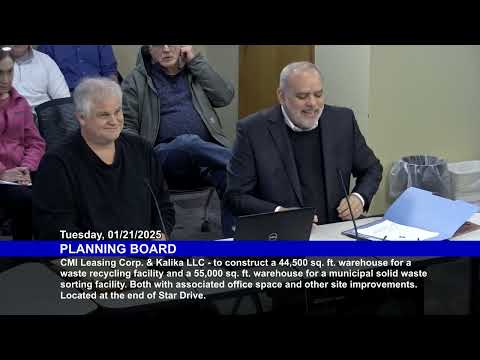
Recycling Associates and its development team described a preliminary plan on Jan. 21 to build two industrial warehouses at the end of Star Drive in Merrimack — a roughly 44,500-square-foot building proposed for recycling operations and a roughly 55,500-square-foot building for municipal solid waste (MSW) sorting and transfer — but no approvals were sought or granted at the Merrimack Planning Board meeting.
The conceptual presentation by the applicant’s attorney and consultants outlined a multi-step permitting path that will include a petition this week to the New Hampshire Department of Transportation for a railroad crossing, a likely zoning review (because recycling and municipal solid waste uses are not specifically listed in the I-1 district), and an extended solid-waste permitting process with the New Hampshire Department of Environmental Services (DES) that the applicant estimated could take one to two years if DES is inclined to approve the use.
Board members, abutters and elected officials focused on environmental and community impacts: whether PFAS (also called PFOA in public comments) could be kept off-site, how odor and birds would be controlled at an open-air transfer building adjacent to the Merrimack River and an aquifer protection district, and how 150–250 MSW truck trips a day would affect Star Drive, D.W. Highway and nearby neighborhoods and parkland.
The applicant team said the two parcels under agreement would be reconfigured by a lot-line relocation, producing a northern lot for Recycling Associates’ operations and a southern lot that could host the MSW transfer building or be offered for sale if MSW permitting fails. The team showed a preliminary layout with separation of tractor-trailer circulation from passenger vehicles, stormwater basins proposed on the river side of the site, and a potential railroad siding or spur into the MSW building to load out compressed or baled material for transport by rail to out-of-state destinations.
“We’re out of space,” said Michael Valucci, identified in the presentation as vice president of Recycling Associates, describing the company’s move from Nashua. Valucci told the board the company currently employs about 35 people, operates two shifts and runs about eight company trucks; the proposed MSW transfer operation would serve municipalities and independent haulers and the applicant estimated roughly 150–250 MSW truck arrivals per business day (the recycling operation would generate a smaller truck load). Valucci said the applicant intends to operate the MSW transfer only during daytime hours — roughly 6 a.m. to 5 p.m. — and that open-top roll-off trucks use tarp systems and are required to cover loads when they travel.
The applicant said DES staff recently provided guidance on the solid-waste permitting path and that DES staff described the solid-waste review as taking “between a year [and] two years” if approved. The team also said it would file a crossing petition with DOT this week; DOT will notify CSX and other interested parties and the crossing process — if it moves forward — will include design review under DOT oversight.
Board members and neighbors pressed specifics that would be needed in a formal application. Questions included whether composting or other open-air operations were planned (the applicant said composting would require more detailed study and could be added later), whether floor drains or leachate controls would be installed (the applicant said engineering studies are still to be determined and Ares Engineering would advise), and whether odor-control and bird/rodent controls would be effective for an open-air transfer building (the applicant described industrial dust/odor controls and rapid loading to rail as key mitigations and offered to arrange site visits to comparable operations).
Public commenters and a state representative who lives nearby raised the project’s proximity to the Merrimack River, an aquifer protection district, Sklar Park and a nearby elementary school and organic farm. Several written comments read into the record urged rejection, citing concerns about aquifer contamination, odors and a history of contamination in the region. One resident asked whether the town would become “the terminal” for out-of-state trash; the applicant said its goal is to pull recyclables out of the waste stream and to transport residual MSW out of state by rail to reduce local disposal.
Board members emphasized the conceptual nature of the presentation. Planning staff told the board that the meeting was information-gathering only and that there would be no motion or vote on the concept tonight. The board chair said staff would likely evaluate whether the proposal has regional impact and, if so, notify neighboring communities accordingly at a later application stage.
What’s next: the applicant will pursue the DOT crossing petition, coordinate required DES reviews (shoreland, alteration of terrain and solid-waste permitting), and return to the Planning Board with site plans and a lot-line relocation if zoning and state permits progress. Board members asked the applicant to expect detailed studies on traffic, hydrogeology, stormwater and wildlife habitat (including consultation with New Hampshire Fish and Game and the Natural Heritage Bureau for possible eagle habitat), and to provide examples of comparable MSW transfer operations for the board’s site visits.
The Planning Board did not vote on the project at the Jan. 21 hearing. The conceptual hearing record includes the petitioner’s filings and the public comments read into the record; formal permitting, site plans and public hearings will follow if the applicant files a complete application.