Get Full Government Meeting Transcripts, Videos, & Alerts Forever!
Get email alerts on the Criminal Evidence topic
No spam. Unsubscribe anytime.
Court weighs admissibility of prior threats and a video of the decedent in State v. Gibson
Summary
The Court of Criminal Appeals heard argument in State v. Antonio Gibson about the exclusion of investigator testimony about threats and a video showing the decedent with a handgun, which defense counsel said corroborated a self‑defense claim.
The Court of Criminal Appeals heard arguments in State of Tennessee v. Antonio Gibson over whether the trial court improperly excluded evidence defense counsel said corroborated a self‑defense claim: (1) investigator testimony recounting threats the decedent allegedly made, and (2) a video the defense described as showing the decedent ‘‘showing off’’ a handgun.
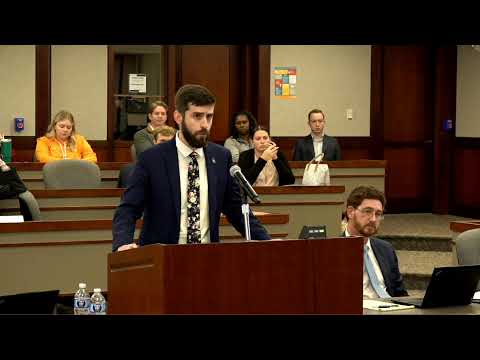
Appellant counsel Joshua Hedrick said the excluded investigator testimony would have corroborated contemporaneous statements the decedent allegedly made to the victim’s girlfriend and would have strengthened the girlfriend’s account at trial. Hedrick acknowledged the record lacked a contemporaneous offer of proof when the investigator was excluded, which limited appellate review, but he argued the trial court erred in ruling before hearing the proffered testimony. Hedrick also pressed that a video (described in the record as showing the decedent carrying or “showing off” a gun in his waistband) was admissible to corroborate Gibson’s account that the decedent had a handgun and that Gibson reacted because he reasonably believed the decedent was about to draw.
Assistant Attorney General Garrett Ward told the court the record does not contain the investigator’s proffered testimony and that many of the alleged threats were later presented to the jury through other witnesses and through text messages introduced into evidence; he argued any incremental corroborative value was therefore diminished or harmless. On the video, Ward relied on Frasier (noted in briefing) and argued the defense had not shown the video’s probative value overcame its potential irrelevance: Frasier and related authorities weigh against giving months‑old footage showing a person carrying a firearm generalized relevance to the events that led to the shooting, absent proof the prior conduct tended to show the victim’s role as first aggressor or a distinctive method of carrying that made the footage specifically probative.
Hedrick responded that counsel repeatedly told the trial court the video corroborated the defense by showing the decedent’s manner of carrying and that trial counsel explicitly urged the video was admissible as corroboration of self‑defense. Both sides acknowledged the appellate record does not contain the video itself; Hedrick asked the court to consider the contemporaneous in‑court discussion describing the footage and argued exclusion deprived the jury of relevant corroboration.
Judges questioned counsel about the absence of an offer of proof for the excluded investigator testimony and about whether a harmless‑error analysis is possible without the video in the record. The court also discussed Ruane‑style corroboration doctrine (as cited by defense) and Frasier as the state’s leading relevancy precedent. No decision was issued at argument.