Get Full Government Meeting Transcripts, Videos, & Alerts Forever!
Get email alerts on the Criminal Procedure topic
No spam. Unsubscribe anytime.
Tennessee Court of Criminal Appeals hears arguments on suppression and forfeiture in State v. Flamini
Summary
The Court of Criminal Appeals heard argument in State of Tennessee v. Michael Flamini over whether evidence seized during a traffic stop should have been suppressed and whether later forfeiture evidence was improperly used at trial.
The Court of Criminal Appeals heard argument in State of Tennessee v. Michael Flamini over whether evidence seized during a traffic stop should have been suppressed and whether later forfeiture proceedings were improperly used at trial.
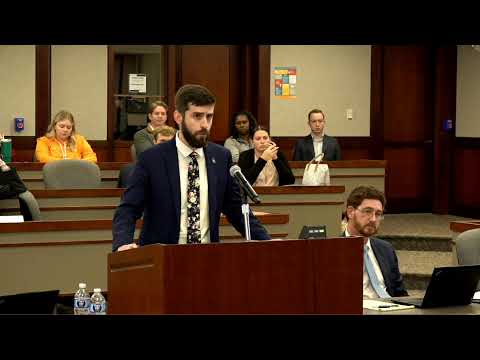
Appellant counsel Jonathan Harwell told the three-judge panel the key Fourth Amendment question was “pulling out of the car, holding on to him, putting the handcuffs on him, and the pat frisk,” and argued those steps happened “before the officer testifies he sees the suspicious item in the seat of the car.” Harwell said the state never argued plain‑view at trial and that the state’s theory on appeal (search incident to arrest) represented a new, post‑trial theory not supported by the suppression‑hearing evidence. He also argued the arresting officer did not attempt to verify Flamini’s identity before handcuffing him, undercutting the state’s claimed exception to the cite‑and‑release statute referenced in briefing.
Assistant Attorney General Garrett Ward responded that the initial stop and asking the driver to step out were lawful and that circumstances (an occupant recently released from prison, lack of identification, and the officer being alone on scene) supplied a reasonable‑suspicion officer‑safety justification for a frisk. Ward told the panel that the record also supports an objective finding of arrest once Flamini was handcuffed, invoking the search‑incident‑to‑arrest exception and Tennessee precedents that examine whether objective factors “meet the standard for what constitutes an arrest.”
On the forfeiture issue, Harwell said the prosecutor introduced evidence that an $880 cash seizure later was forfeited by the Department of Safety and that the jury was told Flamini could have sought return of the money but did not; Harwell argued that use of that later administrative forfeiture improperly allowed the jury to infer guilt and that silence after Miranda warnings cannot be used as substantive evidence. Ward countered that defense cross‑examination opened the door to inquiry about the officer’s investigation and that some related evidence (text/exhibit references in the record) and later witness testimony lessened any prejudice; he also argued the defense chose not to recall the investigator after the trial court said that option was available.
The panel asked detailed questions about (1) whether the pat frisk was supported by specific, articulable facts that justified officer safety measures, (2) whether handcuffing created an objective arrest for search‑incident purposes even if the officer subjectively intended only an officer‑safety restraint, and (3) the procedural consequences of the state advancing a different justification on appeal than it advanced in the trial court. Both sides acknowledged the record contained body‑cam footage and that the court could view it while considering the appeal.
The judges reserved further questions and signaled they would consider the parties’ briefs and the record, including the body‑cam footage, in deciding whether suppression or exclusion of the forfeiture evidence was required. No decision was announced at argument.
Evidence and procedural details referenced at argument include the officer’s body camera, testimony about an $880 cash seizure and an administrative forfeiture order, and disagreement over whether the officer sought Flamini’s identity or relied on exceptions to the cite‑and‑release statute.