Get Full Government Meeting Transcripts, Videos, & Alerts Forever!
Get email alerts on the Water Infrastructure topic
No spam. Unsubscribe anytime.
Council directs engineering firm to propose Market Street water-line replacement as leaders weigh OPWC loan
Summary
Council discussed a multi-pronged plan to replace aging water mains, pursue Ohio Public Works Commission (OPWC) financing and map the village’s distribution system; a motion was made directing engineering firm B3 to draft a proposal for Market Street 4‑inch line replacement, but no formal roll-call vote is recorded in the transcript.
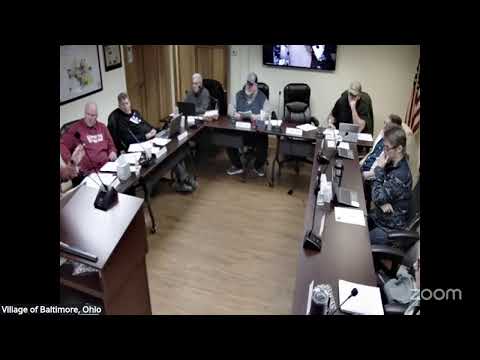
Village of Baltimore council members discussed urgent water system repairs and financing options at their meeting, including a motion to have the village’s engineering firm prepare a proposal to replace failing 4‑inch water mains on Market Street.
Council members and public works staff emphasized the age and failure rate of local lines and described a plan to pursue OPWC (Ohio Public Works Commission) loans to accelerate replacements. The council asked staff to get a cost estimate, an amortization schedule and to schedule a meeting with B3 (the village’s engineering consultant) to define priorities and project cost. A motion “to direct B3 to to make a proposal to replace the Market Street 4 line” is recorded in the transcript; the record does not show a formal roll-call vote on that motion.
Why it matters: speakers said many of the village’s water lines date to the early 1900s and have had repeated breaks; accelerated replacement would reduce emergency repairs, service interruptions and public‑health risk from line failures. Councilors discussed using OPWC financing now and applying tax/capacity fees later to cover payments.
What council and staff said: - Public works staff described repeated breaks and said the 4‑inch mains serve sections of town that have had multiple failures; one council member said the lines “were put in about the 1930s” and are approaching 100 years old. - The village administrator and others outlined OPWC terms they researched: a 20‑year amortization example at 2.21% and a 30‑year example at 2.46% (described in the meeting as the financing scenarios to consider). Staff recommended calculating the annual debt service and comparing that to projected capacity/tap fee receipts. - Council asked that B3 produce a scope and cost estimate and that staff schedule a meeting with B3/Crane to review options (transcript: “I'm gonna set up something in Crane to come down here maybe next Wednesday”).
Actions and next steps: staff will ask B3 for a written cost estimate and an annual debt‑service calculation; the council directed staff to set a meeting with B3/Crane to review project scopes and priorities. The transcript records the motion to direct B3; it does not show a formal recorded vote on that motion.
Context and constraints: speakers repeatedly cautioned that OPWC loan repayment rules limit partial prepayments (an attendee reported the agency requires either the scheduled periodic payment or full payoff, not ad hoc partial payments). Councilors discussed sequencing replacements by criticality (8‑inch mains first where already started, then 4‑inch feeders) and mapping historic repairs to prioritize work.
What remains open: a formal vote on the B3 proposal was not recorded in the transcript. Staff said they would report back with cost estimates, an amortization schedule, and a recommended priority list at a future meeting.