Get Full Government Meeting Transcripts, Videos, & Alerts Forever!
Get email alerts on the Education Mtss topic
No spam. Unsubscribe anytime.
Cohoes board reviews districtwide MTSS rollout under Resource Allocation Review grant
Summary
The Cohoes City School District presented progress on a districtwide Multi‑Tiered System of Supports (MTSS) effort funded by a Resource Allocation Review grant, with two pilot schools, an outside consultant, and plans to standardize benchmarks, interventions and parent engagement.
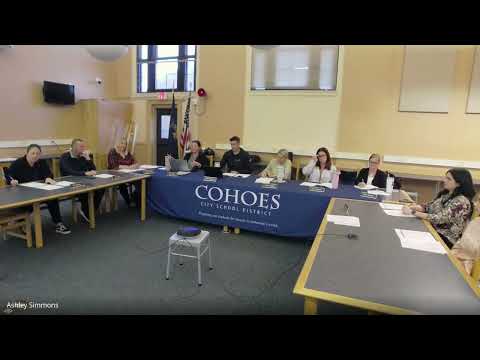
Superintendent O'Shea and district staff updated the Cohoes City School District Board of Education on the district's MTSS (Multi‑Tiered System of Supports) implementation at the Oct. 8 board meeting, saying the work is underway under a Resource Allocation Review (RAR) grant and that two schools are serving as pilots.
Rachel Marshall, director of MTSS, told the board the district has formed a districtwide MTSS team and has already held two district‑level meetings. "We officially have a district wide MTSS team. We started meeting. We've had 2 district level meetings," Marshall said, and noted the district contracted with Renee Brulier from Building Better Futures, who has worked with the MTSS Eye Center at SUNY Albany, to assist with implementation.
The presentation explained how the MTSS model will be used to align tiered supports to benchmark data. District staff recited the commonly used distribution for tiers: roughly 80% of students at Tier 1 (core instruction), about 10–15% at Tier 2 (targeted interventions) and about 5% at Tier 3 (intensive services). The district plans to standardize benchmark tools, citing iReady as one tool already in use for reading and math, and to set cut scores and protocols that determine when students enter and exit interventions.
Marshall described immediate next steps: staff will compare benchmark data across grade levels, pull the lowest percentiles into targeted intervention groups, and create schedules for interventionists. She said two pilot schools in the RAR grant—identified in the meeting as Avril and Lansing's (middle school)—will run initial data‑team cycles and smaller MTSS team meetings over the coming weeks.
Superintendent O'Shea and other staff also stressed that MTSS extends beyond academics to attendance and behavior. The district will review attendance thresholds and behavior referral data as part of placement decisions and intends to use social‑emotional screeners; at the meeting staff referenced the use of a "DESA SEO Screener" for social‑emotional competencies. The presenters said the MTSS work will include professional development so staff can implement interventions with fidelity, and that the districtwide team includes representatives from all buildings so findings from the pilots can inform a district rollout next year.
Board members asked about curriculum alignment, professional development and how the district will ensure equity across buildings. District staff said the initiative does not change the adopted curricula but focuses on ensuring interventions and AIS (Academic Intervention Services) align with district curriculum and research‑based practices. The presenters characterized the work as longer‑term system change supported by the RAR grant, and said cycles of data review will inform prescriptions for individual buildings.
Next steps identified at the meeting included additional meetings with data teams in the two pilot schools, continued benchmark data review and development of cut scores and intervention protocols to be rolled out districtwide.