Get Full Government Meeting Transcripts, Videos, & Alerts Forever!
Get email alerts on the Battery Storage Safety topic
No spam. Unsubscribe anytime.
State Fire Marshal briefs Kerr County on battery energy storage risks and local options
Summary
State Fire Marshal staff told Kerr County officials that NFPA standards require emergency plans, separation distances and inspections for large battery energy storage systems; commissioners discussed appointing a county fire marshal, water availability for responses and runoff containment.
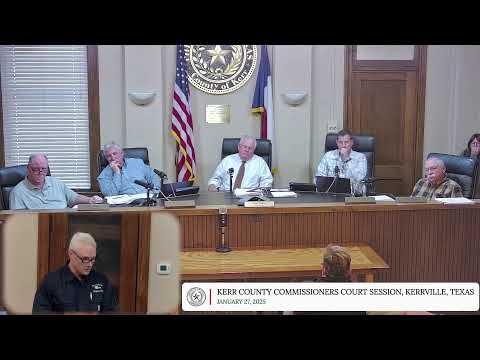
Deputy Chief Kelly Stalder and Chief Engineer Eric DeArmond of the Texas State Fire Marshal’s Office visited the Kerr County Commissioners Court on Jan. 27 to brief the court on fire-safety requirements for battery energy storage systems (BESS).
The presentation focused on NFPA 855, the standard the state adopts for BESS installations 20 kilowatt-hours or larger, and what the county should expect if large utility-scale storage is proposed in or near the county.
Why it matters
Commissioners and staff said the county is fielding inquiries about large battery storage proposals in the region. Kerr County has limited municipal water supply in many rural areas; commissioners raised concerns about how water used to fight a BESS fire would be stored and contained — both for firefighting effectiveness and for protecting groundwater and the Edwards aquifer.
What the state fire marshal said
- NFPA 855 applies to battery electric storage systems at or above 20 kilowatt-hours; the standard calls for emergency operations plans, inspections, functional testing and requirements to limit spread if a thermal runaway fire occurs. Kelly Stalder said most systems meet the threshold for the standard and that lithium-ion chemistries — the most common for utility-scale systems — pose distinct thermal-runaway risks.
- The standard requires facility operators to prepare emergency procedures for shutdown, de-energization, handling damaged equipment, and drills to ensure responders can follow the plan.
- The standard includes requirements for sprinkler and suppression systems and for on-site water or other water-supply arrangements where municipal supply is unavailable; Texas A&M and UT research on burn-test methods is ongoing and the state will consider alternate suppression approaches on a case-by-case basis with the authority having jurisdiction (AHJ).
Local authority and options
Stalder and DeArmond told the court that counties with populations below statutory thresholds may not adopt their own fire code in the same way larger counties or municipalities can, but a county may appoint a county fire marshal (or contract with a municipal fire marshal) and that appointed official could enforce standards the State Fire Marshal has adopted. Eric DeArmond said county-appointed fire marshals remain county employees; they are not state employees.
Commissioner and public concerns
Commissioners asked whether the county can require containment of firefighting runoff; staff said the NFPA emergency plan could include runoff containment, and the county could request and enforce that as part of facility approval or through the AHJ review process. Commissioners also noted wildfire risk and drought conditions in the county and stressed that required on-site water supplies could be costly and should be defined by engineering calculations tied to system size.
What the court decided
The court used the presentation to ask questions of the State Fire Marshal's Office and to note concerns for future projects. The county did not adopt any new local regulations at the meeting. Commissioners and staff said they will ask to be notified early about any proposed BESS projects and may request plan reviews and third-party engineering reviews when proposals are filed. A draft state-level bill (House Bill 1378, 89th Legislature) was noted by the presenter; that proposal would enlarge required minimum separation distances in statute.
Ending
The State Fire Marshal’s staff said they are available to consult with county staff as proposals arise. Commissioners said they want early notification of siting requests and will consider options — including appointing a county fire marshal or contracting with a municipal AHJ — to ensure code enforcement and public-safety planning.