Get Full Government Meeting Transcripts, Videos, & Alerts Forever!
Get email alerts on the Education Space Hamradio topic
No spam. Unsubscribe anytime.
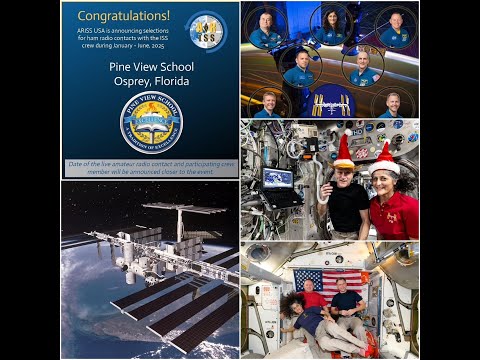
Pine View students speak live with astronaut Suni Williams during ham-radio contact
Summary
Students at Pine View School in Osprey held an approximately 11-minute live ham-radio conversation with NASA astronaut Commander Suni Williams aboard the International Space Station, part of an ARISS contact organized with local amateur radio clubs and school staff to support STEM learning.
Students at Pine View School in Osprey, Florida, spoke live with NASA astronaut Commander Suni Williams during an amateur-radio contact that lasted about 11 minutes and linked the school's auditorium to the International Space Station.
"Students at Pine View today, you are making history," said Dr. Steven Covert, principal of Pine View School, as the program began. The contact was arranged through the Amateur Radio on the International Space Station (ARISS) program with technical support from the Tamiami and Fort Myers amateur radio clubs and school staff.
The event combined a short technical briefing, prepared student questions and a live question-and-answer segment. Marie Rosander, Pine View's science teacher who led the school's NASA Space Club, told the audience the effort began when "it started with 2 students" who asked to form the club. Students asked questions about life and work on the station, including how microgravity affects the human body and what a rocket launch feels like.
Commander Suni Williams, speaking from the ISS, answered several student questions. She described early effects of microgravity: "As soon as you get to space, it starts to have an effect on you. Things are a little bit weird because your balance is not quite there." On advice for young people, Williams said: "Ask questions. Ask as many questions as possible. Don't ever be satisfied with, I I don't know." The contact included explanations of daily life on the station, ongoing experiments such as growing stem cells in microgravity, and an upcoming spacewalk mentioned by Williams.
Organizers gave students and the audience a brief explanation of ham-radio operations and emergency uses. Volunteers explained the ground station uses directional antennas and Doppler-shift corrections to track and maintain contact with the ISS, and that the school's new call sign is W4PVS. The technical team said the ARISS contact window was timed to the station's pass directly overhead and that the antenna array and computer-controlled rotator on the school roof were used to maintain the link.
Local amateur-radio volunteers who supported the event included members of the Fort Myers Amateur Radio Club and the Tamiami Amateur Radio Club; volunteers named in the event included Brian (Fort Myers Amateur Radio Club), Paul, Steve and others who set up radios, backup power and antennas. Rosander and staff said students also participated in technician-license training; organizers noted the technician exam is free for people under 18 in the program and that some students have earned licenses.
The assembly closed with school and volunteer recognition and plans to continue ham-radio activities at Pine View. Organizers said the contact and the supporting equipment and training will enable future amateur-radio events from a station that will be installed in a school building.
No formal votes or policy actions were taken during the assembly; the event was an educational program and public demonstration rather than a governing-body meeting.