Get Full Government Meeting Transcripts, Videos, & Alerts Forever!
Get email alerts on the Workers Compensation topic
No spam. Unsubscribe anytime.
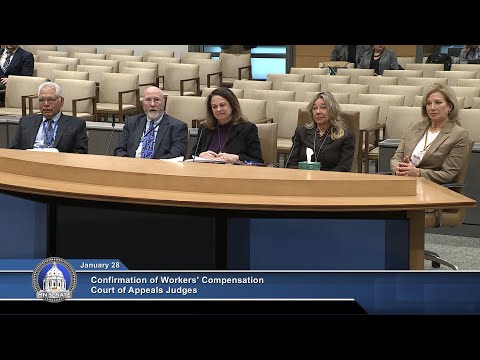
Senate Labor Committee recommends confirmation of four judges to Workers' Compensation Court of Appeals after court overview
Summary
The Senate Labor Committee recommended to the full Senate the confirmation of Chief Judge Patricia J. Millen and three colleagues to the Workers' Compensation Court of Appeals after an agency overview and introductions; the committee recorded the motion as carrying unanimously.
The Senate Labor Committee recommended to the full Senate the confirmation of Chief Judge Patricia J. Millen and judges Deborah K. Sundquist, Thomas J. Christiansen and Catherine H. Carlson to the Workers' Compensation Court of Appeals (WCCA) after the judges introduced themselves and Chief Judge Millen provided an overview of the court's history, jurisdiction and funding. The committee recorded the motion as carrying unanimously.
The WCCA, created by legislation identified in the record as 175 a in 1981, sits at the appellate level for Minnesota workers' compensation disputes. Chief Judge Millen told the committee the court has five judges who sit in different panels and has statewide jurisdiction to hear direct appeals from the Department of Labor and Industry, the Office of Administrative Hearings and arbitration proceedings. The court also has original jurisdiction to hear petitions to vacate settlement agreements. The WCCA’s operating budget, Millen said, is funded entirely from the workers' compensation fund and receives no general-fund or revolving-fund appropriations.
Nut graf: The confirmations follow a procedural introduction and a public overview intended to explain how the WCCA fits into the state workers' compensation system, the court’s caseload dynamics, and its budget source. Committee members used the opportunity to ask about caseload volume, recent changes in state case-management systems and the practical timeline for injured workers seeking benefits.
In her overview, Millen described the appellate path: an initial claim typically proceeds through the Department of Labor and Industry and, if litigated, to the Office of Administrative Hearings; dissatisfied parties may then appeal to the WCCA and, subsequently, to the Minnesota Supreme Court. She outlined the court’s personnel as five judges, five staff attorneys and two additional full-time employees and characterized the court’s operations as fiscally responsible.
Judges introduced professional backgrounds: Deborah K. Sundquist described prior practice representing Minnesota employers and leadership roles in the Minnesota Defense Lawyers Association; Catherine H. Carlson said she had 30 years representing both injured workers and employers across the state; Tom Christiansen and Sean Quinn summarized similar lengthy practice and court-service credentials and noted collegial panel work. Millen and several colleagues emphasized that the court’s panel structure fosters collaborative decision-making that addresses both legal and medical aspects of workers' compensation law.
Committee members asked several substantive questions. Senator Pratt asked whether updates to the Department of Labor’s case-management software (named in the record as Campus) and the Office of Administrative Hearings’ Ctrack system had affected filings before the WCCA. Millen said the court has worked with parties and the other agencies on e-filing and eservice, and that moving away from paper filings has created manageable challenges while improving access to the system. Millen noted that the court is redrafting data in the agency profile because file delivery methods have changed.
Senators sought information on caseload volume and timelines for claim resolution. Millen said the court’s caseload has “statistically gone down” and varies through the fiscal year; she offered to supply committee members with a printout of case volumes for periods of interest. Judge Quinn, who described a long practice representing injured workers, said a typical workers' compensation claim “from the beginning to the end” often runs about a year to a year and a half, though some cases can take longer; he explained that repetitive-trauma claims (referred to in the record as Gillette injuries) frequently require substantial medical proof and are often contested by insurers.
Committee procedure: Senator Dornick moved that the committee recommend confirmation of Millen, Sundquist, Christiansen and Carlson; the committee voted “aye” and the chair stated the motion carried unanimously. Members clarified that Judge Quinn’s reappointment paperwork had not yet been formally referred to the committee, so his name was not included in the motion; the committee said it would notify him he need not reappear when that paperwork is later moved.
Ending: The committee’s recommendation moves the four judges' nominations to the full Senate for consideration. Chief Judge Millen offered to provide additional caseload data to members on request.