Get Full Government Meeting Transcripts, Videos, & Alerts Forever!
Get email alerts on the Elections topic
No spam. Unsubscribe anytime.
Minnesota officials say 2024 elections ran smoothly overall but flag ballot‑proof, chain‑of‑custody issues
Summary
Secretary of State Steve Simon told the Senate Elections Committee on Jan. 28 that Minnesota’s three 2024 statewide elections produced high turnout and were largely low drama, while officials flagged localized ballot‑proofing errors, a chain‑of‑custody incident and results‑upload problems that will prompt new guidance and training.
Secretary of State Steve Simon told the Senate Elections Committee on Jan. 28 that Minnesota’s three 2024 statewide elections produced high turnout and were “low drama,” while officials flagged several operational problems the office and counties will address before 2026.
Simon, joined by Paul Linnell, the office’s director of elections, and Bill Ekblad, the state election security navigator, briefed senators on turnout, outreach, voting methods, voting‑system certification, post‑election audits and security supports for counties.
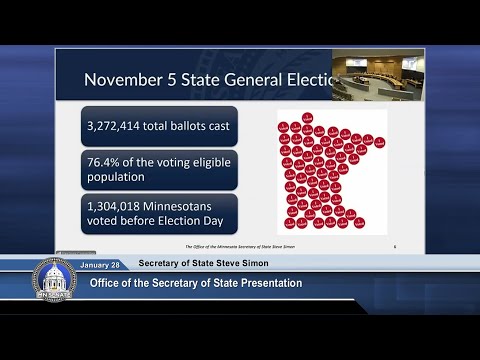
The presentation highlighted a 2024 general election turnout of 3,272,414 ballots — about 76.4% of the voting‑eligible population — and that more than 1.3 million ballots (roughly 39% of total votes) were cast before Election Day. Simon said the office and local partners registered roughly 99,000 permanent absentee voters and translated voter materials into multiple languages to assist precincts designated as language‑minority districts.
Why it matters: Minnesota’s high turnout and the state’s post‑election audits and recounts bolster public confidence in results, officials said, but recent localized errors underscore the need for clearer county guidance on ballot proofs, chain‑of‑custody procedures and results uploads.
What officials told the committee
Steve Simon, Minnesota secretary of state, said Minnesota again ranked near the top nationally in turnout and that the state’s outreach — including a large student mock election program and the Restore the Vote effort — expanded access. “We had high turnout and low drama,” Simon said, summarizing the year, and he credited tens of thousands of local election judges and county staff.
Paul Linnell, director of elections, walked senators through operational responsibilities at the state, county and municipal levels, the Statewide Voter Registration System (SVRS), voting‑system certification steps, public accuracy tests and post‑election reviews. He said four voting‑system vendors were certified for use in Minnesota and that the office will begin post‑election performance reviews of randomly selected counties next month.
Bill Ekblad, election security navigator, described outreach and training the office provided to county election and IT staff, tabletop exercises, county visits and partnerships with federal, state and nonprofit security partners. “See something, say something,” he said, describing the state’s effort to share timely information among counties.
Problems identified
Ballot proofs and vendor errors: Linnell told senators a handful of counties received incorrect ballot proofs from one vendor that the vendor later acknowledged was underresourced. County attorneys and election officials sought court remedy to correct printed ballots; the secretary’s office reviewed the vendor’s processes with the vendor and said corrective steps were identified.
Chain of custody and absentee processing: Linnell and other officials described a publicized incident in which sealed absentee ballot signature envelopes were temporarily left unattended while being transferred to a central counting location. County review found no missing or tampered envelopes in that case, but both counties and the Secretary of State’s Office called the incident unacceptable. The office said it issued reminders to counties about chain‑of‑custody practices and is exploring ways to standardize procedures.
Results upload and “100% reported” confusion: Several counties uploaded incomplete or incorrect results files on election night, which caused the public results page to show that a jurisdiction had reported when additional corrected or supplemental data was still required. Linnell said the office is looking at options to make the status display clearer and to add verification checks before upload.
Post‑election audits, recounts and contests
Minnesota requires hand‑count post‑election audits of selected precincts for governor/president, U.S. Senate and U.S. House contests; Linnell said those audits in 2024 affirmed that equipment counts matched hand counts within statutory thresholds (the post‑audit deviation threshold was tightened in a 2021 law change). The state canvassing board certified federal and multi‑county state contests Nov. 21.
Linnell and staff noted there were recounts and two election contests after 2024 (House District 40B residency and House District 54A absentee handling). The office said recounts and contests remain the statutory remedies for disputed results; if a losing candidate requests a recount within statute, state funding may cover it when the margin falls within the statutory threshold.
Outreach, accessibility and restored voting rights
The office described outreach and accessibility work: translations in Hmong, Somali, Spanish and other languages; online voter tools in 11 languages; a student voting program that included 439 schools and more than 131,000 student ballots; and Restore the Vote outreach after a 2023 law change that restored voting rights to over 55,000 Minnesotans who had left incarceration. Nicole Freeman, the office’s government relations director, said the office continues to coordinate with the Restore the Vote Coalition and corrections and probation partners to spread information and assist re‑entry organizations.
Questions from senators and next steps
Committee members pressed officials on several operational issues: how permanent absentee lists are maintained, verification of same‑day registrations and postcard returns, the effect of federal funding pauses on security grants, whether counties will be required to retain all materials through contest periods, and the effect of increased weekend absentee voting on smaller counties’ staffing.
Simon and Linnell said the office will provide required legislative reports and is open to clarifying statutes, rules and guidance on retention and chain‑of‑custody procedures. The office also said it will redouble outreach on ballot proofing, provide additional training for counties and explore display and verification changes to the election‑night reporting system.
Ending note: Office says most problems were limited and procedural
Office staff emphasized that the problems described were localized and that post‑election audits, recounts and contest processes validated election outcomes. Officials asked the committee for continued support for training and resources for county and municipal election administrators.