Get Full Government Meeting Transcripts, Videos, & Alerts Forever!
Get email alerts on the School Budget topic
No spam. Unsubscribe anytime.
Prior Lake-Savage Area Schools outline $4 million annual reductions; board and parents press for alternatives
Summary
Prior Lake-Savage Area Schools administrators told the board in a study-session presentation that the district must identify roughly $4 million in annual reductions starting in fiscal 2025–26 to address long-term fund balance declines and flat enrollment.
Prior Lake-Savage Area Schools administrators told the board in a study-session presentation that the district must identify roughly $4 million in annual reductions starting in fiscal 2025–26 to address long-term fund balance declines and flat enrollment.
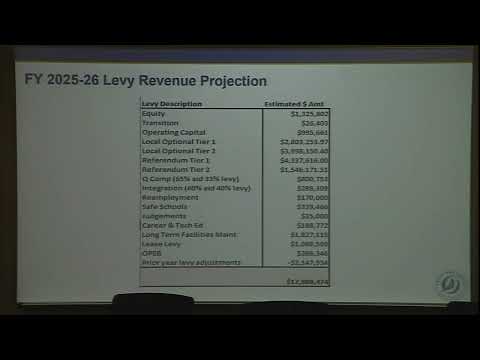
The district’s superintendent, Dr. Thomas, and finance staff member Tammy outlined revenue projections and spending assumptions and presented a package of staffing and program changes administration says would achieve the target while trying to limit classroom impacts. Tammy said the district’s revenue projections for 2025–26 assume a flat enrollment and formula-driven state aid and noted several categories of restricted, formula-based funding the district must spend as directed by statute.
Why it matters: The proposals would change course offerings at middle schools, reduce some special‑education paraprofessional scheduling, remove third‑grade SAGE screening and end the district’s high‑school online program. Board members and parents said several proposed cuts risked undermining programs the district identifies in its strategic plan and could prompt families to seek alternatives outside the district.
Topline numbers and timing Tammy presented the district’s revenue picture: the district’s multi‑year forecast assumes roughly flat enrollment, a basic formula aid of $7,465 per pupil unit in the current projection, and levy and other revenue that together produce a 2025–26 revenue projection the administration described in the presentation (figures cited in the presentation were approximate and rounded). The board has previously authorized use of fund balance in the current year for one‑time needs; administration said continued use of fund balance is not sustainable and that the $4 million number reflects recurring, structural adjustments they expect will be necessary if revenues do not increase.
Administrators emphasized scheduling constraints and a calendar: staffing allocations for schools are usually set shortly after the January study period; administrators said moving elements of the reduction package after staffing has been finalized would complicate hiring and scheduling. Tammy said staffing rollouts are usually about two weeks after the study session and that any late changes could have “secondary impact to our staffing.”
Proposed reductions and program changes (high‑level) - Middle‑school elective model change: Administration proposes model changes that would realize part of the savings by removing a small number of full‑time equivalents (FTE) at the middle‑school level and streamlining elective offerings (music and language combinations would be limited in some schedules). Board discussion and parent emails indicated the change has already produced community concern about lost elective options and possible effects on enrollment. - Special education paraprofessional hours: A proposed realignment would reduce a small number of paras (administration described this as reducing hours or not filling a few paras rather than immediate layoffs) and reassign hours to align schedules and contractual minutes. Michelle, the district’s director of special education, said, “I will always ensure that our students in special ed get their IEP needs met and they get a free and appropriate public education,” and described how the department plans to absorb modest reductions and to request help from the board if service gaps emerge. - Third‑grade SAGE screening: Administration proposed phasing out third‑grade SAGE identification to realize about $127,000 of recurring savings, citing lower-than-expected qualifying numbers under surrounding districts’ cut scores and declining participation after invitations. Board members and parents pushed back strongly, arguing the change would reduce gifted‑student supports and that alternatives should be identified before eliminating the program. - Laker Online (9–12 online program): Administration proposed eliminating the district-run online high‑school option for a modest saving, and to work with Bridges ALC and regional partners (Southwest Metro) to place students who benefit from an online environment. Administrators acknowledged some students who use the program are seniors and that the change could prompt some families to seek outside providers. - MNCAPS/MCAPS move to high school and administrative reconfiguration: Administration proposed moving the MNCAPS program into the high school to gain facility efficiencies and to reduce one assistant‑principal position by reorganizing administrative responsibilities; counselors already carried the satellite campus caseloads in part. Administrators said facility work would be minimal and some retrofitting could be done in-house. - Technology and device/software reductions: The technology director, Marcus Milazzo, outlined roughly $9,000 in annual reductions tied to mobile device management and endpoint management software and noted some desktop and device management contracts could be scaled back. He said leases on many devices have reached buyout points and that the district has reduced Chromebook carts since a failed technology levy, which has changed how testing and device access are provided at elementary schools. - Facility changes and pool: Facilities staff outlined options for Twin Oaks pool, including taking it offline to avoid near‑term maintenance and chemical costs (estimated savings cited in the presentation were approximately $75,000 for pool utilities/chemicals); they warned decommissioning and restarting a pool would require significant additional expense if the district wanted to reopen it later. - Other operational adjustments: Reductions in peer‑coaching/Q‑Comp staffing and some administrative assistant positions were proposed; administration described a mix of true savings and organizational realignments and asked the board for direction on priorities and alternatives.
Board and community reaction Darren White, board chair, and several board directors urged clarity on governance versus management roles and asked administration to cost alternative scenarios before the board takes final direction. Multiple board members said the package contained items they thought should be last resorts (for example, SAGE and advanced‑math offerings and direct classroom supports) and urged that the administration provide detailed plans for how students affected by program eliminations would be served.
Parents and some board members said communication about the middle‑school elective changes had been unclear; several directors noted that the reduction direction was discussed earlier (December) and that timing and communication created a gap between what some community members expected and what administration implemented to meet registration deadlines. One director summarized the community reaction: parents are upset, and some perceive the changes as already implemented without sufficient transparent notice.
Distinctions among discussion, direction and decisions Administrators stressed that the study session was intended to surface options and get board direction; no formal votes were recorded in the transcript. Tammy and Dr. Thomas asked the board for guidance and said administration needs clear direction in time for a February study session so staffing allocations can be finalized. Several directors requested more scenario analyses and alternatives (for example: targeted admin/support reductions, transportation efficiency work, phased program changes with explicit replacement supports) before committing to specific program eliminations.
Next steps Administration said it will cost out alternatives the board suggested, run additional analyses (transportation ride‑time and capacity, organization‑wide administrative ratios and alternative gifted supports), and return with refined scenarios for decision at the next study session. Several board members asked for an implementation plan that specifies how individual students affected by program cuts would be supported if the board approves the recommendations.
Sources: This article is based on the board study session transcript and presentations by district staff. Direct quotes in this story are from district leadership and program directors who spoke during the session.