Get Full Government Meeting Transcripts, Videos, & Alerts Forever!
Get email alerts on the Public Health Safety topic
No spam. Unsubscribe anytime.
Council hears first readings on alcohol impact area, public-health measures and eminent-domain water project; action deferred
Summary
The Spokane City Council held first readings for three separate ordinances — creating an alcohol impact area, creating a community health impact area to address addiction impacts, and authorizing eminent domain for a water booster pump site — and deferred further action.
The Spokane City Council received first readings of three separate ordinances — C-36-634 (creating an alcohol impact area), C-36-635 (establishing a community health impact area and public-health measures) and C-36-632 (authorize eminent domain for land needed for a water booster pump station) — and deferred further action. The clerk read the ordinance captions during the meeting.
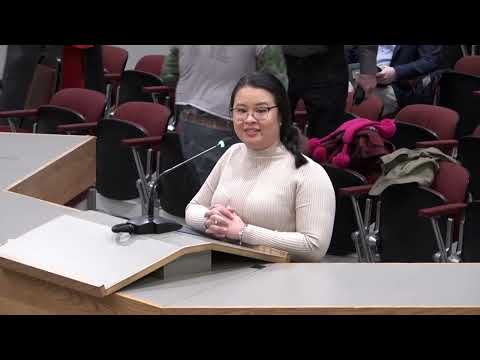
The first-reading agenda item drew extensive public testimony. Several speakers urged stronger enforcement against drug dealers, more involuntary or mandated treatment options and targeted public-health measures in the downtown core. Wendy Fishburne, vice president of the Spokane Business Association and a licensed marriage and family therapist, told the council: “I applaud the attention the city is giving this community impact ordinance trying to address the addiction problem in the downtown core.” Fishburne cited local medical examiner data showing increases in fentanyl-related deaths and urged the council to shift emphasis from housing-only responses to addiction treatment and prevention.
Other commenters expressed concern that proposed alcohol restrictions could simply move problematic activity to adjacent neighborhoods. Will Hewings of downtown Spokane argued the proposed ordinances were “misguided and ineffective” and that the drug crisis — particularly fentanyl overdoses — should be addressed with law enforcement and treatment rather than new local regulatory restraints. Several speakers referenced state and local policy debates, including House Bill 1380 and last fall Proposition 1 (a local ballot measure addressing sit-and-lie restrictions), urging the council to consider public safety implications.
Council took no final action on the first-reading ordinances at the meeting; the clerk announced that “further action is deferred on the first reading ordinances.” No final vote or timetable for return to the council was provided in the record.
What happens next: First readings allow for public input and give council time for deliberation. Because the council deferred further action, staff or sponsors must return the ordinances at a later date for subsequent readings, amendments or final votes if they choose to proceed.