Get Full Government Meeting Transcripts, Videos, & Alerts Forever!
Get email alerts on the Zoning Density Downtown topic
No spam. Unsubscribe anytime.
Salisbury council overrides mayor's veto to restore higher downtown density
Summary
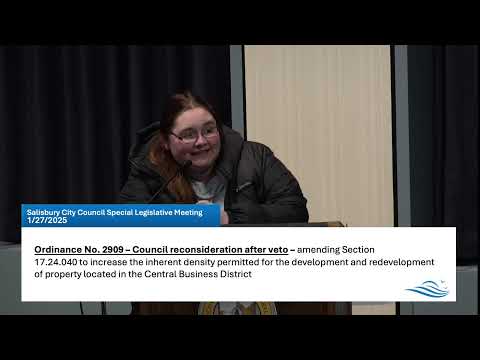
The Salisbury City Council voted to override Mayor Randolph J. Taylor's veto of Ordinance 2909 on Jan. 27, 2025, restoring an amendment to the city's zoning code that increases the allowable density in the central business district. The vote drew heated public comment over parking, affordable housing and developer influence.
Salisbury City Council voted to override Mayor Randolph J. Taylor's veto of Ordinance 2909 on Jan. 27, 2025, restoring an amendment to Section 17.24.040 of the Salisbury City Code that increases the inherent density permitted for development and redevelopment in the city's central business district. The motion to reconsider and approve the ordinance passed by the four-of-five threshold required under the Salisbury City Charter.
The override followed a public hearing period and earlier committee action: the Planning and Zoning Commission held a public hearing on Nov. 21, 2024, and recommended the amendment (6-1). Council first passed the ordinance after a public hearing on Jan. 13, 2025, by a 4-1 vote; Mayor Taylor returned the ordinance with a veto on Jan. 19, 2025. Under the charter, an ordinance returned without the mayor's approval may become law if the council passes it again by four-fifths of the whole council within 20 days; councilors completed that process at the special legislative session on Jan. 27.
Why it matters: The change removes or raises density limits in the central business zoning district, a move supporters say is intended to encourage housing and economic activity downtown. Opponents and some residents say the change will worsen parking congestion, produce mostly market-rate/luxury units rather than affordable units, and favor outside developers over longtime residents.
Council debate and recorded action
Council members debated before the roll call. Councilwoman DeShield said she would not support overturning the veto and said she remained concerned about parking and the long-term impact on the city: "I'm going to stick with my initial veto of this ... there's a huge issue with parking. There is another issue when you have less parking than you have traffic issues," she said during the session. The council then voted to override the veto; the chair announced that Ordinance 2909 "passes as originally adopted by 4 5ths of the whole council" in accordance with the relevant section of the city charter.
Public comment: supporters and opponents
More than a dozen members of the public spoke during the meeting's extended public-comment period. Speakers in favor said the measure would add housing options for younger workers and families and help slow rent increases by increasing housing supply. Claire Bolin, identifying herself as a "lifelong resident and a teacher," said council action "gave us residents assurance that our voices and our struggles were being heard" after the veto.
Several downtown residents and business owners opposed the change and cited parking and equitable housing concerns. Mayor Taylor, speaking as a private citizen after the veto hearing, told the council the central issue was parking and urged more study, saying the proposal effectively "double[s] the density from 40 to 80" (statement made in public comment and recorded in the transcript). Holly Worthington, a downtown business owner, said she had filed a complaint for declaratory and injunctive relief in Wicomico County Circuit Court over the city's transaction involving public parking lots.
Other speakers raised questions about influence and transparency. One commenter said records show donations totaling about $14,000 from landlords to the mayor's campaign and suggested that influenced positions; that claim was advanced by a speaker during public comment and is presented here as the speaker's assertion.
Planning and process history
City staff and the city attorney reviewed the statutory process on the record: the Planning and Zoning Commission recommendation (Nov. 21, 2024), the December work session presentation, first reading and passage at the Dec. 16, 2024 legislative session (first reading), the Jan. 13 public hearing and council vote (4-1), the mayor's veto on Jan. 19, and the council's reconsideration vote on Jan. 27. The council cited Section 2-12 of the Salisbury City Charter and provisions in Chapter 17 of the city code during the proceedings.
Votes at a glance (other business at the Jan. 27 session)
- Resolution 3378 (Hobbs Road annexation agreement, amended and restated): approved (voice vote). - Resolutions 3375 and 3376 (wastewater treatment plant annexation): approved (second reading; no public comment). - Ordinance 2910 (FY24 field operations budget amendment): approved (second reading). - Ordinance 2911 (grant contract with Maryland Institute for EMS, $4,000): approved (second reading). - Ordinance 2912 (state grant for fire department, $542,000): approved (second reading). - Ordinance 2913 (Rural Maryland Council grant, $13,791): approved (second reading). - Ordinance 2914 (budget amendment accepting Draper Holdings Charitable Foundation donation for Santa Workshop): approved (second reading). - Ordinance 2915 (Edward Byrne JAG grant, $2,998): approved (second reading). - Ordinance 2916 (memorandum of understanding with Wicomico County Health Department for Safe Station program, $10,000): approved (first reading). - Ordinance 2917 (rezoning 413 Snow Hill Road from R10 to General Commercial): approved (first reading).
What's next
Council actions restore the zoning amendment as city law, but several speakers said they plan to continue public scrutiny. Holly Worthington announced a court filing she said she had prepared; the city clerk and mayor said they would provide follow-up information to council members and the public on related materials. City staff said other zoning and annexation items on the agenda will proceed through the normal permitting and review processes.
Ending
Council members and residents signaled that debate over downtown density is likely to continue in public meetings and, possibly, in court. Supporters said the change is a necessary step to encourage housing and economic activity downtown; opponents pressed for more study of parking, affordability and potential conflicts of interest. The council's vote to override the veto took effect immediately.