Get Full Government Meeting Transcripts, Videos, & Alerts Forever!
Get email alerts on the Equity Assessment topic
No spam. Unsubscribe anytime.
City health equity office outlines strategic plan, equity-assessment tool and interdepartmental work
Summary
Cleveland’s Division of Health Equity and Social Justice presented a strategic plan, a health and equity impact assessment tool for city departments, and a review of programs including Moms First, HIV/STI, minority health, and addiction recovery; council members pressed for fatherhood inclusion, language access and procurement accountability.
The Cleveland Department of Public Health’s Division of Health Equity and Social Justice (HESJ) presented the administration’s 2024–27 interdepartmental equity strategic plan, explained an adapted Health and Equity Impact Assessment (HEIA) tool for city use and described program work on maternal and infant health, addiction recovery, minority health and HIV/STI services.
Lita Wills, commissioner of Health Equity and Social Justice, told the committee the division uses social determinants of health — education, economic stability, neighborhood and the built environment, health care and social/community context — as organizing pillars. She said the division’s work includes programmatic services housed in Public Health (Moms First, Office of Mental Health and Addiction Recovery, Minority Health and HIV/AIDS services) and cross-city efforts led by an interdepartmental equity team and an Equity Advisory Group.
Wills described a brief, user-friendly health and equity assessment tool the city adapted with support from the National Public Health Law Institute. The tool is designed for internal review of proposed or existing policies, programs and procedures to identify potential equity gaps or negative health impacts and to suggest mitigation measures. The team has piloted HEIA reviews in small groups aligned to the five strategic pillars and will publish annual reports with findings, recommendations and progress metrics.
Council members raised several operational and policy questions during the presentation. Multiple members pressed for stronger fatherhood engagement in the Moms First home-visiting program and discussed the name of the program; Wills and program staff said fatherhood services are offered alongside maternal supports and that separate fatherhood case management, peer support and outreach exist within the program. The presentation also named project directors and staff for program areas: Kadeisha Fair (Moms First), Samantha Holmes (Office of Mental Health and Addiction Recovery), Lydia Hill (division coordinator), Rafiq Ali (minority health project director) and Tiffany Green (HIV/AIDS project coordinator).
Council members asked about customer service training, bilingual hiring and access to a citywide language-line contract. Wills and staff said the city has language-line access at least in Public Health and that Human Resources is developing standardized customer-service training and recruitment strategies for bilingual staff; committee members asked staff to confirm the language-line contract’s citywide availability and to provide a date for follow-up. Committee discussion also highlighted procurement and small-contract strategies — staff noted an initiative to be more intentional about contracts under $50,000 as a possible avenue to increase participation by minority- and women-owned firms.
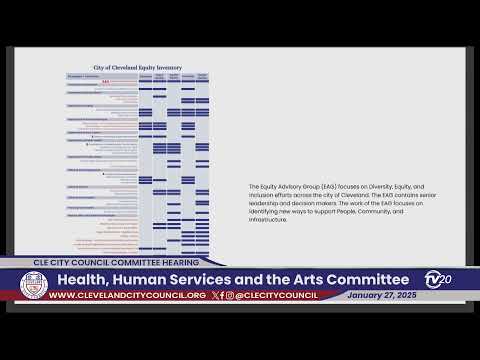
Wills also summarized the Equity Advisory Group’s inventory of existing city equity initiatives and commended the Cleveland Commission on Black Women and Girls, which launched an official commission in January 2024 and is pursuing listening sessions and committee work on economic development, health, justice, education and research.
Committee members expressed general support for using the assessment tool in council policy review and asked HESJ staff to coordinate a follow-up orientation for council policy staff to explore pilot assessments. Wills said the team is willing to meet with council policy staff and to pilot the HEIA on council policies if the council chooses to do so.
The committee did not take formal votes on the presentation. Staff said HEIA assessments already completed will be compiled into an annual report, and the interdepartmental equity team will continue small-group HEIA work and return recommendations and findings to the larger group and to council as needed.