Get Full Government Meeting Transcripts, Videos, & Alerts Forever!
Get email alerts on the Neighborhood Development Fund topic
No spam. Unsubscribe anytime.
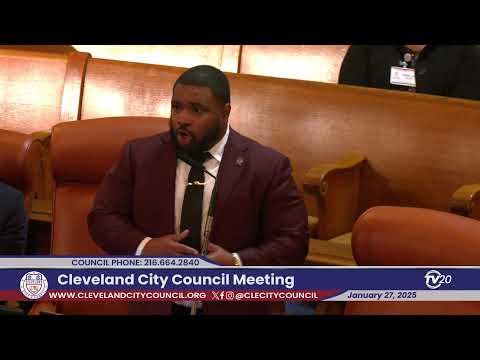
Cleveland council hears broad support for Neighborhood Development Fund, moves to advance ordinance 113-2025
Summary
Community development corporations urged City Council to replace restrictive CDBG rules with a new Neighborhood Development Fund that would provide predictable, flexible operating support. Council signaled detailed review and advanced legislation for final passage with a unanimous roll call on a related package of measures.
Council President Blaine Griffin and members of Cleveland City Council heard extended public comment on a proposed Neighborhood Development Fund ordinance, with multiple community development corporation leaders urging the city to replace parts of its Community Development Block Grant (CDBG) funding model with a locally controlled, flexible revenue source.
The neighborhood development legislation appears as Ordinance 113-2025 on the council docket. Supporters argued the change would allow CDCs to receive predictable operational funding and pursue a wider set of neighborhood activities without the federal CDBG requirement that eligible service areas meet a 51% poverty threshold.
"Currently, about half of my operating budget comes from the city of Cleveland sourced through federal community development block grants or CDBG funds," said David Robinson, executive director of West Park CAMS Neighborhood Development. Robinson told the council that the HUD poverty threshold rule can penalize CDCs that succeed at reducing neighborhood poverty: "If a CDC like mine does its job, if we attract investment, if we support residential needs, grow small businesses, and help reduce poverty, we actually risk losing the very funding that makes that success possible."
John Analefo, executive director of Famicos Foundation, told the council the existing reimbursement model is slow and onerous and urged a replacement funding stream: "The proposed new development fund will create trust between the CDC's residents and city hall as well as infuse predictability in the work we do." Several other CDC leaders echoed those points, including Mark Lam of Campus District, Ashley Shaw of Midtown Cleveland, Joy Johnson of Burton Belcar Development, and Mickey Smith of New Point Community Development Corporation, who described long reimbursement delays and administrative burdens under the current model.
Speakers gave examples of programmatic results they say are not captured by the current federal rules: Robinson cited volunteers who built the city’s largest accessible playground and noted his CDC served as the fiscal backbone for that work; he also said a recent state investment of $95,000 supported that project. Ashley Shaw said Midtown’s programs have supported more than 700 housing units, and that CDBG helps pay roughly half of her staff. Joy Johnson said CDCs have had to cut positions because of the reimbursement model and applauded the ordinance’s list of 15 eligible activity categories.
Council members responded that the proposal will require careful review. "This is gonna be a rigorous conversation. We are not going to fast track this," Griffin said, announcing plans for multiple hearings and further engagement with Director Alyssa Hernandez of the Department of Community Development. Council members Anthony Hairston and Carrie McCormick were named by Griffin as leaders who had helped craft the working-group work so far; several council members encouraged CDCs to participate in upcoming hearings.
Council proceeded later in the meeting to suspend rules and place a package of listed ordinances on final passage by roll call. The roll call recorded 16 ayes on the motion to suspend rules and later 16 ayes on passage for the set of legislation that included Ordinance 113-2025 (as listed on the agenda). The suspension and passage votes were moved by Council Member Spencer and seconded by Council Member House Jones.
Why this matters: CDCs provide neighborhood-level development, small-business support and housing services across Cleveland. Local leaders said the Neighborhood Development Fund would let CDCs plan multi-year work without the constraint that successful poverty reduction can make an area ineligible for federal CDBG funding. City officials said they will deliberate carefully to avoid unintended consequences and ensure federal rules and oversight needs are observed.
Votes at a glance
- Motion: Suspend the rules and place the listed legislation on final passage. Mover: Council Member Spencer; Second: Council Member House Jones. Roll call on suspension: 16 ayes (Griffin; Bishop; Conwell; Gray; Hairston; Harsh; House Jones; Jones; Casey; Kelly; Moore; McCormack; Polencic; Santana; Slife; Spencer; Star). Outcome: approved.
- Motion: Final passage of the listed legislation including Ordinance 113-2025 (establishing a neighborhood development sub fund). Roll call on passage: 16 ayes (same roll call list). Outcome: approved.
What the ordinance would do (as described in the agenda): establish a neighborhood development sub fund for various neighborhood development activities to benefit residents and businesses by improving quality of life. The ordinance text and final implementation details will be subject to the hearings and administrative review Griffin announced.
Discussion vs. decision
Discussion: Multiple CDC leaders testified in favor of changing how CDBG funds are used and disbursed. Speakers pressed points about reimbursement delays, eligibility limits tied to HUD poverty thresholds (51% low-income requirement), the need for advance/prorated payments to avoid long cash-flow gaps, and the ability to track and report impact across fifteen enumerated activity categories.
Direction: Council directed staff to engage with CDCs and Director Alyssa Hernandez, and President Griffin said he expected a series of hearings and deeper review rather than an immediate fast-track.
Decision: Council voted to suspend rules and to place the listed legislation on final passage; the roll calls recorded 16 ayes. The transcript records the suspension and passage votes for the package of items that included Ordinance 113-2025. Implementation details, funding swaps, and oversight mechanisms remain to be defined in forthcoming hearings.
Ending: Council members said they will schedule multiple hearings and neighborhood meetings to solicit additional input and to work through pros and cons before final implementation details are settled.