Get email alerts on the Stormwater Code Amendments topic
No spam. Unsubscribe anytime.
Staff preview stormwater code amendments to meet 2021 NPDES permit requirements
Summary
City staff presented proposed stormwater code amendments at a Jan. 27, 2025 Eugene City Council work session aimed at aligning local stormwater development standards with the 2021 NPDES permit and the Clean Water Act.
City of Eugene staff on Jan. 27, 2025 presented proposed amendments to the city’s stormwater development standards intended to align local code with the 2021 National Pollutant Discharge Elimination System (NPDES) permit issued through the Oregon Department of Environmental Quality.
Doug Singer, a civil engineer with Public Works Engineering, said the proposed changes would simplify and clarify chapter 9 provisions that regulate stormwater flood control, water quality and flow control for new construction. Singer described a three-part hierarchy for water-quality control: infiltrate runoff on-site where feasible, filter where infiltration is not possible, and use off-site mitigation as a last resort funded by systems development charges.
Singer said the permit and proposed code promote low-impact development and green infrastructure — such as stormwater planters, rain gardens, swales, sand filters and green roofs — to reduce runoff velocity and remove pollutants before water reaches Amazon Creek and the Willamette River. He said the city received a new NPDES permit in 2021 and the amendments are intended to align Eugene’s standards with the permit and the Clean Water Act. "The permit is issued through the Oregon Department of Environmental Quality, or DEQ, to comply with the Clean Water Act," Singer said.
The presentation noted several exemptions the city proposes to retain or rewrite to conform with the NPDES permit: exemptions where infiltration is infeasible because of low infiltration rates, shallow bedrock, shallow groundwater or steep slopes, and exemptions for maintenance and repair activities or where there is insufficient on-lot space for green infrastructure. Staff said a map in the stormwater management manual identifies "infiltration-limited" areas where the infiltration-first requirement would not apply.
Staff told councilors that the proposed amendments remove date-based exemptions that were previously in code, including an exemption that had applied to construction of single-family units and duplexes on tax lots created before 2014. Public testimony and stakeholder input prompted some edits during the planning commission process; the presentation states the planning commission held a work session, a public hearing and subsequent deliberations and unanimously recommended that the City Council adopt the proposed amendments. Staff also said they met with stakeholders including the Western Oregon Builders Association during the planning commission process.
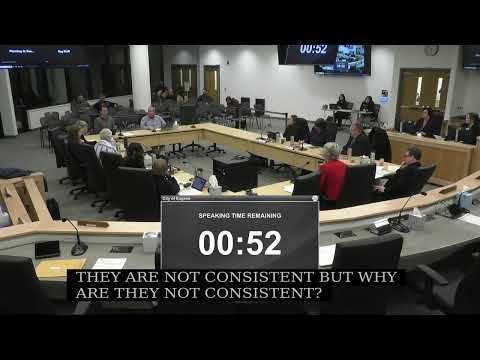
Councilors asked several procedural and impact questions during the roughly 15–20 minute discussion. Councilor Clark asked how many acres would be affected if the date-based exemptions were removed; staff replied they had not compiled that data. Councilor Zelenka asked why the prior exemptions were inconsistent with the NPDES permit; staff responded that the 2021 permit does not allow exemptions based solely on lot creation dates and that the city has rewritten exemptions to match permit criteria. Councilor Kaczynski asked whether many parcels would still qualify for other exemptions (for example, high groundwater), and staff confirmed multiple exemption categories could apply and that most of the city falls into one or more infiltration-limited categories.
Staff did not present an ordinance or motion for council adoption at this work session; the presentation was described as preparatory to a future public hearing where council will consider formal action. Councilors requested additional information, including data on acreage and the consequences of noncompliance with the permit; staff said they would return with more information at future meetings.
The work session closed after the stormwater presentation; no vote on the code amendments was recorded at this meeting.
AI generated
The text on this page is AI generated. Summaries, highlights, analysis, and video transcripts are all produced from the original source material.
AI can make mistakes, so if you spot one, and we will fix it for everyone.
Note: the source content is unaltered by us. Any content source we link to, be it a video, an audio recording, or a document, is presented exactly as its publisher released it. That publisher is usually a government body, sometimes an individual official or another organisation.