Get Full Government Meeting Transcripts, Videos, & Alerts Forever!
Get email alerts on the Disaster Relief Property Tax topic
No spam. Unsubscribe anytime.
Board of Equalization reviews wildfire property-tax relief, outlines 2024 accomplishments
Summary
At a regular meeting, the State Board of Equalization heard an update on property-tax relief available to Southern California wildfire victims and a year-end summary of the agency’s 2024 work, including outreach, audits, and legislative wins.
Lede: At a January meeting of the California State Board of Equalization, Executive Director Ms. Stowers updated the board on property-tax relief available to property owners affected by recent Los Angeles and Ventura County wildfires, and then summarized the agency’s major accomplishments for 2024.
Nut graf: The board was briefed on statutory disaster-relief eligibility and administrative guidance the agency has published, and on outreach done with county assessors and other state offices to speed relief for affected taxpayers. The executive director also reviewed 2024 production figures from multiple BOE divisions, from state-assessed property rolls to training and legal casework, underscoring the staff’s operational activity over the past year.
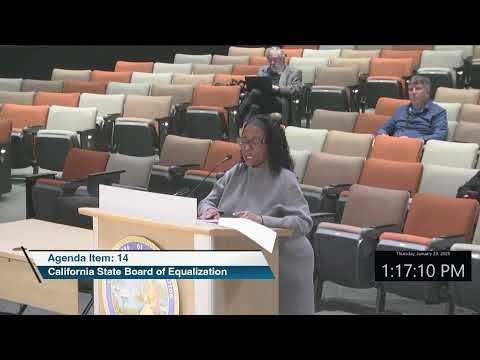
Body: Executive Director Ms. Stowers opened her report by offering condolences to communities affected by the Southern California wildfires and said that the agency issued a news release on Jan. 14 outlining available property-tax disaster relief. She told the board that “section 170 of the revenue and taxation code provides property tax disaster relief to victims of the Los Angeles and Ventura County wildfires,” and summarized the statute’s general thresholds, including a stated $10,000 minimum loss in current market value for eligibility and county filing requirements.
Stowers said approved claims can yield a temporary reduction in property taxes until the property is rebuilt, and that eligible owners may also get a postponement of their next regular property-tax installment while assessors reappraise damaged property. She directed the public to BOE’s disaster-relief webpage and an informational guide the agency published.
Deputy Director David Young clarified nuances of the law during board discussion, noting that most affected counties have local ordinances that allow assessors to initiate disaster-relief adjustments without an owner’s application, but that “not all counties may have that ability to start the disaster relief process without an application,” and urged property owners to file claims “out of abundance of caution” so assessors have current contact information.
Board members and other officials praised rapid outreach: Ms. Stowers said County Assessor staff have been proactive in completing claims for owners, and Member Vasquez and Controller Cohen were thanked for distributing informational materials and amplifying the guidance. The executive director also told the board she and staff are in active conversations with the administration and the Legislature about additional relief proposals and will report back when concrete proposals are available.
Stowers noted an executive order from the governor extending state property-tax deadlines for affected counties through April 2026 and summarized other timing points discussed in the meeting: the current filing minimum is 12 months to file a claim (with some counties able to adopt longer periods), there is discussion about legislative extensions to 24 months for filing, and a general five-year minimum to complete rebuilding before property value is restored — with previous special legislation extending that period (for example, Paradise) when necessary.
In the same report Stowers presented a year-end roundup of BOE operations for 2024: the Property Tax Department produced the 2024 state-assessed roll and processed hundreds of adjustments and appeals; the agency published and updated guidance (including for Proposition 19); staff completed training and outreach programs; Legal issued multiple opinions and closed litigation matters; and the Taxpayer Rights Advocate’s office completed hundreds of cases. Stowers and the board repeatedly credited staff for the operational volume across divisions.
Ending: The board did not take a formal vote on policy changes during this session; board members asked clarifying questions and requested continued updates as legislative and administrative proposals develop. The BOE’s disaster-relief webpage and the newly published informational guide were cited as the primary resources for affected property owners.