Get Full Government Meeting Transcripts, Videos, & Alerts Forever!
Get email alerts on the Charter Structure topic
No spam. Unsubscribe anytime.
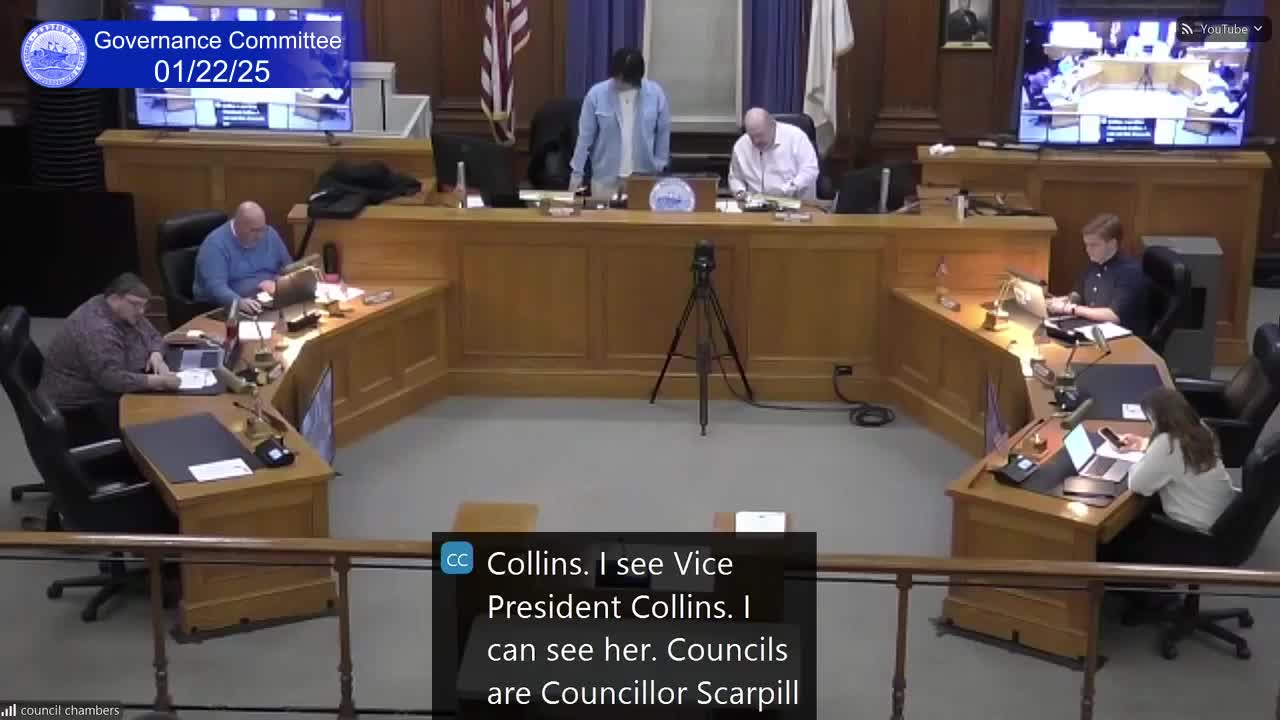
Governance committee advances charter draft after hours of debate; sends amended package for full‑council review
Summary
The Governance Committee on Jan. 22 advanced a revised city charter draft after more than four hours of debate that centered on how Medford should elect its legislative body and several procedural clarifications recommended by the Charter Study Committee.
The Governance Committee on Jan. 22 advanced a revised city charter draft after more than four hours of debate that centered on how Medford should elect its legislative body and several procedural clarifications recommended by the Charter Study Committee.
The meeting opened with the committee’s plan to review the preamble, Article 1 (definitions) and Article 2 (the legislative branch) and continue later with compensation and composition, Chair Singh said. Committee members and members of the Charter Study Committee and the Collins Center then discussed definitions, council powers, appointment review and the most contested subject: whether council seats should be 11 at‑large/ward seats or reconfigured into a hybrid of district and at‑large seats.
Why it matters: the charter would replace rules in place for nearly 40 years and will reshape how residents access and hold local elected officials to account. The committee’s decisions determine the version that will go to the full City Council and, if approved there, to the state legislature as a home‑rule petition and ultimately to voters if the legislature requires a referendum for changes in composition.
Committee members praised the study committee’s work while disagreeing on composition. President Behrs (President Behrs) thanked the Charter Study Committee and the Collins Center for their work and for the listening sessions that informed the draft: “Thank you… the work that they did… and especially for those who are here tonight,” he said. Milva McDonald, chair of the Charter Study Committee, defended the report’s choice points and said the group “looked at other charters… and that seemed like a reasonable provision, so we included it.”
Debate focused on representation. President Barris (President Barris) proposed amending the study committee’s recommendation (11 members: eight ward representatives and three at‑large) to a smaller hybrid: seven councilors (four district seats composed of paired wards, plus three at‑large). He framed the change as a way to preserve local representation while avoiding very small single‑member wards that can produce uncontested races and skewed vote weight. Opponents said the study committee’s 11‑member model better guarantees at‑least‑one representative for every ward and is more likely to expand access for local, lower‑cost campaigns. Several public commenters told the committee they supported full ward representation to increase neighborhood access to elected officials.
Committee actions and process changes: Members voted on multiple procedural amendments and action items aimed at clarifying operation of the legislative branch and ensuring the draft aligns with state law and administrative practice. Key votes (summary):
• The committee approved removing a sentence that had read “the city council shall contact the officers and employees serving under the mayor solely through the mayor,” a change proponents said preserved the rule that councilors cannot give orders to staff while allowing routine communications. Motion passed unanimously (5–0).
• The committee approved changing charter language that had required regular council meeting times be fixed “by ordinance” to instead read “fixed by city council rules.” Motion passed unanimously (5–0).
• Members adopted motions requesting the Collins Center draft language on residency rules for multi‑member boards and to add a “city messenger” position to the officers listed in the charter; the committee voted to send both items forward for drafting and future consideration (vote recorded 5–0 for placing language development on the calendar).
• The committee voted to ask the Collins Center to confirm ordinance references to the city clerk and the Elections Commission (there have been local changes moving some clerk duties to the Elections Commission) and to ensure draft text reflects current Massachusetts practice. Motion passed unanimously (5–0).
• After extended debate about council composition, the Governance Committee voted to consolidate the committee’s work into a single committee‑of‑the‑whole meeting to produce a redline draft for full council consideration. That referral motion passed 3–2.
Public input and data: The Charter Study Committee and Collins Center staff told the committee they had performed outreach (15 listening sessions, targeted events and a public survey). Jean Zodder, who led survey work for the study committee, said survey respondents skewed older and more likely to be homeowners than the city population: “81% were homeowners… 79% were white… 54% were 45 years or older,” she reported, and said the study committee used listening sessions to reach groups underrepresented in the online responses.
Several residents and charter committee members urged the council to move the full package to the state in the near term; others called for one more round of public polling that explicitly compares alternative hybrid maps (four districts/three at‑large, five at‑large/four districts, etc.) before a final council vote.
Votes at a glance: • Remove “council shall contact officers… solely through the mayor” (procedural clarification). Mover: President Barris. Outcome: approved 5–0. • Change “fixed by ordinance” (meeting times) to “fixed by city council rules.” Mover: President Behrs. Outcome: approved 5–0. • Request Collins Center draft language on residency rules for multi‑member boards and add city messenger position to charter officer list. Mover: Councilor Scarpelli / President Behrs (motions to send for drafting). Outcome: approved 5–0 (to send for drafting and future vote). • Request Collins Center confirm references to city clerk vs. Elections Commission in ordinance language. Outcome: approved 5–0. • Refer consolidated, amended charter recommendations to a committee‑of‑the‑whole for final redline review before a full council vote. Mover: President Behrs. Outcome: approved 3–2.
What remains: The committee did not adopt a final composition for the council. That issue — the choice between the study committee’s 11‑member hybrid (eight ward representatives + three at‑large) and alternative hybrid maps proposed by councilors — will be carried into the committee‑of‑the‑whole and then to a full council meeting that must also consider timing for a home‑rule petition to the state legislature.
Next steps: The Governance Committee will finish scheduled charter review sessions and the committee‑of‑the‑whole will prepare a consolidated redline draft for final council consideration. If the council approves the final text, the mayor and council would submit a home‑rule petition to the state legislature; some charter changes (notably composition) will require voter approval before taking effect.
Residents and stakeholders who asked to be considered in future rounds included community organizations that said they would like more comparative polling on hybrid options and civic groups that urged the council to prioritize outreach to renters and younger voters to improve turnout and competitiveness.
The meeting closed after the committee adopted the procedural motions and agreed a consolidated review would be held; the committee adjourned after the motions were recorded.