Get Full Government Meeting Transcripts, Videos, & Alerts Forever!
Get email alerts on the Roads And Infrastructure topic
No spam. Unsubscribe anytime.
Medford officials outline plan to use $500,000 override for road crew hires, equipment and targeted resurfacing
Summary
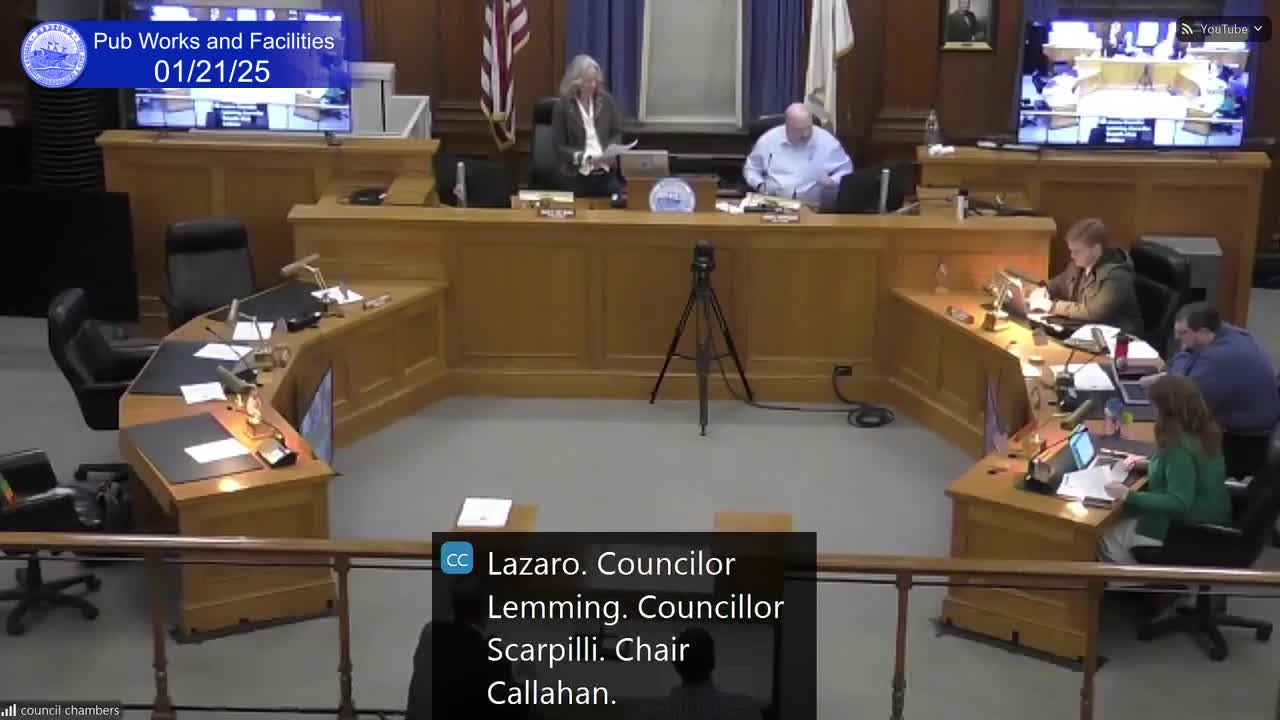
Medford’s Department of Public Works told the city’s Public Works and Facilities Committee on Jan. 21 that $500,000 from a recently approved ballot override will be used to add personnel and equipment to the highway division and to free up contracted dollars for larger capital projects.
Medford’s Department of Public Works told the city’s Public Works and Facilities Committee on Jan. 21 that $500,000 from a recently approved ballot override will be used to add personnel and equipment to the highway division and to free up contracted dollars for larger capital projects.
The update was delivered by DPW Commissioner Tim McGivern and Engineer Owen Wartella. "We're increasing the size of the highway division by approximately 20%," McGivern said, describing a plan to add three positions — a mason working foreman and two maintenance/laborers — plus one internal transfer from the cemetery. "The expected increase in efficiency is about 20%."
The $500,000 allocation, McGivern said, covers new staff, parts and supplies for equipment, gasoline, repair supplies, concrete and asphalt, and an allowance for future capital purchases such as additional trucks. "When you add more people, you are going to need more trucks as time goes on," he said.
Why it matters: City officials told the committee that hiring in-house crews for spot repairs and box-out patching will be more cost-effective than continuing to move contractors around the city for small repairs. McGivern said shifting that work in-house will free capital dollars to be used on larger, production-style engineering projects such as miles of roadway or blocks of sidewalk.
Committee members pressed officials on timing and scale. McGivern said the three jobs are posted internally and that interviews for internal candidates could take "3 to 4 weeks," but the full internal promotion-and-backfill cycle to bring three entry-level workers into the highway division could take "3 or 4 months" or longer depending on transfers. "We'll do it as fast as we can," he said.
On contract spending, McGivern estimated the city has historically spent roughly $500,000 to $1,000,000 per year on sidewalk contracts and said recent stump and sidewalk repairs were about $250,000 per season. Engineered contracting details were provided by Owen Wartella, who said a three-year sidewalk contract with Cassidy recently ended at about $500,000 per year and that a new contract using Community Development Block Grant (CDBG) funds is expected to be about $650,000.
Wartella also said the city has about $2.4 million in unallocated Chapter 90 funds and that engineering plans to use those and other sources to target "6 or 7" roadways this year. The DPW plans to spend more than $2 million on mills and overlays in the coming year, Wartella said, while noting that mills and overlays cover less square footage per dollar than large patches or production-style repairs.
Officials described the city's pavement backlog and condition metrics: using last year’s numbers, they said the pavement backlog is about $70 million and the sidewalk backlog about $30 million. McGivern summarized the funding relationship to condition: roughly $3.5 million per year will maintain current pavement condition, $5 million per year would begin to show improvement, and $9 million per year would deliver a steeper improvement curve.
Staff also described administrative changes intended to slow future degradation, including improved permitting and online tracking of utility trenching and stricter restoration standards for contractors. "We are now a little way more organized so that we can know who's going in there, how they're restoring it and kind of forcing them to make sure that they go back and restore it correctly," McGivern said.
The committee did not take formal action on Paper 24-492 (a resolution to receive an update on roads); the item was an informational briefing. Committee members asked for ongoing condition-index updates and clearer links between specific dollar allocations and condition-index changes in future reports. Councilors and staff agreed it will take multiple years to see measurable improvements in condition indices.
Ending: The road update closed with councilors urging patience and a request that staff return with future condition-index results and more granular analyses showing how investment in particular treatments (preventative maintenance, large patching, mills/overlays) affects the Pavement Condition Index (PCI) and Sidewalk Condition Index (SCI).