Get Full Government Meeting Transcripts, Videos, & Alerts Forever!
Get email alerts on the Transportation Funding topic
No spam. Unsubscribe anytime.
Council closes public hearing and delays vote on continuing 'Lincoln on the Move' sales tax
Summary
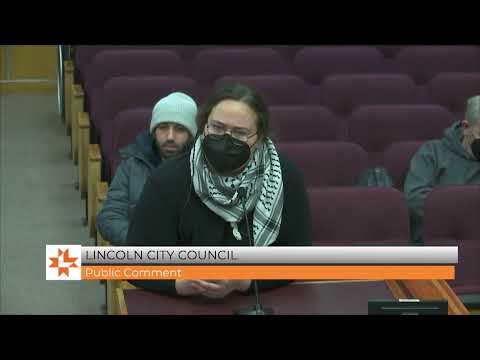
After a three-hour public hearing with dozens of speakers for and against, the Lincoln City Council closed comment and voted to delay a final decision on placing an 8‑year continuation of the quarter‑cent "Lincoln on the Move" street sales tax on the April 8 ballot until Feb. 3.
The Lincoln City Council heard more than two hours of testimony on Jan. 27 about whether to place a question on the April 8 ballot to continue the quarter‑cent Lincoln on the Move sales tax. The council closed the public hearing and voted 7–0 to delay action until its Feb. 3 meeting.
Elizabeth Elliott, director of Lincoln Transportation and Utilities, told the council the proposal would continue an existing quarter‑cent sales tax and would not increase taxes for Lincoln households. "This continuation would not create any new cost for Lincoln taxpayers," Elliott said during her presentation. She said an eight‑year renewal would preserve a funding stream that has delivered about $102 million in street work over the current six‑year program and would produce about $140 million more over eight years if voters approve it.
Supporters at the hearing argued the program accelerated repairs, lowered long‑term construction costs by allowing projects to be built sooner and helped economic development. Jeanne McClure, executive director of ACEC Nebraska and co‑chair of the advisory committee on transportation, said the program has led to more projects and visible street improvements across the city. Jason Ball, president and CEO of the Lincoln Chamber of Commerce, and representatives of the Home Builders Association and the Lincoln Independent Business Association urged councilors to let voters decide.
Opponents questioned whether the city had prioritized street funding within the general fund, raised equity and land‑use concerns and warned the measure could subsidize outward growth. William McCoy, a lifelong Lincoln resident, said voters already pay multiple taxes associated with roads and asked why the general fund could not cover additional maintenance. Spencer Farley of Strong Towns Lincoln urged caution about language that guarantees 25% of revenue go to new streets; he said that requirement can incentivize low‑density expansion that creates long‑term infrastructure liabilities.
Elliott described the proposal's structure: 73.5% of revenue would continue to go to existing streets, 25% to growth (new streets) and 1.5% to the Railroad Transportation Safety District (RTSD) as a match for a 33rd & Cornhusker grade‑separation project. She told councilors the 1.5% set aside would help match a $66.7 million federal grant awarded for that railroad crossing elimination project and that the RTSD interlocal agreement would automatically dissolve if voters reject the renewal.
Elliott and multiple speakers emphasized that Lincoln on the Move funds are restricted to paving and rehabilitation and do not directly pay for sidewalks, curb ramps, bike lanes, traffic signals or debt service; those components would be paid from other street funding sources such as highway allocation funds or vehicle‑related taxes. She also said the advisory committee on transportation — a citizen panel created under the original ballot measure — would continue to review projects and provide oversight if the council and voters approve a renewal.
At the close of the hearing the council voted 7–0 to delay action and asked staff to return with any requested follow‑up information at the Feb. 3 meeting. In the meantime the public comment record — ranging from public‑transit advocates who said better streets help buses, to business and real‑estate groups who argued the measure supports housing and growth, to residents who objected to allocation language — will remain part of the administrative record.
If the council ultimately places the question on the April ballot and voters approve it, the sales tax would continue from Oct. 1, 2025, for eight years under the same spending breakdowns discussed at the hearing. If voters reject a renewal, Elliott said, the city would lose roughly $18 million a year dedicated to streets and the pace of projects would slow dramatically, increasing the time required to address the city's backlog and likely increasing overall construction costs.
The council closed the public hearing on Jan. 27 and left the resolutions on the ballot question, the impact‑fee freeze and the RTSD interlocal agreement to a Feb. 3 vote.