Get Full Government Meeting Transcripts, Videos, & Alerts Forever!
Get email alerts on the Strategic Plan topic
No spam. Unsubscribe anytime.
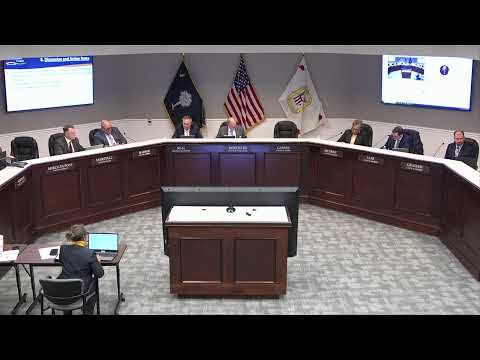
Lancaster County staff gives quarterly strategic-plan update to council
Summary
County staff presented a quarterly update on the county strategic plan, outlining targets and progress on public safety, infrastructure, quality development, grants management and IT inventory work. Council members asked for more timeline detail on road- and utility-funding recommendations and for analysis of impact-fee exceptions.
Good evening, vice chairman and members of council, I will be going through a quarterly update of the strategic plan, said Stephanie Snouten, a county staff member, as she opened the presentation.
Snouten told the Lancaster County Council that the county’s strategic plan centers on five themes — public safety, infrastructure, quality development, resource optimization and high performance — and reviewed a set of objectives and target dates to align staffing, capital projects and grant activity with projected growth. “Our vision is the county being a network of thriving communities offering the highest quality of life in the Carolinas,” Snouten said.
The presentation summarized several ongoing efforts the county said support those goals: construction of a new detention facility, a coroner’s office and a sheriff’s evidence-storage facility; enhancements to 911, fire infrastructure and equipment; and distribution of premium COVID-19 pay. On public-safety planning, Snouten said the county intends to prepare “a comprehensive public safety operational analysis to establish growth planning methods by March 30, 2025.” Several departments already produce five-year plans, she said, and the county administration is participating in a Public Safety Needs Assessment Committee.
On roads, Snouten said the county is preparing a comprehensive roadway funding study with a June 30, 2025 target and described ongoing mapping of county-maintained roads to support data-driven prioritization. The public services division estimates the service-level mapping will cost about $100,000 per year and take roughly three years to complete if council approves continued funding during the FY26 budget process, she said.
Council members pressed staff for clearer timelines and for analysis that includes state- and municipal-maintained roads. “Whatever recommendations are going to be made … please do it in a timely manner where we will have time to get all of our questions out,” one council member said, noting the previous transportation proposal felt rushed. Snouten said the administration will begin presenting that work in February.
The county’s economic-development and planning work was also discussed. Snouten said staff has completed an inventory of utility availability at multiple industrial and business sites (Ariel Park, Quality Drive, Hosscamp Road, Foster’s Crossroad, Heath Springs Business Park and Air Veil Park phase 2) and plans a utility-infrastructure gap analysis by June 30, 2025 to target commercial-growth opportunities.
On resource optimization, Snouten said the county lacks a centralized grant-management function; grants are written and managed by individual departments or outside consultants. She noted the county continues to administer FAA and other federal grants through consultants overseen by finance and said the county is examining whether a dedicated grant administrator or outsourced arrangement would be cost effective.
Snouten also provided IT and workforce details: the county’s IT asset valuation is approximately $2.7 million and staff have repurposed about $20,000 of software during recent consolidation efforts; human-resources work includes a completed market-based compensation review completed in April 2024 and expanded employee-engagement efforts.
Council members asked for several follow-ups: a clearer funding package that addresses county, state and municipal roads together; an analysis of how prior impact-fee exceptions affected revenue; and more detail on how a grant-management role would pay for itself. Snouten and staff said they would return with additional analysis during the budget process and in February’s follow-up presentations.
The presentation concluded with staff noting some target dates remain ambitious and that the county will continue working across departments to assemble the analyses and funding recommendations council requested.
The council did not take formal action during the presentation; staff said follow-up items will be brought back for council consideration.