Get Full Government Meeting Transcripts, Videos, & Alerts Forever!
Get email alerts on the Airport Infrastructure topic
No spam. Unsubscribe anytime.
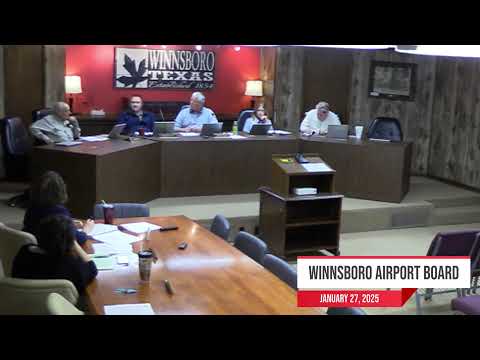
Winnsboro airport board prioritizes AWOS, hangar compliance and property negotiations
Summary
At a meeting focused on implementing the airport master plan, Winnsboro board members reviewed available federal/state funds, placed automated weather observing and an operations-tracking sensor high on the priority list, and flagged hangar upgrades and property easements as prerequisites for reclassification and future development.
Winnsboro — Board members reviewed a staff-produced checklist of master-plan implementation items and directed follow-up on several near-term priorities, including installing an automated weather observing system, counting operations with an ADS‑B/aircraft‑tracking system, and getting four dirt or noncompliant hangars upgraded so they can count as based (home‑based) aircraft.
The discussion centered on what improvements the city should ask staff and consultants to pursue first and what items require property acquisitions or easements. Board members and staff noted roughly $800,000 in potential state and federal funds could be available for projects such as an AWOS, perimeter fencing, a berm removal/earthwork program and hangar upgrades. Board members said the AWOS and an operations tracking system are low‑cost, independent steps that would produce data useful for grant requests and any eventual FAA reclassification.
Why it matters: installing an AWOS and documenting traffic counts would provide hard data for grant applications and for asking the Federal Aviation Administration to reclassify the airport if the facility reaches the threshold of based aircraft. Upgrading hangars so they meet Federal Aviation Administration eligibility standards is a precondition for capturing non‑primary entitlement funds tied to based aircraft counts.
Board discussion and staff reports Board members spent most of the meeting walking through a list prepared by a staff member, Mackenzie (staff member), that broke master‑plan actions into smaller, deliverable tasks. Board members prioritized: (1) an AWOS installation, (2) a low‑cost operations‑tracking system (ADS‑B counter), (3) bringing multiple hangars into compliance so they qualify as based aircraft hangars, and (4) addressing pilot‑lounge repairs and hangar roof storm damage.
City‑hired consultant Michael Mitchell (KSA consultant) and staff described which projects carry matching requirements. Board members were told that some funding (identified in the meeting as ARPA and CRRSAA allocations and other non‑primary entitlement funds) does not require a local match, while other grants do. The group discussed the timing and sequencing: installing the AWOS and the tracking counter could proceed in parallel with annexation and easement negotiations for two privately held parcels that affect runway sightlines.
Property and easement work Board members identified two privately held parcels — a church parcel and property owned by a resident identified in the meeting as Mr. Carr — as blocking sightlines and taxiway alignment. Board members asked staff to pursue negotiations and said it would be useful for board members or pilots with established relationships to test the waters with property owners. The board discussed potential land swaps, relocation of small structures such as a Quonset‑hut, and the possibility of the city taking usable berm material for other public works needs if easements are secured.
Hangar compliance and reclassification Board members emphasized that raising the number of FAA‑eligible based aircraft depends on getting existing hangars upgraded to meet FAA standards. The board discussed repair and reroofing needs; one pilot‑lounge or office roof repair was estimated by the group at about $100,000 if not eligible for grant reimbursement. Board members said reclassification is triggered chiefly by the FAA metric for based aircraft (board members cited a 10‑based‑aircraft threshold), and they asked staff to confirm whether traffic counts are an independent metric for any part of the FAA process.
Operational and safety items Other topics included rekeying hangars (a locksmith has been engaged and three incoming aircraft are ready once locks are replaced), fuel‑system compliance and sampling (the board discussed TxDOT and Texas Department guidance on fuel sampling and the need for a certified sampler or contract), and relocating above‑ground fuel tanks to meet long‑term compliance and safety goals.
Pilot lounge, marketing and economic development Board members discussed a low‑cost renovation of the pilot lounge (furniture, Wi‑Fi and local imagery) and recommended a public education/marketing campaign to explain the airport’s economic value to the city. The group also discussed incorporating adjacent 92 acres for an airpark-style residential/industrial development and asked staff to contact local developers and the Economic Development Corporation for potential partnerships.
Votes at a glance - Meeting minutes for the prior meeting: Approved by voice vote; motion moved and seconded and the chair declared the motion passed (voice vote; no roll‑call tally recorded in the transcript).
What happens next Board members asked staff and the KSA consultant to provide: cost estimates and procurement steps for an AWOS; a procurement path and cost for an operations‑tracking counter (ADS‑B); an engineer’s estimate for hangar upgrades and hangar reclassification steps; and a plan for approaching the two privately held parcels for easements or acquisition. Several board members volunteered to make initial contacts with property owners or their representatives. The board also signaled it expects to return with budget numbers and a short, focused presentation to city council when staff and consultants can show concrete cost and schedule proposals.
Ending The board adjourned after agreeing on priorities and assigning follow‑up actions: confirm funding match rules, obtain cost estimates for AWOS and tracking equipment, evaluate hangar upgrade costs, and develop a property‑negotiation strategy. The group said it will revisit details once staff and the KSA consultant return with numbers and exhibits.