Get Full Government Meeting Transcripts, Videos, & Alerts Forever!
Get email alerts on the Budget Appropriations topic
No spam. Unsubscribe anytime.
OMES seeks increased appropriations for IT modernization, cybersecurity and underfunded mandates
Summary
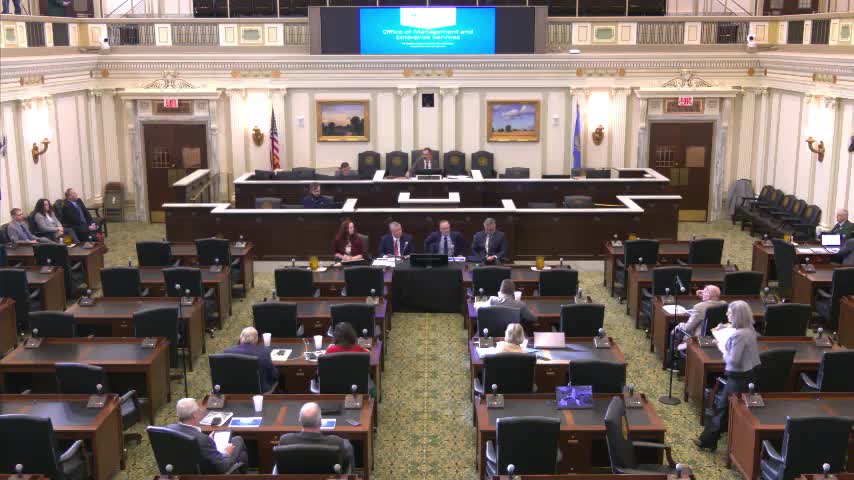
Oklahoma Management and Enterprise Services Director Rick Rose told the House Appropriations and Budget Committee at an annual budget hearing that OMES will request increased appropriations to maintain and expand statewide shared services, fund underfunded mandates and finish modernization projects.
Oklahoma Management and Enterprise Services Director Rick Rose told the House Appropriations and Budget Committee at an annual budget hearing that OMES will request increased appropriations to maintain and expand statewide shared services, fund underfunded mandates and finish modernization projects.
Rose said OMES has focused on improving customer service and internal transparency while keeping core operational appropriations relatively flat. "Our vision is serving those who serve Oklahomans," Rose said, adding that OMES publishes service-level metrics and customer satisfaction data online.
The request covers recurring costs such as Office 365 licensing, PeopleSoft (the state financial system), Workday (human capital/payroll), cybersecurity tools, and project-specific increases that appear on OMES accounts though they fund another agency's project. Rose and deputy staff described three categories: base operations, underfunded mandated responsibilities, and optional one-time investments the committee could choose to fund.
Why it matters: OMES provides shared IT, procurement, payroll and other centralized functions used by state agencies. Changes in OMES appropriations affect how those services are priced to agencies, whether agencies must absorb fees, and how quickly OMES can continue consolidation and oversight projects.
What OMES told lawmakers - Operational appropriations: Rose said base OMES operations have remained “relatively flat” while appropriations can increase when OMES is assigned new services or holds money for agency projects (for example, an IT project funded for the Unemployment Security Commission but administered through OMES accounts). - Underfunded mandates: Rose identified programs that were directed by statute or past legislative action but lack a dedicated funding source (examples cited include firefighter insurance administration and maternity leave administration). He said the agency will seek funding or consider charging agencies if the Legislature does not appropriate money. - Software and cloud costs: Rose said Office 365 license increases and more agencies moving onto PeopleSoft and Workday raise recurring costs. PeopleSoft costs were described as partly a function of total state budget size and added users. - Deferred maintenance and capital oversight: OMES presented an eight‑year deferred maintenance plan for state facilities and asked for additional project managers as construction workload increased.
Performance and efficiency claims OMES reported process improvements it tied to technology and management changes: a procurement cycle-time decline from about 135 days (FY 2022) to roughly 60–61 days in FY 2024; a reported central purchasing savings of about $182 million on approximately $1 billion of spend; and a help-desk standard-device deployment time reduced to 2–3 days. The agency said it now publishes near‑real‑time metrics (call wait time, average deployment time, procurement segment days) on its transparency pages.
Budget request examples and quantification OMES staff identified the following illustrative amounts (figures given by OMES during the hearing): Office 365 increases (~$2.4 million), PeopleSoft recurring costs (~$15.3 million total for licensing/compute/project costs), Workday-related activities, and cybersecurity tooling (noted in totals elsewhere). Rose said fiscal year 2024 carryover was reduced and projected relatively flat going into the next year due to improved invoicing and collection processes.
Lawmakers pressed OMES on specifics: how many projects lack on-site oversight, how exemptions in purchasing are policed, and how appropriations appear to rise when OMES holds funds for other agencies. OMES said it has assigned staff to construction projects in its portfolio and has tightened exemption monitoring (see separate article on procurement audit tooling).
Ending: Rose asked the committee to consider both recurring appropriations for mandated services and a limited set of optional one‑time investments (website modernization, a statewide call‑center platform, and other digital services). He closed by offering further follow-up materials and promised to provide requested data to committee members.