Get Full Government Meeting Transcripts, Videos, & Alerts Forever!
Get email alerts on the Appropriations And Budget topic
No spam. Unsubscribe anytime.
ODOT tells lawmakers inflation and falling fuel revenues are widening repair backlog
Summary
Director Gatz told a legislative appropriations committee that rising construction costs and declining motor-fuel tax collections are reducing ODOT’s buying power and stretching an estimated $27 billion state repair backlog.
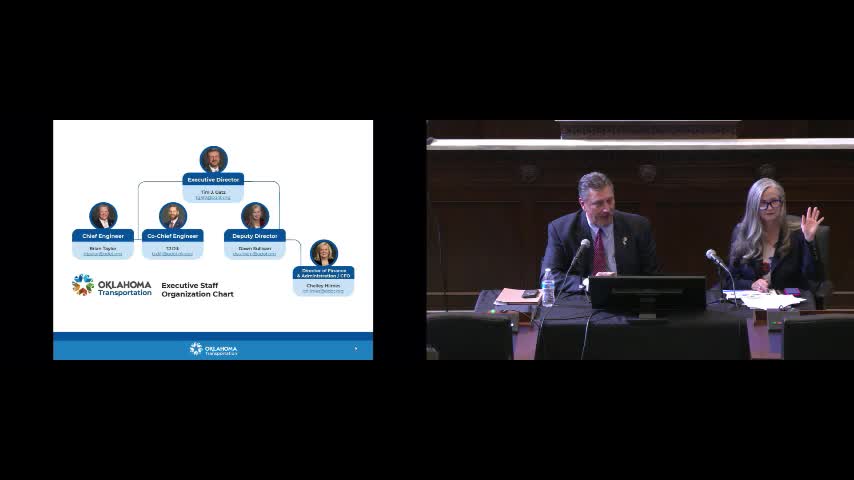
Director Gatz, head of the Oklahoma Department of Transportation (ODOT), told members of a legislative budget oversight panel that the agency faces a growing mismatch between transportation needs and revenue.
Gatz said ODOT estimates the state-owned highway system’s replacement-value at about $102,000,000,000 and described a “state of good repair” backlog—work ODOT says is needed to restore the system—of roughly $27,000,000,000. He said the department’s eight-year construction work plan totals about $8,600,000,000, or roughly $1,100,000,000 per year, and that the plan targets major rehabilitation projects while asset-preservation contracts and routine maintenance cover overlays, bridge rehabs and day-to-day repairs.
Why it matters: ODOT argued in the hearing that two trends are reducing its effective purchasing power and slowing the pace of work: construction cost inflation well above the consumer price index and a plateau or decline in motor-fuel tax receipts. Gatz said the department has tracked about a 60% increase in major pay items from early 2021 through early 2024 and described the highway construction cost index as roughly twice the CPI over that period.
ODOT described its revenue mix as roughly half federal funds and half state funds, with motor-fuel taxes, vehicle fees and the state’s Rhodes Fund among key state sources. Gatz noted that motor-fuel tax collections have fallen short of earlier projections at year-end for several recent years and that fuel-efficiency improvements in vehicles are reducing per-mile fuel consumption—putting downward pressure on fuel-tax receipts even as vehicle miles traveled rise.
Gatz also credited recent one-time state appropriations with helping ODOT maintain progress amid inflationary pressure, and said the department will continue to pursue federal discretionary grants and work with the Legislature to secure recurring revenue. He urged lawmakers to provide the department’s full statutory allocation of the State Transportation Fund and said the agency expects to ask the Legislature for additional targeted appropriations to cover specific shortfalls discussed in the hearing.
Supporting details from the presentation included: about 2,296 ODOT employees at the end of calendar year 2024 (roughly 1,500 in field districts); responsibility for about 33,000 lane miles of state highways and interstates; an eight-year construction plan of $8.6 billion; and estimates that roughly 84% of ODOT’s budget supports highways rather than administrative overhead.
Committee members pressed for more detail about why some projects involve full realignments or new road bases rather than shoulder additions; Gatz said alignment changes can be required for engineering, geometric, drainage or environmental-permitting reasons and that, in some cases, adjusting alignment can be faster or less expensive than obtaining a permit that imposes additional mitigation costs.
Gatz said ODOT is adjusting its revenue projections to reflect the recent anomalies in collections and reiterated that the department is studying lifecycle-extending treatments (shorter, less‑costly repairs intended to preserve pavement life) as one strategy to stretch available dollars when full-depth replacements are not affordable.
Ending: The presentation closed with Gatz and ODOT staff asking legislators to consider both short-term targeted appropriations and longer-term revenue solutions as construction costs, vehicle technology and federal funding trends reshape transportation finance.