Get Full Government Meeting Transcripts, Videos, & Alerts Forever!
Get email alerts on the Medical Examiner Budget topic
No spam. Unsubscribe anytime.
Chief medical examiner seeks $3.5 million to preserve staffing, accreditation and lab capacity
Summary
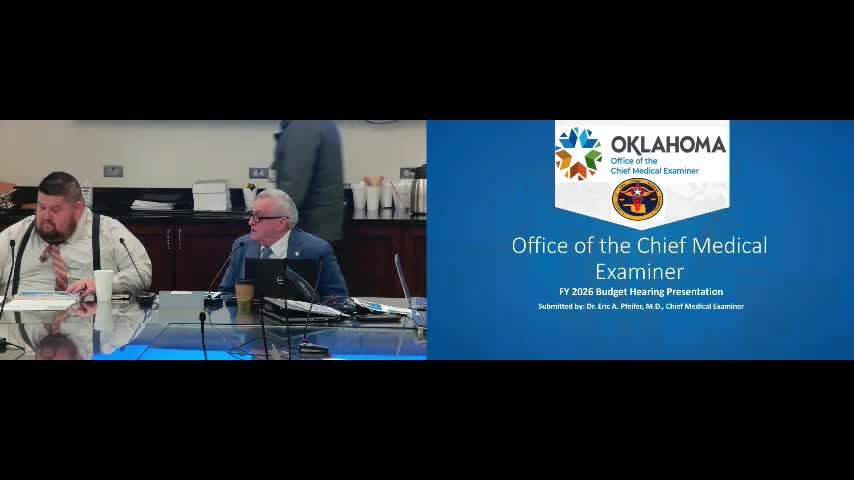
Chief Medical Examiner Eric Pfeiffer told the Appropriations and Budget committee the Office needs a $3.5 million increase to retain forensic pathologists, maintain new facilities and expand technology such as electronic case management and CT-based overdose review.
Chief Medical Examiner Eric Pfeiffer told the Appropriations and Budget Committee that the Office of the Chief Medical Examiner needs a $3.5 million increase in appropriations to recruit and retain forensic pathologists and cover rising operational costs.
Pfeiffer, who identified a 34‑person agency staff on the state’s payroll, said the office now completes about 90% of cases within 90 days but has experienced cost pressures from higher salaries for pathologists, IT and medical supplies. He described the office’s growth from a one‑doctor shop into a nationally accredited forensic operation with toxicology, CT scanning and a fellowship program that helped recruit staff from across the country.
The requested increase is driven largely by personnel costs, Pfeiffer said. He told the committee that market forces and a nationwide shortage of forensic pathologists — “about 600 active practitioners in the country” — require salary adjustments to remain competitive with neighboring states. He said the office recently added five pathologists and a forensic anthropologist and that the fellowship program has helped retain trainees.
Pfeiffer highlighted investments the office has made that he called efficiencies: a CT scanner that he said spared surgical autopsies in roughly four of 10 cases, an electronic fingerprint terminal that speeds identifications, and a web‑based permits system that replaced tens of thousands of paper faxes. He described a project to use CT plus bedside toxicology to analyze overdose deaths without surgical autopsy and said that, if validated, the approach could reduce costs substantially.
He also described capital and operating costs. The office now owns a Tulsa facility built with prior appropriations and rents space in Oklahoma City under a public‑private partnership; Pfeiffer said expected rent increases and a three‑year office expansion to house staff would add costs. He said a planned case management system procured through a health department piggyback contract is estimated around $2,000,000 and is currently in legal review.
Committee members asked about the base budget and whether a statewide cut would threaten accreditation. Pfeiffer said the office’s total budget is roughly $24–$27 million depending on receipts and that a 1.5% across‑the‑board cut would be “devastating” because carryover balances are declining and staff costs are the principal driver. When asked whether accreditation would be at risk if the office could not pay doctors, Pfeiffer said simply: “That’s very fair to say.”
Pfeiffer described operational measures: average scene response time statewide of about one hour and 11 minutes for 40 investigators covering 77 counties; investigator equip‑up costs of roughly $127,000 for a new hire the first year; and a goal to reduce 90% of case completions from 90 days to 60 days over the next several years as staff experience grows.
The presentation included an invitation to tour the Tulsa and Oklahoma City facilities and demonstrations of CT efficiencies, forensic CT workflows, and other technology. Committee members thanked the office for its work and pressed for clarity on the appropriation request and the office’s options if the requested amount is not granted.
Pfeiffer characterized the $3.5 million ask as “conservative” and said the office could likely use additional funding, but that the current request is grounded in zero‑based budgeting of likely 2026 costs.