Get Full Government Meeting Transcripts, Videos, & Alerts Forever!
Get email alerts on the Appropriations And Budget topic
No spam. Unsubscribe anytime.
Oklahoma aerospace agency asks lawmakers for recurring airport and UAS funding, highlights workforce and infrastructure work
Summary
At a Transportation A and B subcommittee budget review, the Oklahoma Department of Aerospace and Aeronautics outlined agency accomplishments, workforce and education programs, and requested two $1 million recurring increases to support airport growth and unmanned/advanced air mobility infrastructure.
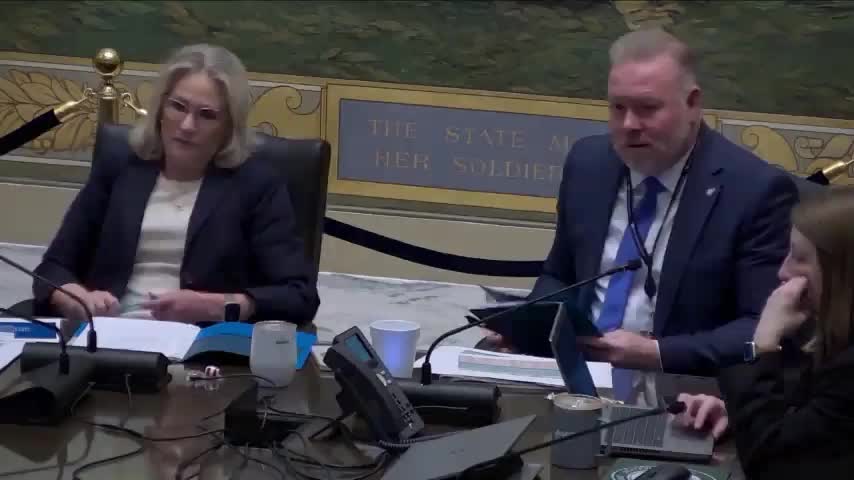
The Oklahoma Department of Aerospace and Aeronautics told the House Appropriations and Budget Transportation A and B Subcommittee on the day of its budget performance review that it is seeking two recurring budget increases — $1 million for airport growth infrastructure and $1 million for unmanned aircraft systems (UAS) and advanced air mobility (AAM) infrastructure — while describing the agency’s role in education, airport construction and industry promotion.
The agency’s executive director (title given in the hearing but name not consistently specified in the transcript), speaking at the start of the session, said the department focuses on four pillars: airports and aviation infrastructure, industry promotion, workforce development and new advanced technologies such as UAS and AAM. “We have 108 public airports throughout the state of Oklahoma, 4 commercial airports, 104 general aviation or municipal airports,” the director said. The director also gave a statewide economic figure: “our state's second largest industry in aerospace and defense at $44,000,000,000 a year of annual economic activity.”
Why it matters: lawmakers and agency officials said aviation and aerospace funding supports local economic development (hangars, terminals and industrial sites), a statewide network of schools and training programs meant to feed the workforce pipeline, and new testing and manufacturing opportunities tied to UAS and advanced air mobility.
Key program and budget details - Agency scale and education: the director said the department is a small agency of roughly 15 staff, and highlighted 117 high schools participating in the AOPA You Can Fly high school curriculum. Officials said that roughly 1,100 companies in Oklahoma describe themselves as aerospace-related and that the sector supports about 120,000 direct jobs. - Recent appropriations and one-time investments: the director described a series of appropriations beginning in FY 2022, including one-time funding for an engine test cell program ($16 million) and $41 million for nine PREP-designated airport economic development projects (sometimes referred to in the hearing as PREP2 or PREP competitive projects). Committee materials distributed at the hearing show larger PREP and ARPA investments for aviation in 2022; the director said about $80.8 million of earlier PREP money went to four major projects. - FY‑26 recurring request: the department asked to increase recurring airport growth infrastructure funding by $1 million and recurring UAS/AAM infrastructure funding by $1 million. The director said the increase would move recurring program funding from 15 full-time equivalent (FTE) staffing equivalents to 17 (a phrasing used in the presentation to indicate recurring support rather than literal headcount changes). - UAS infrastructure: committee exchanges identified a combined $9 million for UAS/AAM infrastructure in the state’s accounts, described by staff as consisting of $5 million provided through the PREP-related pot and approximately $2 million appropriated to the department in recent budgets, plus related partner funding; those funds were described in the hearing as supporting radar/detection hardware at Burns Flat Airport and radar work in Tulsa and related projects. - Aero education grants and classroom lab program: the department runs a competitive Aerospace Classroom Lab Improvement Grant program. Officials said grants require a local match and that the program is rolled out as funds are available; the department described plans for additional grant rounds and aviation‑STEM competitions aimed at middle and high school students.
Questions and clarifications from committee members Members pressed staff on specific program details and procurement choices. Representative Archer asked whether a specific “avoid expense” or cost element was borne solely by the agency; staff said the UAS work is a shared expense with partners and that the broader UAS program represents about $9 million of investment when combined with partner funds. Representatives asked about classroom-lab grant timing and matching requirements, and the director said the department advertises minimum and maximum grant thresholds and requires local matching funds.
Committee members also raised practical issues tied to grant program rules and local needs. Representative Crossbow Hitter questioned adding mobile fuel systems to the fuel grant program; staff said the department began rule-making in late 2023 and approved mobile fuel systems in March 2024 to supplement traditional fixed fuel systems, and that fewer than two dozen airports statewide would likely need mobile systems. Multiple legislators asked whether pro‑growth hangar and terminal investments were yielding return on investment; the director described the expected ROI as threefold — airport revenue, greater based-aircraft counts and improved readiness to host aviation businesses that require immediate hangar/terminal availability for rapid relocation or expansion.
Staffing and internal capacity The director said the agency has two vacancies in its 17 FTE authorized level and identified hiring a civil engineer as a near-term priority. The agency also described in-house capabilities such as survey-grade drone operations and limited design capacity used to reduce costs on small projects.
Ending and next steps The department plans to finish an updated statewide aerospace economic-impact study by the end of calendar 2025, continue PREP-funded “mega projects” at Ardmore, Woodward, Tulsa National and Will Rogers (Oklahoma City), and maintain classroom grants and STEM outreach. Lawmakers did not take a committee vote on the department’s FY‑26 recurring requests during the session but asked for follow-up data on specific items including education grant match requirements and detailed spending timelines for PREP/ARPA projects.