Get Full Government Meeting Transcripts, Videos, & Alerts Forever!
Get email alerts on the Pensions And Retirement topic
No spam. Unsubscribe anytime.
Teachers Retirement System reports highest funded ratio in its history; trustees project full funding by 2035
Summary
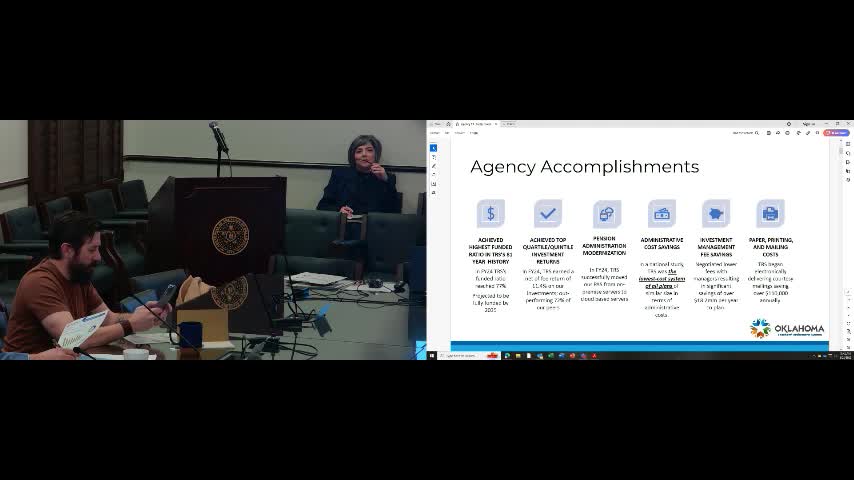
The Teachers Retirement System told the Banking, Pensions and Financial Services committee it reached a 77% funded ratio in FY 2024 — the highest in its 81‑year history — and projects full funding by 2035, while warning that unfunded liability remains the state's largest fiscal exposure.
Sarah Green, executive director of the Teachers Retirement System (TRS), gave an overview of the pension plan’s finances, investments and operational work to the Banking, Pensions and Financial Services Committee. She said FY 2024 delivered strong investment returns and marked the plan’s highest funded ratio in its history: “FY 24, TRS achieved our highest funded ratio in the 81 year history of our plan. So we are now 77 funded,” Green said, adding the board projects full funding by 2035 if current assumptions hold.
TRS reported an actuarial value of assets of about $22.68 billion and an unfunded actuarial accrued liability of roughly $6.76 billion as of June 30, 2024. Green said the plan’s funded period shortened to 11 years from the prior year and that investment returns for FY 2024 were 11.4% net of fees. She told committee members the plan’s long‑term assumed rate of return is 7.0 percent and explained the difference between normal cost (the annual accrual cost of one additional year of service) and percent funded (the ratio of actuarial assets to actuarial accrued liability).
Green reviewed reforms and funding history, telling the committee the system experienced severe funding shortfalls through the 2000s and early 2010s and credited legislation and dedicated revenue streams with stabilizing the plan. She described the 2011 reforms (cited in the presentation as legislation shepherded by then‑legislators) that introduced stronger funding discipline and revised retirement rules. The commission reviewed the plan’s current funding model and described four primary revenue sources: investment earnings, employer contributions (currently 9.5% for most employers, 8.55% for a few non‑participating entities), member contributions at 7% and dedicated state revenue earmarked to pay down the unfunded liability.
Green and TRS staff also described operational work: migration of the pension administration system to cloud infrastructure, administrative cost reductions, management fee savings that the chief investment officer said saved an estimated $18 million versus peers in FY 2024, and a multi‑year modernization of member and employer portals. TRS said it continues to optimize staffing and technology and plans to adopt a revised strategic asset allocation effective July 1 of the coming fiscal year.
Committee members asked clarifying questions about the normal cost concept, the funding period and the dedicated revenue formula. TRS staff noted the dedicated revenue was reduced in one year during the pandemic and later restored to a slightly different formula that will return to the prior percentage in FY 2028. The board and staff cautioned lawmakers that any post‑reform benefit increases would need to be cost‑funded because the unfunded liability remains the state’s largest financial exposure and could affect borrowing costs if left unmanaged.
Ending: TRS did not seek an appropriation in this hearing (the agency is non‑appropriated) and presented a status report, projections and modernization updates to the committee; members were invited to follow up through the TRS website and actuarial reports the agency circulated to the committee.