Get Full Government Meeting Transcripts, Videos, & Alerts Forever!
Get email alerts on the Arts And Cultural Grants topic
No spam. Unsubscribe anytime.
Oklahoma Arts Council seeks ongoing funding after $10M ARPA infusion; requests one-time preservation and operating support
Summary
The Oklahoma Arts Council told lawmakers the sector remains fragile after the pandemic despite a $10 million ARPA grant and asked for ongoing and one‑time state funding to support arts education, Capitol collection preservation and operational costs tied to returning to the Jim Thorpe Building.
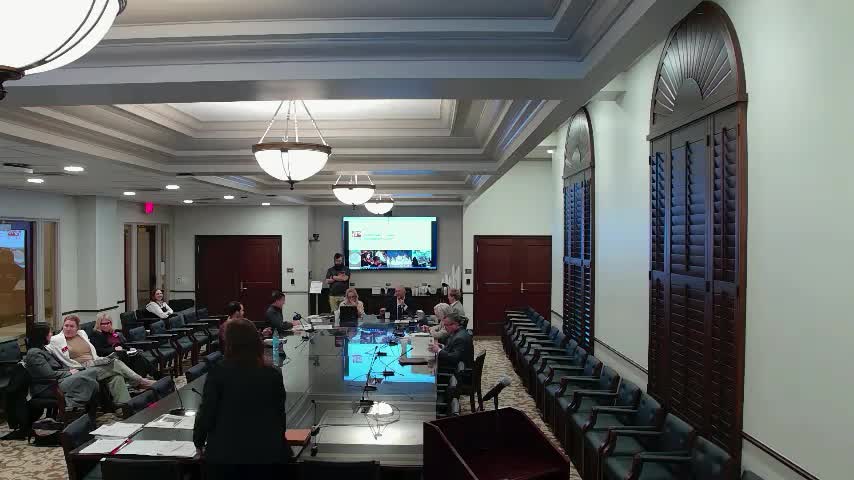
Amber Sharples, executive director of the Oklahoma Arts Council, told the Appropriations and Budget committee the agency is using $10 million in federal ARPA funding to stabilize arts organizations statewide but is asking the Legislature for additional ongoing and one‑time state funds to preserve the State Art Collection, support arts education and cover new occupancy costs. “Our state believes in the value of the arts,” Sharples said as she opened the council’s budget presentation, noting the ARPA infusion and related private matches aided hundreds of organizations.
The council reported awards to 182 organizations for the ARPA sector grants and said it has paid out $3.7 million so far — about 38 percent of that funding — and is using the investment to restore programs that support attendance, workforce development and rural arts access. Sharples told lawmakers the Arts Council also has paid staff time and technical assistance commitments associated with administering the large ARPA program: “In 2024 alone, our team dedicated 1,884 hours in the administration of ARPA grants,” she said.
Sharples outlined the agency’s priorities for the fiscal year 2026 request, splitting immediate needs from longer‑term goals. Short‑term requests include $104,166 in new ongoing costs tied to relocating back into the Jim Thorpe Building (half a year’s rent estimated at roughly $89,166 for 2026, with a full year estimated near $170,000 after the move), plus a $15,000 increase for employment benefits. One‑time requests totaling $405,855 include $305,855 for museum‑quality special collections storage (hanging racks, storage for works on paper, sinks for conservation work) and funds to install protective glazing or other risk‑mitigation for high‑risk works in the Capitol collection.
Sharples framed the preservation request in terms of recent conservation work and a museum‑grade risk assessment the council commissioned for the Capitol collection. She cited past incidents during moves and everyday visitor traffic as reasons for protective measures and described the proposed stanchions and glazing as ways “to mitigate the potential impact and costs” of accidental or intentional damage.
The agency also described longer‑term priorities, including $290,000 to reestablish a full‑time docent/education coordinator to manage growing Capitol tours and field‑trip programs, and a $1.5 million request to expand grant making to rural ‘‘arts deserts.’’ Sharples said the council’s Capitol tour program has grown rapidly after the building renovation: the council reported roughly 1,200 tours for 13,500 people and 461 students reached so far through a restored capital art field‑trip grant. She also described the Betty Price Gallery re‑installation (one‑time FY‑2025 funding of $50,000) and other capital public art projects such as Route 66 programs and ODOT partnerships.
Sharples stressed the arts’ economic contribution, citing the council’s estimate that Oklahoma’s arts sector contributes about $4.8 billion to the state economy and employs roughly 42,000 people. She argued the council’s grant and education programs — from microgrants for classroom supplies to creative‑aging and military arts initiatives — affect workforce development, cultural tourism and student outcomes. Lawmakers asked about specific items including the timing and destination of rent payments and the council’s ability to provide technical assistance for Route 66 communities preparing for the 2026 centennial.
The Arts Council requested that the Legislature consider the mix of ongoing operating funding and targeted one‑time investments to preserve the Capitol collection and sustain statewide arts education and rural access programs. Sharples closed by inviting committee members to a February 20 sneak preview and a February 25 public opening of the reinstalled Betty Price Gallery.
Ending: The Arts Council did not present formal vote items at this hearing; the agency left the committee with a mix of immediate rent/operations asks and longer‑term requests for conservation, expanded grant capacity and marketing/technical assistance for rural arts and Route 66 preparations.